Is China Flooding Europe With Fake Biofuels?
Relevance: GS3 - Conservation, environmental pollution, and degradation, environmental impact assessment, Infrastructure: Energy,
(Source: Indian Express, 08/25/2023)
Click here for Daily Current Affairs
Why in the news?
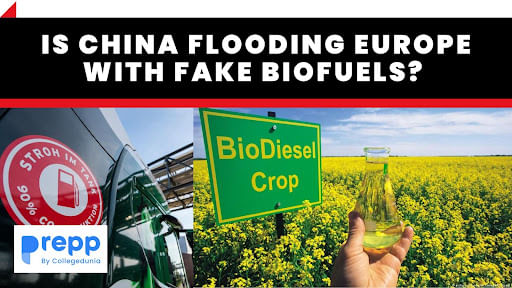
- This article discusses the increase in Chinese exports of biofuel to Europe amid concerns over the raw materials used and the potential impact on the European waste-based fuel industry.
- Biofuels are a cornerstone of Europe’s ambitious plan to reduce harmful carbon emissions in the transportation sector.
- Most of the advanced or second-generation biofuels which are produced from non food biomass like used cooking oils, tallow, and other waste and residue lipids for Europe are obtained from China.
Table of Contents
Why is the glut in Chinese biofuels suspicious?
Time
- The production process of advanced biofuels is complex and time-consuming, taking about three years for the design and construction of an advanced biofuel plant.
- This has raised concern about Chinese exports of biofuels, as they have emerged suddenly.
- The doubling of Europe’s imports of Chinese fuel in the first half of 2023 as compared to 2022 can be attributed to the increased demand.
Costs
- Chinese biofuels are characterized by high product quality and meager prices.
- The Chinese biofuels are available at half the price despite the high shipping costs (20%).
Raw materials
- There are concerns about the raw materials used in Chinese biofuels with experts claiming that cheaper palm oil is being reclassified and added to the product instead of waste and residual materials.
- It is not possible to scientifically determine the raw material from which the advanced biofuel was made.
- Therefore, content control depends solely on the paperwork provided to the authorities which contains information about the origin of the raw materials, and the greenhouse gas reduction.
- EU certification requirements do not mandate private auditing companies to investigate if a facility can process the mostly heavily contaminated raw materials for advanced biofuels.
- Although auditors should normally be accompanied by state officials to see if the checks are according to the law, random checks are prohibited in China.
Greenwashing
- The greenwashing of oil-based biofuels as advanced biofuels could be replicated in more industries, including steel, aluminum, and hydrogen which would significantly affect the EU’s climate commitments.
- China’s fake biofuel products which are available at a lower price could end domestic industries and increase dependence on China.
Biofuels for climate targets
- European Union climate laws mandate an 8% reduction of carbon footprint by the oil and gas industry and sectors like transportation in 2023.
- Additionally, the share of biofuels in the fuels used or produced by them must be increased to at least 0.3%.
- The share of conventional biofuels produced from raw materials such as rapeseed is limited because the grain is primarily used for food.
- Under the EU’s industrial emission reduction targets, conventional biofuels count for only half as much as advanced biofuels.
- As a result, producers prefer to use advanced biofuels in their products.
Impact of the unchecked impact of Chinese biofuels
- Market prices have dropped 50% in 2023 due to the increased availability of Chinese biofuels.
- As a result, producers of advanced biofuels who were supported by state subsidies and guaranteed demand from fuel companies have been adversely impacted.
- This could also lead to the shutdown of some European biofuel production firms according to the EWABA, the EU-based trade association for waste-derived biofuels.
- The EWABA stated that nearly half of all production sites in Europe are either struggling or had already closed production facilities.
The palm oil trace
- The reason for the cheap price of Chinese biofuels could be the use of palm oil as a raw material.
- It is also used in sectors such as food, energy, cosmetics, and transportation fuel.
- Palm oil has been previously linked to rainforest destruction in the largest producers and exporters of palm oil such as Malaysia and Indonesia.
- The EU’s revised biofuel policy aims to phase out palm oil-based biodiesel by 2030 and impose restrictions on its imports from 2023.
- China could be acquiring palm oil-based biodiesel from Indonesia, rebranding it, and then selling it in Europe.
- Although the German agricultural authorities charged with biofuel certification launched an official investigation and filed a lawsuit against some importers there was insufficient evidence to support the cases.
- Nevertheless, they have revoked certifications for one company following inspections of three biodiesel plants in Europe.
- German biofuel producers have demanded that the entire biofuel certification process be reviewed.
Indian export of biofuels
- According to the Directorate General of Commercial Intelligence and Statistics, approximately 3520064 Kg of biodiesel and mixture have been exported in FY 22-23.
- In March 2023, the Indian government permitted the export of biofuels from special economic zones (SEZs) and export-oriented units (EOUs) without any restrictions if the biofuel is produced by using imported feedstock.
- India, Brazil, and the U.S.A. have established a Global Biofuels Alliance to facilitate cooperation and the use of sustainable biofuels.
- It will strengthen markets, facilitate global biofuels trade, policy sharing, and technical support for national biofuels programs across the world.
(*Click this link to read prelims specific weekly current affairs articles)
FAQs
Question: What are biofuels?
Answer:
Biofuels refer to a hydrocarbon fuel that is produced from organic matter in a short period of time. It may be solid, liquid, or gaseous in nature. It is classified into 1st generation biofuels, 2nd generation biofuels, 3rd generation biofuels, and 4th generation biofuels.
Question: What is greenwashing?
Answer:
Greenwashing is the deceptive practice of making a product, service or company appear more environmentally friendly by making misleading or unsubstantiated claims about its environmental benefits.
UPSC Mains Practice Question:
|
MCQs
Question: Consider the following statements:
- Maize can be used for the production of starch.
- Oil extracted from maize can be a feedstock for biodiesel.
- Alcoholic beverages can be produced by using maize.
Which of the statements given above is/are correct? (UPSC CSE 2014)
(a) 1 only.
(b) 1 and 2 only
(c) 2 and 3 only
(d) 1, 2 and 3
Answer: (d) See the Explanation
- Corn starch can be produced from maize kernels. Hence statement 1 is correct.
- Oil extracted from maize can be used to manufacture ethanol and biodiesel. Hence statement 2 is correct.
- The ethanol used in making alcoholic beverages is obtained from maize. Hence statement 3 is correct.
Therefore, option (d) is the correct answer.
Question: It is possible to produce algae-based biofuels, but what is/are the likely limitation(s) of developing countries in promoting this industry?
- Production of algae-based biofuels is possible in seas only and not on continents.
- Setting up and engineering the algae-based biofuel production requires a high level of expertise/technology until the construction is completed.
- Economically viable production necessitates the setting up of large-scale facilities which may raise ecological and social concerns.
Select the correct answer using the code given below:
(a) 1 and 2 only
(b) 2 and 3 only
(c) 3 only
(d) 1, 2 and 3
Answer: (b) See the Explanation
- The production of algae-based biofuels is possible on land or saline water or wastewater. Hence statement 1 is incorrect.
- Setting up and engineering algae-based biofuel production requires a high level of expertise/technology until the construction is completed because producing biofuels from algae is still in a pre-commercial stage of technology development and capital investments. Hence statement 2 is correct.
- Setting up of large-scale facilities is necessary for economically viable production.
- This may raise ecological and social concerns as it will reduce the amount of food available for humans and increase the cost of food and fuel. Hence statement 3 is correct.
Therefore, option (b) is the correct answer.
Download the PREPP App and attempt FREE IAS Exam Mock Tests and get complete study material!

Full Test - 04: UPSC CSE Prelims CSAT (Paper-II)
Full Test - 03: UPSC CSE Prelims CSAT (Paper-II)
UPSC CSE Prelims 2026 GS Paper 1 Question Paper (24-May-2026)
UPSC CSE Prelims 2026 CSAT Paper 2 Question Paper (24-May-2026)

17 February 2025 | The Hindu Must Read Articles | Current Affairs

16 February 2026 | The Hindu Must Read Articles | Current Affairs

13 February 2026 | The Hindu Must Read Articles | Current Affairs









Comments