The Fujiwhara Effect: When Cyclones ‘Dance’
Relevance: GS 1 - Important Geophysical phenomena such as earthquakes, Tsunami, Volcanic activity, cyclones etc.
(Source: Indian Express, 08/25/23)
Click here for Daily Current Affairs
Why in the news?
- The United States west coast has been witnessing unusual weather phenomena lately, it has experienced Hurricane Hilary, prompting the National Hurricane Centre (NHC) to issue its first-ever tropical storm watch for parts of Southern California. Earlier this year, California faced an unusually wet winter with 12 'atmospheric river' storms, carrying moisture.
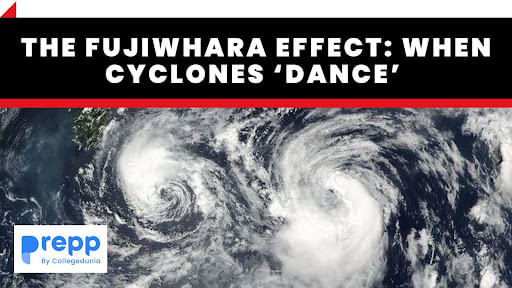
- In one of these storms, two low-pressure areas interacted in a 'dance'. Contrary to merging, the stronger one dominated, showcasing the 'Fujiwhara effect' briefly.
- ‘Atmospheric rivers’ are vast airborne currents laden with dense moisture, hanging low in the atmosphere.
Table of Contents
What is the Fujiwhara effect?
- According to the National Weather Service (NWS), USA, when two hurricanes or cyclones, spinning in the same direction, are brought close together, they begin 'an intense dance around their common center' – this interaction between two cyclones is called the Fujiwhara effect.
- When one hurricane is stronger, the smaller orbits and merges. If the hurricanes are of similar strength, they merge or spin before separating. In rare instances, the two ‘dancing’ cyclones, if they are intense enough, may merge with one another, leading to the formation of a mega cyclone capable of wreaking havoc along coastlines.
- The Fujiwhara effect was identified by Sakuhei Fujiwhara, a Japanese meteorologist. This phenomenon was first mentioned in a paper published in 1921.
How is this related to today’s climate?
- According to experts, the rising frequency of this unusual effect is attributed to a rapidly warming world and the subsequent heating of ocean waters.
- There has been a 35 percent increase in the strength of typhoons that have hit Taiwan between 1977 and 2016 due to a 0.4 to 0.7°C rise in the sea surface temperature during these 40 years in the northwest Pacific.
Historical occurrence and impact
- In 1964, typhoons Marie and Kathy merged over the western Pacific.
- In 2023, this effect caused powerful winds, damaging California.
- Earlier, typhoon Hinnamnor and tropical storm Gardo interacted, and cyclones Hilary and Irwin merged in 2017, possibly intensifying systems.
- The effect can lead to cyclone amalgamation, causing havoc and fatalities.
- Difficult to assess: The occurrence of the Fujiwhara effect also makes cyclonic systems harder to predict, as every interaction between two storm systems is unique and difficult to assess within the present climate models.
(*Click this link to read prelims specific weekly current affairs articles)
FAQs
Question: What is a cyclone?
Answer:
A cyclone is defined as any low-pressure area with inward spiraling winds. In the northern hemisphere, cyclones rotate anticlockwise, while in the Southern Hemisphere, they rotate clockwise. Cyclogenesis is the process of cyclone formation and intensification.
Question: What are Atmospheric rivers?
Answer:
Atmospheric rivers are large, narrow sections of the Earth's atmosphere that carry moisture from the Earth's tropics near the equator to the poles.
Question: What is the positive impact of tropical cyclones?
Answer:
They boost the flow of rivers and streams pulling garbage, recharge aquifers, assist balance heat in the oceans, and drag nutrients into the sea, bringing rain to drought-stricken areas.
MCQ
Question: In the South Atlantic and South-Eastern Pacific regions in tropical latitudes, cyclones do not originate. What is the reason?(UPSC-2015)
(a) Sea surface temperatures are low
(b) Inter-tropical Convergence Zone seldom occurs
(c) Coriolis force is too weak
(d) Absence of land in those regions
Answer: (b) See the Explanation
- In the South Atlantic and South-Eastern Pacific regions, the Inter-tropical Convergence Zone (ITCZ) is less active compared to other tropical regions like the North Atlantic or North Pacific.
- The ITCZ is an area where trade winds from both hemispheres meet, creating a zone of converging winds and rising moist air, which is a favorable environment for cyclone formation. Since the ITCZ is less pronounced in the South Atlantic and South-Eastern Pacific, cyclones are less likely to originate there.
- Therefore, option (b) is the correct answer.
Download the PREPP App and attempt FREE IAS Exam Mock Tests and get complete study material!

Full Test - 04: UPSC CSE Prelims CSAT (Paper-II)
Full Test - 03: UPSC CSE Prelims CSAT (Paper-II)
UPSC CSE Prelims 2026 GS Paper 1 Question Paper (24-May-2026)
UPSC CSE Prelims 2026 CSAT Paper 2 Question Paper (24-May-2026)

17 February 2025 | The Hindu Must Read Articles | Current Affairs

16 February 2026 | The Hindu Must Read Articles | Current Affairs

13 February 2026 | The Hindu Must Read Articles | Current Affairs









Comments