Building Resilience Against Landslides
Relevance: GS1: Geography - Important Geophysical Phenomena Such As Earthquakes, Tsunami, Volcanic Activity, Cyclones, Landslides GS3: Disaster and Disaster management, Environmental issues - Geo-hazards caused by natural processes, Environmental degradation
(Source: The Indian Express 08/23/23)
Click here for Daily Current Affairs
Why in the news?
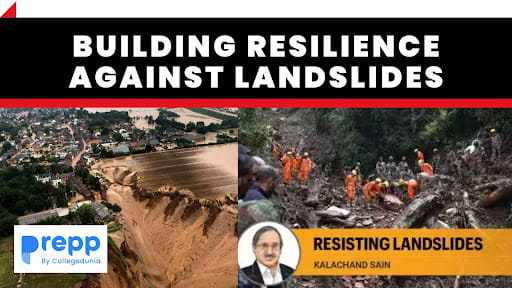
- The deaths and damage caused by landslides in Himachal Pradesh this week have focused much-needed attention on the Himalayan ecology.
- According to the Geological Survey of India, the economic damage caused by landslides may equal 1% to 2% of the Gross National Product in many developing nations.
Table of Contents
- What are the Causes of Landslides in the Himalayan Region?
- What are the steps taken by the Government to mitigate the risk of landslides?
- What measurements should be taken to reduce landslides in himalayan region?
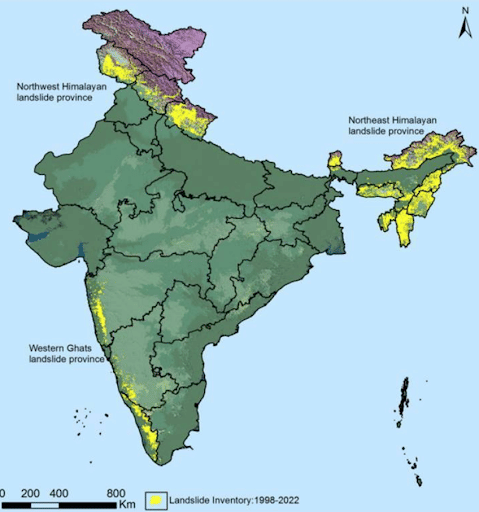
- What are the different causes of landslides in Himalayan region and Western Ghats?
- FAQs
- MCQs
What are the Causes of Landslides in the Himalayan Region?
- Fragile ecosystem: The Himalayan environment is influenced by tectonic or neotectonic events and surface processes such as erosion, weathering, and rainfall.
- Earthquakes: The convergence of the Indian plate with the Eurasian plate in the Himalayan area has caused subsurface pressures that are released as earthquakes, causing cracks and loosening of the litho-structures near the mountain surface.
- Excessive Climate-Induced Events: Extreme climatic events caused by climate change worsen environmental vulnerability. Avalanches, landslides, debris flow, glacier lakes outburst floods, landslide lakes outburst floods, and fast floods are all possible outcomes.
- Human activities: Road building, tunnelling, mining, quarrying, deforestation, urbanisation, agriculture, excessive tourism, and hydropower projects are all examples of human activity that can cause or intensify landslides in the Himalayas.
- Geological Composition: Some Himalayan rocks are composed of limestone, which is more prone to flooding and landslides than other types of rocks due to its ability to dissolve in weakly acidic precipitation or groundwater. This process produces caves, sinkholes, and other karst characteristics that undermine the slope's stability.
- Westerly Disturbance: The Westerly Disturbance, a low-pressure system originating in the Mediterranean Sea and moving eastward across central Asia and northern India, and the South West Indian Summer Monsoon have combined to cause excessive and concentrated rainfall in parts of J&K, HP, and Uttarakhand, resulting in landslides and flash floods.
To know more about landslides in India Click here
What are the steps taken by the Government to mitigate the risk of landslides?
- The National Landslide Risk Management Strategy (2019): It is a comprehensive framework for reducing and managing landslip catastrophe risk. Hazard mapping, monitoring, early warning systems, awareness programmes, capacity building, legislation, policies, and stabilisation/mitigation activities are all part of it.
- Landslide Risk Mitigation Scheme (LRMS): It is a new programme that will give funding for state-recommended landslide mitigation measures. The system focuses on disaster prevention, mitigation, and R&D for monitoring important landslides. It aims to improve capacity building and establish early warning systems.
- Flood Risk Mitigation Scheme (FRMS): It is a new programme that will focus on a variety of initiatives such as pilot projects for building adaptable flood shelters, constructing river basin-specific flood early warning systems and compiling digital elevation maps.
- The National Disaster Management Authority's (NDMA) National Guidelines on Landslides and Snow Avalanches give comprehensive guidelines for managing landslide hazards at all levels.
- Landslide Atlas of India: It provides thorough information about landslide-prone areas around the country, as well as damage assessments for individual places. This map, created by the National Remote Sensing Centre (NRSC), an ISRO centre, is a helpful resource for studying and managing landslides in India.
What measurements should be taken to reduce landslides in himalayan region?
- Formation of Himalayan States Council: To assess the impact of surface and subsurface strains, a Council of Himalayan States must be formed.
- The state disaster management authorities should work together under a consolidated council. Though the Himalaya is diverse across its length, knowledge from various sets of evaluations must be distributed and shared by all Himalayan states.
- Sustainable Socio Economic Development: The Himalaya's glaciers, snow fields, springs, riverine systems, valuable mineral deposits, geothermal, hydrocarbon, and hydro-power energy resources, and medicinal plants, as well as the region's tourism potential, might be used for this purpose.
- Anthropogenic activities: Heavy constructions should be prohibited, care should be taken to have a proper drainage system, slope cutting should be done scientifically, and emphasis should be placed on having retaining walls and adhering to building codes.
- Building Codes and Assessment: Building codes should be based on high-resolution mapping of all municipalities and an assessment of their load-bearing capabilities.
- Sustainable tourism: It may prevent landslides through increasing environmental awareness, natural resource conservation and preservation, and respect for biodiversity and ecosystems.
What are the different causes of landslides in Himalayan region and Western Ghats?
| Region | Causes |
|---|---|
| Himalayan region |
|
| Western Ghats |
|
(*Click this link to read prelims specific weekly current affairs articles)
FAQs
Question: What do you mean by sustainable tourism?
Answer:
Sustainable tourism, also known as responsible tourism or ecotourism, is a tourism concept that attempts to reduce negative consequences on the environment, society, and local cultures while creating positive benefits for all stakeholders. The basic purpose of sustainable tourism is to guarantee that the tourist sector continues to be successful and helpful in the long run, without depleting natural resources, harming ecosystems, or upsetting local populations.
Question: What is the Landslide Atlas of India?
Answer:
The Landslide Atlas of India is a thorough publication that gives specific information regarding landslide-prone regions and incidences throughout India's vast geographical breadth. This atlas is an invaluable tool for understanding, mapping, and managing landslides throughout the country.
Question: What is Landslide?
Answer:
A landslide is a geological occurrence that occurs when a mass of rock, soil, or debris slides down a slope. Landslides range in size and scale, from minor rockfalls to huge earth movements that can cause substantial damage and loss of life. They are usually caused by a combination of causes like high rainfall, earthquakes, volcanic activity, human activity, and changes in the natural terrain.
UPSC Mains Practice Question:
|
Download the PREPP App and attempt FREE IAS Exam Mock Tests and get complete study material!

Full Test - 04: UPSC CSE Prelims CSAT (Paper-II)
Full Test - 03: UPSC CSE Prelims CSAT (Paper-II)
UPSC CSE Prelims 2026 GS Paper 1 Question Paper (24-May-2026)
UPSC CSE Prelims 2026 CSAT Paper 2 Question Paper (24-May-2026)

17 February 2025 | The Hindu Must Read Articles | Current Affairs

16 February 2026 | The Hindu Must Read Articles | Current Affairs

13 February 2026 | The Hindu Must Read Articles | Current Affairs









Comments