How One Health Can Help India Respond Better To Health Crises
Relevance: GS 2 - Issues relating to the development and management of Social Sector/Services relating to Health
(Source: The Hindu, 08/24/23)
Click here for Daily Current Affairs
Why in the news?
- This article discussed the importance of ‘One Health’ which is currently gaining popularity worldwide.
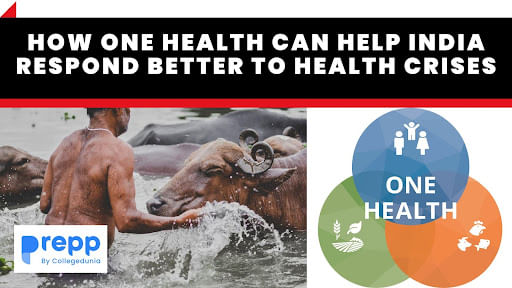
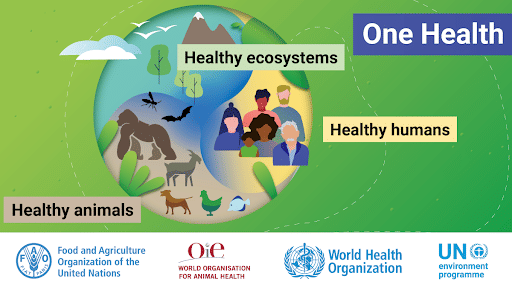
- The 'One Health' concept acknowledges the interdependence of human, animal, plant health, and the environment.
- Its roots trace back to Hippocrates' writings in 460-367 BC, recognizing the link between public health and a clean environment.
- Rudolf Virchow (1821-1863), 19th-century German physician and pathologist saw no separation between animal and human medicines. Modern veterinarians Steele and Schwabe, stressed ecology's role in both animal and human health.
Table of Contents
Why is One Health special?
- Rapid urbanization, industrialization, and population growth have harmed biodiversity and led to zoonotic diseases like bird flu and Ebola.
- Researchers have estimated that 60% of emerging diseases that can infect humans are zoonotic in nature.
- Moreover, humanity faces significant challenges such as antimicrobial resistance, food safety, security, and vector-borne diseases. These issues emphasize the need for both intersectoral management and the efficiency inherent in the One Health strategy.
- Minimise resources: It minimizes resource requirements across sectors by encouraging coordination across governmental units, including the Ministries of Health and Family Welfare, Fisheries, Animal Husbandry and Dairying, Environment, and Science and Technology.
- For example, One Health approach allows researchers to share their laboratories and findings, and ultimately make decisions that lead to resilient, sustainable, and predictable policies.
- Economic benefits: One Health proves cost-effective compared to managing pandemics in isolation. The G20 assessment predicts a yearly cost of approximately $30 billion for a non-One-Health approach, while the World Bank estimates that adopting One Health would amount to $10.3 billion to $11.5 billion annually.
What are some recent One Health initiatives?
- The COVID-19 pandemic of 2020-2023 highlighted the importance of adopting a One Health approach. Since COVID-19, many interventions based on the One Health model have been launched worldwide.
- Standing Committee on Zoonoses: It was established under the Ministry of Health and Family Welfare (MoHFW). The purpose of this committee was to provide the Union and the State governments guidance and recommendations on challenges related to zoonoses.
- Consortium on One Health: In October 2021, the Department of Biotechnology introduced India's inaugural One Health consortium, uniting 27 organizations from various ministries.
- This consortium aims to evaluate the impact of five transboundary animal diseases and 10 chosen zoonotic diseases.
- The consortium focuses on improving cross-cutting collaborations between the animal, human, and wildlife sectors.
- One Health pilot project in Karnataka and Uttarakhand: In June 2022, the Department of Animal Husbandry and Dairy (DAHD) partnered with the Bill & Melinda Gates Foundation and the Confederation of Indian Industry to launch a One Health pilot project in Karnataka and Uttarakhand. This project focuses on enhancing collaborations across sectors to improve livestock, human, wildlife, and environmental health.
- India is currently preparing for a wider 'National One Health Mission' led by the Office of the Principal Scientific Advisor. This mission aims to coordinate, support, and integrate all ongoing One Health initiatives across the country.
How can we switch to a One Health approach?
- Implementing a holistic One Health approach requires navigating four key stages, each demanding consistent political commitment and sustainable funding structures:
Stage 1: Communication
- Establishing basic communication mechanisms among ministries and sectors is the first step. Stakeholders need to stay informed and engaged throughout the transformation, meeting regularly to review progress. For instance, the National Standing Committee on Zoonoses under MoHFW exemplifies this stage.
Stage 2: Collaboration
- The sector members need to exchange their knowledge and expertise in order to translate ideas into short-term interventions.Clarifying roles in zoonoses management is crucial. Collaboration encompasses risk assessment, surveillance, capacity-building, research, and public outreach. The DAHD's Karnataka and Uttarakhand One Health pilot project strengthens such ties.
Stage 3: Coordination
- This stage involves routine, long-term activities led by a national or subnational agency dedicated to achieving One Health outcomes. Situations requiring long-term coordination include environmental and disease surveillance, cross-border animal trade monitoring, and awareness campaigns. India's forthcoming 'National One Health Mission' illustrates this stage.
Stage 4: Integration
- One Health is inherently intersectoral while existing systems often function vertically. Integration across sectors is essential. A policy framework facilitating resource-sharing and streamlining programmes is vital. India's current programmes, like MoHFW's Integrated Disease Surveillance Programme and DAHD's Livestock Health and Disease Control scheme, lack integration, resulting in uncoordinated initiatives.
Way forward
- India should move beyond short-term collaborations and create an integrated, science-based environment to reap all the advantages of a One Health approach. This is a prerequisite for platforms to not just share office space but to also provide access to laboratories and biological samples to the relevant researchers.
- In an integrated system researchers from various disciplines should be able to use laboratories as necessary and generate the requisite inputs will go a long way to meeting major challenges with the One Health approach.
(*Click this link to read prelims specific weekly current affairs articles)
FAQs
Question: What is zoonosis?
Answer:
A zoonosis is an infectious disease that has jumped from a non-human animal to humans. Zoonotic pathogens may be bacterial, viral or parasitic, or may involve unconventional agents and can spread to humans through direct contact or through food, water or the environment.
Question: What is One Health?
Answer:
One Health is a holistic approach to problems that recognises the interconnections between the health of humans, animals, plants, and their shared environment
Question: What is the aim of the National One Health Mission?
Answer:
The Mission aims to coordinate across achieving overall pandemic preparedness and integrated disease control against priority diseases of both human and animal sectors, with early warning systems built on integrated surveillance system and response readiness for endemic as well as emerging epidemic or pandemic threat.
UPSC Mains Practice Question:
|
MCQ
Question: H1N1 virus is sometimes mentioned in the news with reference to which one of the following diseases?(UPSC-2015)
(a) AIDS
(b) Bird flu
(c) Dengue
(d) Swine flu
Answer: (d) See the Explanation
- The H1N1 flu, sometimes called swine flu, is a type of influenza A virus.
- During the 2009-10 flu season, a new H1N1 virus began causing illness in humans. It was often called swine flu and was a new combination of influenza viruses that infect pigs, birds and humans.
- Therefore, option(d) is the correct answer.
Download the PREPP App and attempt FREE IAS Exam Mock Tests and get complete study material!

Full Test - 04: UPSC CSE Prelims CSAT (Paper-II)
Full Test - 03: UPSC CSE Prelims CSAT (Paper-II)
UPSC CSE Prelims 2026 GS Paper 1 Question Paper (24-May-2026)
UPSC CSE Prelims 2026 CSAT Paper 2 Question Paper (24-May-2026)

17 February 2025 | The Hindu Must Read Articles | Current Affairs

16 February 2026 | The Hindu Must Read Articles | Current Affairs

13 February 2026 | The Hindu Must Read Articles | Current Affairs









Comments