Chandrayaan-3: India Lights Up The Dark Side Of The Moon
(Source: The Hindu, 08/24/2023)
Click here for Daily Current Affairs
Why in the news?
Recently, India became the fourth country to successfully complete a landing on the moon and the first country to land on the south pole of the moon.
Table of Contents
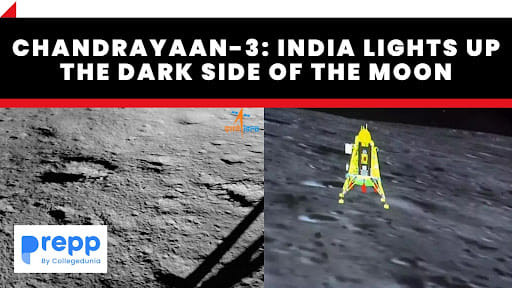
Chandrayaan-3
- Chandrayaan-3 is India's third lunar mission and the second attempt at achieving a soft landing on the moon's surface.
- It was launched from the Satish Dhawan Space Center (SDSC) in Sriharikota on July 14, 2023, at 2:35 p.m.
- It consists of an indigenous Lander module (Vikram), a Propulsion module, and a Rover (Pragyan).
Mission Objectives
- Demonstrate a safe and soft landing on the lunar surface
- Demonstrate Rover roving on the moon
- Conduct in-situ scientific experiments.
Features
- The six payloads on the Vikram lander and rover Pragyan are the same as the Chandrayaan-2 mission.
- The propulsion module houses the Spectro-polarimetry of Habitable Planet Earth (SHAPE).
- It aims to identify smaller planets with potential habitability by analyzing reflected light.
- The Lander module houses the following payloads.
- Radio Anatomy of Moon Bound Hypersensitive ionosphere and Atmosphere (RAMBHA): It measures the density of near-surface plasma (ions and electrons) and its changes with time.
- Chandra’s Surface Thermo physical Experiment (ChaSTE): It measures the thermal properties of the lunar surface such as the vertical temperature gradient & thermal conductivity.
- Instrument for Lunar Seismic Activity (ILSA): It detects lunar seismicity and outlines the structure of the lunar crust and mantle.
- LASER Retroreflector Array (LRA): It is a passive experiment to understand the dynamics of the Moon system.
- The Rover module houses the following payloads.
- Alpha Particle X-ray Spectrometer (APXS): It is used to determine the elemental composition of lunar soil and rocks around the landing site.
- LASER Induced Breakdown Spectroscope (LIBS): It is used to identify the chemical and mineral composition of the moon.
Improvements in Chandrayaan-3
- The landing area has been expanded, providing flexibility to land safely within a larger designated area.
- The lander has been equipped with more fuel to enable longer-distance travel to the landing site or alternate locations.
- It has solar panels on four sides, instead of only two in Chandrayaan-2.
- High-resolution images from the Chandrayaan-2 orbiter are used to determine the landing location and physical modifications have been made to enhance stability and sturdiness.
- Additional navigational and guidance instruments are on board Chandrayaan-3 to continuously monitor the lander’s speed and make the necessary corrections.
- This includes an instrument called Laser Doppler Velocimeter, which will fire laser beams to the lunar surface to calculate the Lander’s speed.
What is the Importance of landing near the Lunar South Pole?
- Other Moon missions have primarily targeted the lunar equator due to its favorable terrain and operating conditions.
- The lunar south pole possesses vastly different and challenging terrain as compared to the equatorial region.
- The polar region experiences a scarcity of sunlight resulting in perpetually dark areas where temperatures can drop to -230°C.
- The absence of sunlight and the extreme cold make it difficult to operate instruments and sustainably operate the devices.
- In contrast, the lunar south pole is a potential repository of valuable information about the early Solar System.
- In-depth exploration of the lunar poles could impact future deep space exploration and help gain information about the solar system.
How does Chandrayaan-3 compare with other missions?
Time taken
- Chandrayaan-3 took 43 days to reach the moon.
- USSR’s Luna-2 craft which was launched in 1959 reached the Moon in just 34 hours.
- The U.S.A.’s Apollo 11 completed its journey to the moon in just 4 days, 6 hours, and 45 minutes.
- China’s Chang E reached the moon in less than five days.
Method
- The Chandrayaan-3 mission was launched on India's heaviest rocket, the Launch Vehicle Mark-III.
- However, it is still not strong enough to propel the mission on a direct path to the Moon.
- In order to counter the lack of a powerful rocket, ISRO uses Earth's gravity to slingshot its way around the Moon.
- It involves a series of Earth-bound maneuvers and lunar orbit insertion burns to gradually raise their orbits and synchronize with the Moon's orbit.
- These missions used a method called a series of "bi-elliptic transfers," which involved multiple engine burns to gradually increase the spacecraft's energy and adjust its trajectory.
- Although this method is more fuel-efficient and cost-effective, it takes much longer to complete.
- In comparison, the U.S., Russian, and Chinese missions used direct translunar injection to adopt a direct path to the moon.
Cost
- Chandrayaan-3 was completed with an overall project cost of ₹615 crores.
- In comparison, Russia’s Luna-25 cost around ₹1,600 crore, China’s first Chang'e probe cost ₹1,752 crore, and while reach Apollo mission of the U.S.A. cost around $185 million ($1.2 billion in 2016 value).
- The Chandrayaan-2 mission cost India ₹978 crore but the development of the launch vehicle and the orbiter helped reduce the costs involved in Chandrayaan-3.
Features
- Chandrayaan-3 is equipped with a lander, propulsion module, and a rover that can traverse the lunar terrain.
- Luna 25 had eight scientific instruments including specialized machinery called spectrometers which can be used to study the lunar soil and detect surface water.
- However, it lacked a rover like Pragyan to travel the surface and conduct experiments.
Upcoming missions of ISRO
- Aditya L1: It is the first space-based Indian mission to study the sun. It will study coronal heating, coronal mass ejection, pre-flare, and flare activities, space weather dynamics, propagation of particles and fields, etc.
- Payloads
- VELC
- Solar Ultraviolet Imaging Telescope (SUIT)
- Solar Low Energy X-ray Spectrometer (SoLEXS)
- Aditya Solar wind Particle Experiment (ASPEX)
- High Energy L1 Orbiting X-ray Spectrometer (HEL1OS)
- Plasma Analyser Package for Aditya (PAPA)
- Advanced Tri-axial High-Resolution Digital Magnetometers
- NISAR: NASA-ISRO Synthetic Aperture Radar has been built by NASA and ISRO under a partnership agreement signed in 2014.
- The satellite will operate for a minimum of three years as a Low Earth Orbit (LEO) observatory.
- It will map the entire globe in 12 days and deepen understanding of climate change, deforestation, melting of glaciers, volcanoes, and earthquakes.
- XPoSat: XPoSat (X-ray Polarimeter Satellite) is India’s first dedicated polarimetry mission to study the dynamics of bright astronomical X-ray sources in extreme conditions.
- It will carry two scientific payloads in a low earth orbit - POLIX (an X-ray Polarimeter) and XSPECT (an X-ray SPECtroscopy and Timing payload)
- SPADEX: SPADEX or Space Docking Experiment is a twin spacecraft mission developed by ISRO.
- It will have applications in orbital rendezvous, docking, formation flying, human spaceflight, in-space satellite servicing, etc.
- Gaganyaan: The Gaganyaan project is India’s mission to demonstrate its human spaceflight capability by launching a crew of three members to an orbit of 400 km for a three-day mission and bringing them back safely to Earth, by landing in Indian sea waters.
- The first trial, an uncrewed flight, is expected to be conducted at the end of 2023 or early 2024, followed by Vyom Mitra, a humanoid, and then the manned mission.
- It will be launched using ISRO's GSLV Mk III.
- India is planning a mission to Venus, Shukrayaan I which was expected to be launched by 2024 but could be delayed due to lack of government approval.
(*Click this link to read prelims specific weekly current affairs articles)
FAQs
Question: What is translunar injection?
Answer:
TransLunar Injection (TLI) is a maneuver performed during space missions to send spacecraft from Earth’s orbit to a trajectory that will reach the Moon. It enables spacecraft to escape Earth’s gravitational pull and is performed when the spacecraft is at the ‘perigee’ or closest point to Earth. During a TLI, the spacecraft’ fires its engines to accelerate the spacecraft to allow it to break free from Earth’s gravitational pull and reach the moon.
Question: What are solar flares?
Answer:
A solar flare is an explosion on the sun that occurs when energy stored in 'twisted' magnetic fields is suddenly released. They are viewed as bright areas on the sun that can last from minutes to hours.
UPSC Mains Practice Question:
|
MCQs
Question: Consider the following statements about the Mangalyaan mission launched by ISRO.
- It is also called the Mars Orbiter Mission
- It made India the second country to have a spacecraft orbit Mars after the USA.
- It made India the only country to be successful in making its spacecraft orbit Mars in its very first attempt
Which of the statement(s) given above is/are correct? (UPSC CSE 2016)
(a) 1 only
(b) 2 and 3 only
(c) 1 and 3 only
(d) 1, 2 and 3
Answer: (c) See the Explanation
- India’s Mars Orbiter Mission is also known as the Mangalyaan Misson. Hence statement 1 is correct.
- It was launched in 2013 by ISRO to trace the presence of methane in Mars’ atmosphere.
- India became the fourth country to successfully send an orbiter mission to Mars after the U.S.A., Russia, and China. Hence statement 2 is incorrect.
- India became the only country to successfully complete an orbit of Mars on its first attempt. Hence statement 3 is correct.
Therefore, option (c) is the correct answer.
Download the PREPP App and attempt FREE IAS Exam Mock Tests and get complete study material!

Full Test - 04: UPSC CSE Prelims CSAT (Paper-II)
Full Test - 03: UPSC CSE Prelims CSAT (Paper-II)
UPSC CSE Prelims 2026 GS Paper 1 Question Paper (24-May-2026)
UPSC CSE Prelims 2026 CSAT Paper 2 Question Paper (24-May-2026)

17 February 2025 | The Hindu Must Read Articles | Current Affairs

16 February 2026 | The Hindu Must Read Articles | Current Affairs

13 February 2026 | The Hindu Must Read Articles | Current Affairs









Comments