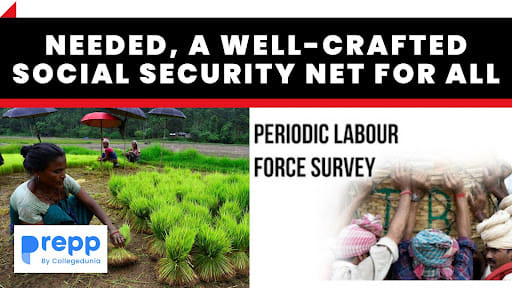
Needed, A Well-Crafted Social Security Net For All
Relevance: GS2 - Welfare schemes for vulnerable sections of the population by the Centre and States and the performance of these schemes; mechanisms, laws, institutions and Bodies constituted for the protection and betterment of these vulnerable section Government policies and interventions for development in various sectors and issues arising out of their design and implementation.
(Source: The Hindu, 08/24/2023)
Click here for Daily Current Affairs
Why in the news?
- Around 91% of India’s workforce is in the informal sector and lacks access to social security according to PLFS Annual Report 2021-22.
- According to the Report around 53% of the salaried workforce in India do not enjoy any social security benefits such as provident fund, pension, health care, and disability insurance.
Table of Contents
What is the current state of social security in India?
- Only 1.9% of the poorest 20% of India’s workforce have access to any benefits.
- Gig labor which accounts for around 1.3% of India’s active labor force is characterized by very poor social security benefits.
- Mercer CFS, which studies global pension systems ranked India’s social security system 40th out of 43 countries in 2021.
Inadequate budget and utilization
- Social security has largely been ignored by Indian policymakers which has resulted in poor utilization of the limited budgetary allocations.
- This is evident in the continued budgetary cuts in the MGNREGA budget.
- The National Social Security Fund was set up for unorganized sector workers, with an initial allocation of just ₹1,000 crores in FY11.
- It aimed to support schemes for weavers, rickshaw pullers, bidi workers, etc.
- However, an estimate by the Center for Budget and Governance Accountability revealed that it required over ₹22,841 crores.
- An audit conducted by the CAG on the Fund in 2017 revealed that ₹1,927 crores, which amounted to the entire amount accumulated in the fund remained unutilized.
- The National Social Assistance Programme was established in the 1990s to focus on old-age poor individuals with no able-bodied earners in their household, who were eligible to earn a monthly pension of ₹75.
- The contribution to the scheme from the Union government to old-age pension schemes has stagnated at ₹200 per month since 2006 which is far below the minimum daily wage.
- In July 2022, the CAG found that 94% of the cess collected to provide social security to construction workers in Delhi was not utilized.
- The CAG also found ₹98.96 crores from the direct benefit scheme of Haryana’s Social Justice and Empowerment Department had been transferred to the accounts of deceased beneficiaries.
Schemes overseas
- The General Social Security Scheme of the Brazil government is a contribution-based scheme.
- It aims to substitute income loss for a worker and his family either partially or completely.
- The scheme also covers situations such as accidents at work, disabilities that prevent the worker from working, death, illness/medical treatment leading to absence at work, family burdens, or the prospect of unemployment.
- It also covers the income loss caused by being imprisoned/
- Healthcare is covered under the Unified Health System and unemployment insurance is paid from worker support funds.
- The Constitution of Brazil has mandated the National Treasury to intervene in case there is a shortage of funds for the scheme.
- As a result, Brazilians can access social security benefits via a phone call or bank visit.
- It removes the need for unnecessary paperwork and bureaucratic red tape, thereby simplifying the process and reducing the difficulties faced by the citizens.
India
- In comparison, around 475 million people who are a part of India’s workforce in the informal sector lack access to social security.
- India is expected to become an aging society by 2050, which could adversely impact the lives of such workers, who have limited savings, in the absence of adequate social security.
- The Code on Social Security (2020) deals primarily with formal enterprises and does not cover the informal sector.
Steps for India to take
- India must set out a target of providing social security to its entire workforce in a fiscally and administratively feasible manner.
- A three-pronged approach can be adopted to reform India's social security system that addresses both formal and informal workers.
Expanding EPFO Contributions
- The contributions to the Employees' Provident Fund Organization (EPFO) by both employers and employees should be expanded.
- This would ensure enhanced benefits and a strong safety net.
Incentivizing Informal Sector Participation
- Partial contributions can be collected from informal workers with meaningful income including self-employed and those employed in informal enterprises.
- Informal enterprises must be encouraged to formalize their operations and contribute to social security.
Government Intervention
- Government intervention is necessary to aid the unemployed, underemployed, or those with insufficient earnings.
- It would cost an estimated ₹1.37 trillion or 0.69% of the GDP (FY20) to provide social protection to the poorest 20% of the workforce including the elderly, pregnant, and disabled.
Additional Reforms
- Digitization of the e-Shram platform has resulted in the enrolment of nearly 300 million workers and expanded accident insurance (of ₹2 lakh cover) and disability insurance coverage(of ₹1 lakh cover).
- However, it is burdensome for the informal worker as they must provide a self-declaration and share their Aadhaar card for registration.
- Employers are not responsible for or incentivized to encourage registration which would have formalized the employee-employer relationships and encouraged them to make social security entitlements mandatory.
- Extend coverage beyond construction and gig workers to categories like domestic workers and migrants.
- Develop a pan-India labor force card and extend existing schemes such as the Building and Other Construction Workers Schemes.
- However, this will require a loosening of existing restrictions on benefit portability, a 90-day mandatory cooling period, and a more straightforward registration process.
- The government must place special focus on other sectors such as domestic workers, particularly females, who lack job security, and migrant workers who are subject to discrimination and suspicion from authorities in their working area.
- Therefore, the coverage of social services such as child care must be expanded and domestic workers must be encouraged to organize themselves.
On existing schemes
- Existing schemes like the Employees' Provident Fund (EPF), Employees' State Insurance Scheme (ESI), and National Social Assistance Programme (NSAP) should be expanded and their budgetary support must be reinforced.
- The existing social security framework for unorganized workers is extremely complex and suffers from problems such as
- Overlapping areas of authority between the State and Centre
- Confusing definitions such as between a platform worker, an unorganized worker, and someone who is self-employed.
- Awareness campaigns must be organized to inform workers, especially women, about their social security rights and available government schemes.
- Organizations like the Self-Employed Women's Association which runs Shakti Kendras (worker facilitation centres) must be funded to complement government efforts.
Conclusion
- Policymakers must prioritize comprehensive and accessible social security systems that protect the livelihoods and well-being of all workers in India.
- Lessons from successful international models such as Brazil’s can be adapted to the Indian context to help the country make use of its demographic dividend and progress into an era of equitable growth and enhanced social protection.
- The entire labor workforce must be provided universal social security as jobs are becoming increasingly on-demand and hire/fire policies are increasing.
Code on Social Security (2020)
|
(*Click this link to read prelims specific weekly current affairs articles)
FAQs
Question: What is social security?
Answer:
Social security refers to a human right that accommodates the universal need for protection against risks to life and human social requirements. It covers sickness, maternity, disability, death, unemployment, and old age.
Question: What is the EPFO?
Answer:
The Employees' Provident Fund Organisation (EPFO) is a statutory body that encourages employees to save funds for their retirement. It was launched in 1951 and is responsible for the regulation and management of provident funds in India. It administers the mandatory provident fund, a basic pension scheme, and a disability/death insurance scheme.
UPSC Mains Practice Question:
|
MCQs
Question: What is/are the facility/facilities the beneficiaries can get from the services of Business Correspondent (Bank Saathi) in branchless areas?
- It enables the beneficiaries to draw their subsidies and social security benefits in their villages.
- It enables the beneficiaries in rural areas to make deposits and withdrawals.
Which of the above statements is/are correct? (UPSC CSE 2014)
(a) 1 only
(b) 2 only
(c) Both 1 and 2
(d) Neither 1 nor 2
Answer: (c) See the Explanation
- The Reserve Bank of India (RBI) developed the Business Correspondent (BC) Model in 2006 to ensure financial inclusion in India.
- Business Correspondents or Bank Saathis are agents who represent banks and are responsible for delivering banking services including deposits and withdrawals at locations other than a bank branch/ATM. Hence statement 2 is correct.
- It enables government subsidies and social security benefits to be directly credited to the accounts of the beneficiaries, enabling them to draw the money from the bank saathi or business correspondents in their village itself. Hence statement 1 is correct.
Therefore, option (c) is the correct answer.
Question: Consider the following:
- Hotels and restaurants
- Motor transport undertakings
- Newspaper establishments
- Private medical institutions
The employees of which of the above can have `Social Security’ coverage under Employees’ State Insurance Scheme? (UPSC CSE 2012)
(a) 1, 2 and 3 only
(b) 4 only
(c) 1, 3 and 4 only
(d) 1, 2, 3 and 4
Answer: (d) See the Explanation
- The Employees’ State Insurance Act, 1948 is social security legislation that provides for medical care and cash benefit in the contingencies of sickness, maternity, disablement, and death due to employment injury to workers.
- The Act applies to non-seasonal factories employing 10 or more persons.
- Under its provisions, the respective State governments have extended it to other classes of establishments such as shops, hotels, restaurants, cinemas, road-motor transport undertakings, and newspaper establishments employing 20 or more coverable employees. Hence statements 1, 2, 3, and 4 are correct.
Therefore, option (d) is the correct answer.
Question: To obtain the full benefits of demographic dividend, what should India do? (UPSC CSE 2013)
(a) Promoting skill development
(b) Introducing more social security schemes
(c) Reducing infant mortality rate
(d) Privatization of higher education
Answer: (a) See the Explanation
- The promotion of Skill Development will allow India to reap the benefits of its demographic dividend.
- A skilled younger population will help create employment and increase employability, which will ultimately increase the rate of India's Economic growth.
Therefore, option (a) is the correct answer.
Download the PREPP App and attempt FREE IAS Exam Mock Tests and get complete study material!

Full Test - 04: UPSC CSE Prelims CSAT (Paper-II)
Full Test - 03: UPSC CSE Prelims CSAT (Paper-II)
UPSC CSE Prelims 2026 GS Paper 1 Question Paper (24-May-2026)
UPSC CSE Prelims 2026 CSAT Paper 2 Question Paper (24-May-2026)

17 February 2025 | The Hindu Must Read Articles | Current Affairs

16 February 2026 | The Hindu Must Read Articles | Current Affairs

13 February 2026 | The Hindu Must Read Articles | Current Affairs









Comments