Implementing A Car Safety Programme
Relevance: GS2: Government Policies And Interventions For Development In Various Sectors.
(Source: The Hindu, 08/24/23)
Click here for Daily Current Affairs
Why in the news?
- The Ministry of Road Transport and Highways has implemented an indigenous star-rating system for crash testing cars, with vehicles receiving one to five stars rating their safety in the event of a collision.
- The rating system, known as the Bharat New Car Assessment Programme (NCAP), will be voluntary and will come into effect on October 1, 2023.
- With this initiative, India becomes the fifth country globally to introduce its own car crash test rating system.
Table of Contents
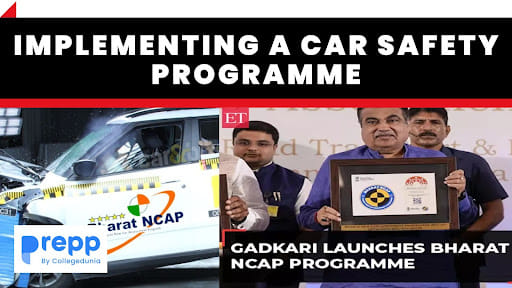
What is Bharat New Car Assessment Programme (NCAP)?
- The Bharat New Car Assessment Programme, abbreviated as the Bharat NCAP, is an Indian New Car Assessment Programme.
- The programme aims to bring India's safety standards in line with those of nations such as the United States, Europe, Japan, Australia, and Latin America, all of which have their own NCAPs.
- It is an important step forward in the government's resolve to improve road safety in India by upgrading the safety requirements of motor vehicles weighing up to 3.5 tonnes.
- Car manufacturers can voluntarily provide their vehicles to be evaluated in accordance with Automotive Industry Standard (AIS) under this scheme.
- With only 1% of the world's automobiles, India has about 1.5 lakh road fatalities every year, accounting for 10% of all road deaths worldwide.
- A World Bank research estimates that traffic accidents cost the Indian economy between 5% and 7% of GDP per year.
Evolution of Bharat NCAP
- The Bharat NCAP's testing standards are based on the Global NCAP, a project of the U.K.-based NGO, Towards Zero Foundation.
- It provides a platform for collaboration among new automotive evaluation programmes across the world, including the United States, which has the world's longest crash testing procedure since 1978.
- In 2014, the NGO began the Safer Cars for India campaign, publishing the country's first independent accident testing on the Suzuki-Maruti Alto 800, Tata Nano, Ford Figo, Hyundai i10, and Volkswagen Polo.
- The Bharat NCAP follows the implementation of a spate of road safety legislation in recent years, including mandated twin front airbags, anti-lock brake systems, seat belt reminders, and reverse parking sensors.
Parameters of NCAP
- Cars will be rated from one to five stars based on three parameters:
- Adult occupant protection,
- Child occupant protection,
- Safety assist technologies present in the car
- The first two parameters will be calculated using three different types of tests, including a frontal offset test in which a vehicle is driven at 64 kmph with 40% overlap into a deformable barrier that represents the oncoming vehicle, simulating a collision between two cars of the same weight.
- Other tests include the 50-kmph side impact test and the 29-kmph pole-side impact test (in which a car is slammed into a rigid pole sideways).
- Though Bharat NCAP is voluntary, cars may be subjected to a crash test in certain cases, such as when a base model of a popular variant (minimum clocked sale of 30,000 units) is recommended for testing by the Ministry of Road Transport and Highways based on market feedback or in the interest of public safety.
Types of testing to be conducted under Bharat NCAP
- The front impact, side impact, and side impact pole tests will be used to evaluate vehicle safety.
- While electric cars (EVs) are not now part of the protocol, the government intends to incorporate the EV segment in the near future.
- Notably, numerous manufacturers have already given roughly 15-20 vehicles for review under the Bharat NCAP scheme.
How does Bharat NCAP address road accidents and fatalities in India?
- Bharat NCAP is expected to increase safety standards in the Indian car sector, pushing manufacturers to build safer automobiles.
- The programme will provide customers with information to help them make educated purchasing decisions, improve export potential, and contribute to the development of a safe vehicle industry in India.
- The issue of road accidents and fatalities in India, with around 1.5 lakh deaths every year.
- Bharat NCAP seeks to reduce accidents, deaths, and GDP loss due to road accidents by increasing vehicle safety standards and promoting safer automobiles.
What is the way forward in Indian conditions?
- For the Bharat NCAP programme to be properly implemented, India will need to expand its crash testing skills and knowledge expertise, such as a software system linked to the dummies put inside automobiles to assess the kind and amount of injuries and analyse scores.
- Over time, India will need to extend testing criteria to align Bharat NCAP with global norms.
- The United States NCAP, for example, includes a roll-over test to determine if a vehicle is susceptible to tipping over on the road during a severe manoeuvre.
- Japan's NCAP covers, among other things, the performance of electric shock protection after a collision, the performance of neck injury protection in a rear end collision, the evaluation of passenger seat belt reminder technologies, and the evaluation of pedestrian protection technologies.
(*Click this link to read prelims specific weekly current affairs articles)
FAQs
Question: What is NCAP?
Answer:
The Global New Car Assessment Programme (Global NCAP) is an initiative of the Towards Zero Foundation, a UK-registered charity. The campaign seeks to encourage the sale of safer cars in emerging areas by providing customers with objective information regarding vehicle safety.
Question: What is the Automotive Industry Standard (AIS)?
Answer:
AIS is an abbreviation for "Automotive Industry Standards," which are India's technical automotive standards. The India Central Motor Vehicles Rules (CMRV) provide the parameters under which automotive goods in India can get a Type Approval Certificate for the Indian market. The Type Approval Certificate (TAC) is required for items and components that must meet stringent technical and safety standards.
Question: What are the three parameters of NCAP?
Answer:
Cars will be rated from one to five stars based on three parameters:
- Adult occupant protection,
- Child occupant protection,
- Safety assist technologies present in the car
Download the PREPP App and attempt FREE IAS Exam Mock Tests and get complete study material!

Full Test - 04: UPSC CSE Prelims CSAT (Paper-II)
Full Test - 03: UPSC CSE Prelims CSAT (Paper-II)
UPSC CSE Prelims 2026 GS Paper 1 Question Paper (24-May-2026)
UPSC CSE Prelims 2026 CSAT Paper 2 Question Paper (24-May-2026)

17 February 2025 | The Hindu Must Read Articles | Current Affairs

16 February 2026 | The Hindu Must Read Articles | Current Affairs

13 February 2026 | The Hindu Must Read Articles | Current Affairs









Comments