How Unemployment Is Measured
Relevance: GS3 - Issues relating to planning, mobilization, of resources, growth, development and employment.
(Source: The Hindu, 09/07/2023)
Click here for Daily Current Affairs
Why in the news?
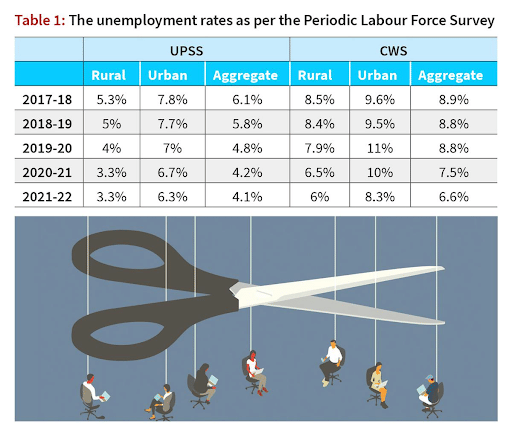
- According to the Periodic Labour Force Survey (PLFS), India’s unemployment rate was 6.1% in 2017 (the highest ever recorded) and the PLFS of 2021-22 showed unemployment reducing to 4.1%.
- Addressing the issue of unemployment is pivotal for the success or failure of any government.
- To effectively combat this challenge, a comprehensive understanding of how unemployment is defined and assessed in the context of a developing economy such as India is essential.
Table of Contents
What is Unemployment?
- Unemployment, as defined by the International Labour Organization (ILO) involves three criteria: being without a job, actively seeking employment, and being available for work.
- If someone loses their job but doesn't actively search for another, they aren't considered unemployed.
- The labor force comprises both the employed and the unemployed, while those who don't fit either category, like students and those doing unpaid domestic work, are classified as out of the labor force.
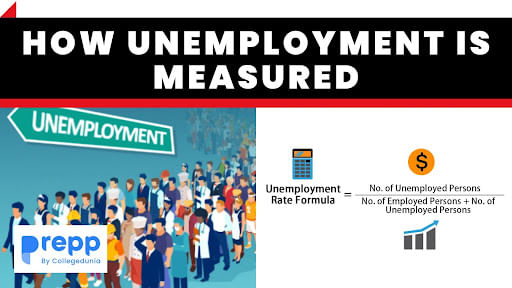
- The unemployment rate is calculated as the proportion of unemployed individuals to the total labor force. This rate can decrease if an economy isn't creating enough jobs or if people choose not to seek work.
About Periodic Labour Force Survey (PLFS)
- It was launched by the National Statistical Office (NSO) in 2017 and is India’s first computer-based survey.
- It was constituted based on the recommendation of the Amitabh Kundu committee.
- Earlier the National Sample Survey Organisation(NSSO) was used to bring the data related to employment and unemployment based on its quinquennial (every 5 years) household socio-economic survey program.
Measuring Unemployment in India
- Measuring unemployment in India is difficult due to the informal nature of jobs. Unlike developed economies, individuals do not hold one job year-round.
- An individual may be unemployed this week, but may have worked as a casual labourer last month, and as a farmer for most of the year.
- The National Sample Survey Organisation (NSSO) adopts two major measures for classifying the working status of individuals in India - the Usual Principal and Subsidiary Status (UPSS) and the Current Weekly Status (CWS).
- The CWS adopts a shorter reference period of a week. An individual is counted as being employed if they have worked for at least one hour on at least one day during the seven days preceding the date of survey.
- UPSS unemployment rates will always be lower than CWS rates because there is a greater probability that an individual would find work over a year as compared to a week.
India’s Labour Force Participation Rate (LFPR)
- Labour Force Participation Rate (LFPR) is defined as the percentage of the population in working age-groups that is employed, or is looking for work, but is unemployed.
- As per OECD, it is calculated as the labour force divided by the total working-age population, hence estimating an economy’s active workforce.
- Data from the Periodic Labour Force Survey shows that 29.4% of women (aged 15-59) were part of India’s labour force in 2021-22, as compared to 29.8% in the preceding year.
- In contrast, men’s LFPR improved from 80.1% in 2020-21 to 80.7 % in 2021-22.

How is Unemployment measured in India?
- Usual Status Unemployment
- This measure estimates the number of persons who remained unemployed for a major part of the year.
- This measure gives the lowest estimates of unemployment.
- Weekly Status Unemployment
- The estimate measures unemployment with respect to one week.
- A person is said to be unemployed if he is not able to work even for an hour during the survey period.
- In other words according to this estimate, a person is said to be employed for the week, even if he/she is employed only for a day during that week
- Current Daily Status Unemployment
- It considers the activity status of a person for each day of the preceding seven days. The reference period here is a day.
- If a person did not find work on a day or some days during the survey week, he/she is regarded as unemployed
- Normally if a person works for four hours or more during a day, he or she is considered as employed for the whole day.
- The daily status of unemployment is considered to be a comprehensive measure of unemployment.
Challenges in Measuring Unemployment in India
- Social Norms and Limited Job Search: Social norms in India restrict active job seeking, leading to underestimation of unemployment. Many potential workers, particularly women, express willingness to work if jobs were available at home.
- According to a NSSO survey, 33.3% of rural women and 27.2% of urban women aged 15 and above who were engaged in domestic work reported willingness to work if it were made available within the premises of the household.
- Informal Job Dynamics: India's informal job market results in frequent job role changes. People may be unemployed temporarily but engage in various roles, making measurement challenging.
- Diverse Methodologies: Different organizations use varied methods to measure unemployment. This can lead to differing results, with higher unemployment but lower labor force participation rates in an informal economy.
- Data Lag and Disruptions: Data collection often lags behind real-time events, as seen during the COVID-19 lockdown. Unemployment rates may not immediately reflect economic disruptions.
- Data Collection Challenges: India is a vast and diverse country with a large population, making data collection a logistical challenge. Surveys and data collection methods may not be uniform or fully representative across regions and demographic groups.
Initiatives by the Government to fight Unemployment
- Support for Marginalised Individuals for Livelihood and Enterprise (SMILE)
- PM-DAKSH (Pradhan Mantri Dakshta Aur Kushalta Sampann Hitgrahi)
- Mahatma Gandhi National Rural Employment Guarantee Act (MGNREGA)
- Pradhan Mantri Kaushal Vikas Yojana (PMKVY)
- Start Up India Scheme
(*Click this link to read prelims specific weekly current affairs articles)
FAQs
Question: What are the measures of unemployment?
Answer:
Unemployment is measured by the unemployment rate, which is the number of people who are unemployed as a percentage of the labor force (the total number of people employed added to those unemployed).
Question: What is Labour Force Participation Rate (LFPR)?
Answer:
Labour Force Participation Rate (LFPR) is defined as the percentage of the population in working age-groups that is employed, or is looking for work, but is unemployed.
Question: What is ILO?
Answer:
International Labour Organization (ILO) is an agency of the United Nations (U.N). The ILO promotes economic and social justice by placing international Labour standards. It headquarters in Geneva, Switzerland,
MCQ
Question: Increase in absolute and per capita real GNP do not connote a higher level of economic development, if (UPSC 2018)
(a) industrial output fails to keep pace with agricultural output.
(b) agricultural output fails to keep pace with industrial output.
(c) poverty and unemployment increase.
(d) imports grow faster than exports.
Answer: (c) See the Explanation
Economic progress encompasses not only financial growth but also human development. There are instances where indicators like Gross National Product (GNP) may rise, but employment and poverty statistics either remain stagnant or worsen. This scenario is referred to as "jobless growth." Jobless growth can occur due to factors such as technological automation replacing human labor. Such a situation results in the accumulation of wealth among a select few, exacerbating inequality within both society and the economy.
Therefore, option (c) is the correct answer.
Question: With reference to the Indian economy after the 1991 economic liberalization, consider the following statements: (UPSC CSE 2020)
- Worker productivity (per worker at 2004-05 prices) increased in urban areas while it decreased in rural areas.
- The percentage share of rural areas in the workforce steadily increased.
- In rural areas, the growth in the non-farm economy increased.
- The growth rate in rural employment decreased.
Which of the statements given above is/are correct?
(a) 1 and 2 only
(b) 3 and 4 only
(c) 3 only
(d) 1, 2, and 4 only
Answer: (b) See the Explanation
- Agriculture and Allied Activities which account for over 56% of the workforce, has the lowest GVA per worker. Hence statement 1 is incorrect.
- The occupational structure in the country has changed with the percentage share of the labour-force in the agricultural sector declining and that of the services sector rising. Hence statement 2 is incorrect.
- According to the Economic Census of India, around 41.89 million rural people were employed in non-agricultural establishments which grew by 4.56 % between 1998 and 2005. Hence statement 3 is correct.
- Steady urbanization has led to the decline of the share of the rural population, in the workforce and GDP of the country. Hence statement 4 is correct.
Therefore, option (b) is the correct answer.
Download the PREPP App and attempt FREE IAS Exam Mock Tests and get complete study material!

Full Test - 04: UPSC CSE Prelims CSAT (Paper-II)
Full Test - 03: UPSC CSE Prelims CSAT (Paper-II)
UPSC CSE Prelims 2026 GS Paper 1 Question Paper (24-May-2026)
UPSC CSE Prelims 2026 CSAT Paper 2 Question Paper (24-May-2026)

17 February 2025 | The Hindu Must Read Articles | Current Affairs

16 February 2026 | The Hindu Must Read Articles | Current Affairs

13 February 2026 | The Hindu Must Read Articles | Current Affairs









Comments