Bridging The Malnutrition Gap, The Bemetara Way
Relevance: GS2 - Issues relating to poverty and hunger, Issues relating to development and management of Social Sector/Services relating to Health Government policies and interventions for development in various sectors and issues arising out of their design and implementation
(Source: The Hindu, 09/07/2023)
Click here for Daily Current Affairs
Why in the news?
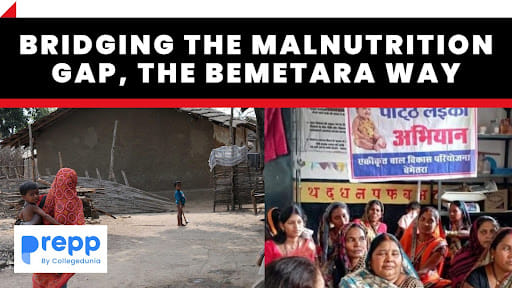
- This article discusses the Potth Laika Abhiyaan, which is being implemented in Bemetara, Chhattisgarh which has a high number of Severe Acute Malnutritioned children despite being agriculturally rich and unaffected by Naxal activities.
- The major problem faced in addressing malnutrition is the lack of knowledge about feeding practices such as when and what to eat.
- Child malnutrition in India contributes to around 68.2% of under-five child mortality and also affects their health, learning capacity, school performance, and potential earnings, and increases the risk of contracting chronic diseases such as diabetes, hypertension, and obesity.
Table of Contents
Government Efforts to combat malnutrition
- Over the years, the Indian government has attempted to implement multiple schemes to ensure the food security of the population.
- This includes initiatives such as the provision of mid-day meals in schools, the Public Distribution System, and the Prime Minister's Overarching Scheme for Holistic Nourishment (POSHAN) Abhiyaan which provides ready-to-eat packets and hot meals to mothers and children at Anganwadi Centres (AWCs).
- Various state-specific schemes such as the Mukhyamantri Suposhan Yojaana (Chattisgarh) have been implemented to distribute nutritional add-ons such as egg, banana, protein powders, peanut chikki, and jaggery.
- Although these initiatives ensure access to food, India still faces persistent challenges related to the lack of information about nutrition.
- There is an inadequate amount of knowledge about proper eating and feeding practices, food-related myths, and insufficient highly processed foods.
Role of Social and Behavior Change Communication (SBCC)
- “Jan Andolan” or Social and Behavior Change Communication is a critical component of the POSHAN Abhiyaan.
- Various awareness programs have been initiated under the POSHAN Abhiyaan such as bicycle rallies, planting Poshan Vatikas, celebrating Poshan Maah, Poshan Pakhwaras, and Godh Bharaais.
- However, the concept of nutrition counseling needs to be institutionalized and uniformly implemented across the country, and field staff must be properly trained in nutritional counseling.
- According to the POSHAN Abhiyaan Progress Report, 2018, it is necessary to implement a focused and coherent SBCC Action Plan.
Case Study: Lessons from Bemetara
- Bemetara is a district in central Chattisgarh that was created in 2012 after the division of Durg district.
- Unique: Severe Acute Malnutritioned (SAM) children in the district was as high as 3,299 (in 2022) despite the district being agriculturally rich and located in the fertile plain region and free from Naxal-extremism.
- The malnutrition figures are similar to those in the tribal-and Naxal-dominated districts of Chattisgarh such as Bastar.
- Major factors for malnutrition:
- The problem faced by the district is not because of a lack of access to nutritious food.
- Rather, it is mainly due to a lack of information about what to eat and when to eat.
- Therefore, a programme of nutritional counseling and robust monitoring was chosen as the strategy to counter malnutrition in the region.
Potth Laika Abhiyaan
- The Potth Laika Abhiyaan, which translates to “Healthy Child Mission” in Chattisgarhi, is a nutrition counseling programme that is implemented in 72 of the most affected AWCs in the Bemetara sub-division of Bemetara district.
- The initiative is being provided technical support by UNICEF.
- Under the scheme, ground-level staff from the Health and Women and Child Development departments have been provided training on ways to provide nutrition counseling in the region.
- Parents of Severe Acute Malnutritioned (SAM) and Medium Acute Malnutritioned (MAM) children are summoned and counseled.
- Local community leaders such as sarpanches, panchayat sachivs, and religious heads also participate in the counseling sessions
- Staff explain the importance of proper nutrition and maintaining a healthy lifestyle in simple Chattisgarhi.
- They dispel misinformation and myths about food and the necessary constituents of “Tiranga Bhojan” or a balanced diet and the the need for regular handwashing and hygiene.
- The progress of the targeted children is regularly monitored including through door-door visits to the houses of targeted children.
|
Has the Abhiyaan been effective?
Encouraging Results
- The Potth Laika Abhiyaan has successfully improved the nutritional status of targeted children through nutrition counseling and monitoring.
- Within nine months, 53.77% of children were rescued from malnutrition.
- 61.5% of MAM children and 14.67% of SAM children have been lifted out of malnutrition.
- In comparison, only 30.6% of children were lifted out of malnutrition in a random control group of 20 AWCs where the Abhiyaan was not implemented.
- This amounted to 33.8% MAM children and zero SAM children who were taken out of malnutrition, indicating a total increase of 23% over and above the control group.
Cost-Effectiveness
- Unlike meal provision programs which require elaborate budgets and face the risk of fund leakages, the Potth Laika Abhiyaan operates at zero cost.
- This makes the Abhiyaan a cost-effective solution for the eradication of malnutrition.
- This is significant as the State of Food Security and Nutrition in the World’ (SOFI) 2023 had the cost of a healthy diet in India, which is still the lowest among BRICS nations, increased by 65%(Mumbai) in five years.
Scaling the Model Nationwide
- The success of the Potth Laika Abhiyaan has provided evidence for the Mission to be replicated on a national scale in all districts and states.
Other Initiatives for Nutrition
|
Conclusion
The combination of providing food and nutrition counseling with appropriate monitoring will help significantly in eradicating malnutrition in India and achieving “Kuposhan Mukt Bharat”.
(*Click this link to read prelims specific weekly current affairs articles)
FAQs
Question: What is malnutrition?
Answer:
Malnutrition refers to deficiencies or excesses in nutrient intake, imbalance of essential nutrients, or impaired nutrient utilization.
Question: What is the State of Food Security and Nutrition in the World?
Answer:
It is an annual flagship report jointly prepared by the FAO, IFAD, UNICEF, WFP, and WHO that aims to spread information on eliminating hunger, achieving food security, and improving nutritional outcomes.
UPSC Mains Practice Question:
|
MCQs
Question: Which of the following are the objectives of ‘National Nutrition Mission’?
- To create awareness relating to malnutrition among pregnant women and lactating mothers.
- To reduce the incidence of anemia among young children, adolescent girls, and women.
- To promote the consumption of millets, coarse cereals, and unpolished rice.
- To promote the consumption of poultry eggs.
Select the correct answer using the code given below:
(a) 1 and 2 only
(b) 1, 2 and 3 only
(c) 1, 2 and 4 only
(d) 3 and 4 only
Answer: (a) See the Explanation
The National Nutrition Mission or Poshan Abhiyaan was established to tackle the problem of malnutrition in the country.
Objectives:
- Building awareness of malnutrition among pregnant women and lactating mothers. Hence statement 1 is correct.
- Reducing the incidence of anemia among young children, adolescent girls, and women. Hence statement 2 is correct.
- Improve maternal and child-under nutrition in high-burden districts.
- The Mission objectives do not mention prompting the consumption of millet, coarse cereals, eggs, and unpolished rice. Hence statements 3 and 4 are incorrect.
Therefore, option (a) is the correct answer.
Download the PREPP App and attempt FREE IAS Exam Mock Tests and get complete study material!

Full Test - 04: UPSC CSE Prelims CSAT (Paper-II)
Full Test - 03: UPSC CSE Prelims CSAT (Paper-II)
UPSC CSE Prelims 2026 GS Paper 1 Question Paper (24-May-2026)
UPSC CSE Prelims 2026 CSAT Paper 2 Question Paper (24-May-2026)

17 February 2025 | The Hindu Must Read Articles | Current Affairs

16 February 2026 | The Hindu Must Read Articles | Current Affairs

13 February 2026 | The Hindu Must Read Articles | Current Affairs









Comments