Equality before law and Equal Protection of laws - Indian Polity Notes
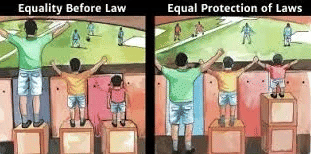
Equality before the law means that no one is above the rule of law. Equal protection of law means that the law gives equal opportunities to all people who are in similar circumstances or situations. Article 14 of the Indian Constitution states that the state shall not refuse any individual within India's territory equality before the law or equal protection under the law. This is a right that both citizens and non-citizens have. This article explains the Features of Fundamental Rights which is important for UPSC Indian Polity Preparation.
Table of Contents

|
"Equality before the law and equal protection of the laws stand as the twin pillars of justice, ensuring that every individual, regardless of their status or identity, is granted the same legal rights and protections under a system governed by fairness and impartiality." |
Right to equality
- The right to equality ensures that everyone is treated equally before the law, prohibits discrimination on various grounds, treats everyone as equals in public employment, and abolishes untouchability and titles.
- Articles 14-18 establish the right to equality.
- Part III (also known as the Magna Carta of India) of the Indian Constitution contains six fundamental rights, which are enshrined in Articles 14-32.
- The Right to equality is divided into two parts:
- Equality before law
- Equal protection of laws
Equality before law
- The Concept of “equality before law” is of British origin which means that no one, rich or poor, low or high, official or non-official, is above the law and that everyone, regardless of status or position, is to be treated equally and subject to the same form of court interference.
- It is a rather negative notion in that it is a proclamation of equality of all persons inside the territory of India, meaning the absence of any privilege in favor of any individual based on birth, creed, or other factors.
- The concept of Equality Before law, on the other hand, does not imply total equality for everybody. Article 14 assures treatment that is comparable but not identical.
- Example: If a normal citizen or a government official murders someone, they will both be punished in the same way, and the penalty will be the same, which implies the same law will apply to both of them.
| Other Relevant Links | |
|---|---|
| Rule of Law | Exceptions to Equality |
| Abolition of Untouchability | Abolition of Titles |
Equal Protection of Laws
- The concept of "equal protection of laws (EPL)" comes from the United States Constitution.
- It means that the law should be applied equally and fairly to all people. As a result, it is a positive concept that implies the right to equal treatment under the same circumstances.
- As a result, Equal Protection of Law necessitates affirmative action by the state in the face of inequity. Thus, Article 14 allows for acceptable categorization, and the notion of equality allows for logical discrimination.
- In brief, equals must be treated equally, and unequals must be treated unequally, according to the Supreme Court, where equals and unequals are treated differently.
- Example: Special seating for women in buses, trains, and metros is not unconstitutional.
Thus, there are exceptions to the right to equality, which have been reaffirmed by several of the Court's decisions and are also stated in the Constitutions. Here are a few examples:
- During the President's or Governor's tenure of office, no court may issue a warrant for his or her arrest or imprisonment.
- No member of Parliament shall be held accountable for anything said or voted in parliament in any legal process (Art 105).
- Article 31C - A state's statute implementing DPSPs in clauses (b) and (c) of Article 39 is not subject to dispute because it violates Article 14.
- Yusuf vs. State of Bombay, 1954: In cases involving women (e.g., adultery), women may be given preferential treatment due to their social rank and need for protection.
- Balsara vs State of Bombay, 1957: Differentiating between civil and military employees, as well as foreign tourists and Indian nationals, would not be unlawful.
Difference between Equality before the law and Equal Protection of laws.
| Equality before law | Equal Protection of laws |
|---|---|
| 1. British origin | 1. Borrowed from American Constitution |
| 2. It declares that no one (rich, poor, high, or low) is above the law. | 2. It states that similar people should be treated equally. |
| 3. There are no special privileges granted to anyone. | 3. Equality of treatment under the same conditions (both in terms of privileges granted and obligations imposed by the laws). As a result, it indicates that the government can take affirmative action (reservation) in favor of society's weaker members. |
| 4. All people are subject to the ordinary law of the nation, which is administered by ordinary law courts. | 4. The same laws are applied in the same way to all people who are in the same situation. |
| 5. It is a negative concept since it prohibits the state from discriminating against individuals arbitrarily. | 5. It's a beneficial concept because it makes the state responsible for preventing rights violations. |
Conclusion
Together, these principles uphold the rule of law, safeguard human rights, and foster a sense of trust and equity in the legal system. They are essential for the maintenance of social harmony and the protection of individual freedoms, reinforcing the fundamental values of justice and equality in any society.
FAQs
Question: What is meant by Equality Before Law in the Indian Constitution?
Answer: Equality Before Law means that all individuals, regardless of their status or position, are equally subject to the laws of the land and that no person enjoys any special privileges in the eyes of the law.
Question: How does Equal Protection of Laws differ from Equality Before Law?
Answer: While Equality Before Law ensures equal subjection to the law, Equal Protection of Laws focuses on equal treatment of similarly situated individuals and allows for reasonable classification to meet different needs in society.
Question: What are the exceptions to the principle of Equality Before Law?
Answer: Exceptions to Equality Before Law include diplomatic immunity, privileges enjoyed by the President of India and Governors, and other similar immunities under certain conditions.
Question: What is reasonable classification under Article 14?
Answer: Reasonable classification allows the state to differentiate between individuals or groups as long as the classification is based on intelligible differentia and there is a rational nexus between the classification and the objective of the law.
Question: Why is Article 14 important for the Rule of Law in India?
Answer: Article 14 ensures the Rule of Law by preventing discrimination and ensuring fairness in legal proceedings, thus promoting justice and equality in the governance of the country.
MCQs
- Which Article of the Indian Constitution guarantees Equality Before Law and Equal Protection of Laws?
A. Article 19
B. Article 21
C. Article 14
D. Article 32
Answer: (C) See the Explanation
Article 14 of the Indian Constitution guarantees the fundamental right of Equality Before Law and Equal Protection of Laws for all individuals within India.
- What is the key difference between Equality Before Law and Equal Protection of Laws?
A. Equality Before Law applies only to citizens, while Equal Protection of Laws applies to everyone.
B. Equality Before Law is a positive concept, while Equal Protection of Laws is a negative concept.
C. Equality Before Law ensures equal subjection to law, while Equal Protection of Laws focuses on equal treatment of similar individuals.
D. There is no difference between the two.
Answer: (C) See the Explanation
Equality Before Law ensures that all individuals are equally subject to the law, while Equal Protection of Laws focuses on providing equal treatment to similarly situated individuals, allowing for reasonable classification.
- Which of the following is an exception to the principle of Equality Before Law?
A. All citizens have the right to vote.
B. The President of India enjoys immunity from legal proceedings.
C. The Right to Freedom of Speech and Expression.
D. Every individual is subject to the laws of the land.
Answer: (B) See the Explanation
The President of India and the Governors enjoy certain immunities from legal proceedings while in office, which is an exception to the principle of Equality Before Law.
- Which of the following is a requirement for reasonable classification under Article 14?
A. Intelligible differentia
B. Rational nexus with the objective of the law
C. Both A and B
D. None of the above
Answer: (C) See the Explanation
For a classification to be considered reasonable under Article 14, it must be based on intelligible differentia and have a rational nexus with the law’s objective.
- Which of the following principles is derived from Article 14 of the Indian Constitution?
A. Directive Principles of State Policy
B. Fundamental Duties
C. Rule of Law
D. Sovereignty of Parliament
Answer: (C) See the Explanation
Article 14 promotes the Rule of Law by ensuring that all individuals are equally subject to the law and that justice is administered fairly without discrimination.
GS Mains Questions and Model Answers
Q1: Discuss the significance of Article 14 of the Indian Constitution in ensuring equality and fairness in governance.
Answer: Article 14 of the Indian Constitution plays a vital role in ensuring equality and fairness in governance. The article provides two essential principles: Equality Before Law, which guarantees that no individual is above the law, and Equal Protection of Laws, which ensures that individuals in similar situations are treated equally. These principles form the foundation of the Rule of Law in India, preventing arbitrary actions by the state and promoting justice. The provision for reasonable classification allows the state to meet diverse needs, ensuring that laws are applied equitably while addressing specific circumstances, such as social and economic inequalities.
Q2: Analyze the scope of the principle of Equal Protection of Laws under Article 14 and its application in judicial pronouncements.
Answer: The principle of Equal Protection of Laws under Article 14 ensures that similarly situated individuals are treated equally by the state. This principle has been interpreted broadly by the judiciary to address inequalities in various spheres, including economic, social, and political rights. The courts have used Article 14 to strike down laws and policies that arbitrarily discriminate against certain groups, such as in cases related to gender equality, affirmative action, and reservations. The doctrine of reasonable classification allows the state to differentiate between groups as long as there is a legitimate objective and a rational basis for the classification.
Q3: Explain the doctrine of reasonable classification under Article 14. How does it strike a balance between equality and practical governance needs?
Answer: The doctrine of reasonable classification under Article 14 allows the state to classify individuals or groups based on an intelligible differentia that distinguishes them from others, and there must be a rational nexus between the classification and the objective of the law. This doctrine strikes a balance between the ideal of absolute equality and the practical needs of governance. For instance, laws providing reservations for historically disadvantaged groups are based on reasonable classification, as they aim to rectify historical inequalities. This approach ensures that equality is not merely formal but substantive, addressing the diverse needs of society while maintaining fairness.
Previous Year Questions on Equality before law and Equal Protection of laws
1. UPSC CSE Prelims 2020
Question: Which of the following ensures equal treatment of similar individuals by the state under the Indian Constitution?
A. Article 19
B. Article 14
C. Article 21
D. Article 32
Answer: B
Explanation: Article 14 guarantees Equal Protection of Laws, ensuring equal treatment of similarly situated individuals by the state.
2. UPSC CSE Mains 2018 (GS Paper 2)
Question: "Article 14 of the Indian Constitution provides for both formal and substantive equality." Explain this statement with examples from judicial interpretations of Article 14.
Answer:
- Explain the dual aspects of formal equality (Equality Before Law) and substantive equality (Equal Protection of Laws).
- Provide examples of judicial interpretations, such as cases related to affirmative action or striking down discriminatory laws.
*email: contactus@prepp.in
Download the PREPP App and attempt FREE IAS Exam Mock Tests and get complete study material!

Full Test - 04: UPSC CSE Prelims CSAT (Paper-II)
Full Test - 03: UPSC CSE Prelims CSAT (Paper-II)
UPSC CSE Prelims 2026 GS Paper 1 Question Paper (24-May-2026)
UPSC CSE Prelims 2026 CSAT Paper 2 Question Paper (24-May-2026)

17 February 2025 | The Hindu Must Read Articles | Current Affairs

16 February 2026 | The Hindu Must Read Articles | Current Affairs

13 February 2026 | The Hindu Must Read Articles | Current Affairs









Comments