Abolition of Titles (Article 18) - Indian Polity Notes
Abolition of titles means the prohibition of any titles that cause inequity in the social dimension. Abolition of titles (Article 18) was incorporated in Part III - Fundamental Rights of the Indian constitution. The hereditary titles of nobility given by colonial States, such as Maharaja, Raj Bahadur, Rai Bahadur, Rai Saheb, Dewan Bahadur, and so on. Article 18 abolished titles and forbids any state from conferring any titles on anyone. Only academic and military honours are immune from this title elimination. Here we will discuss more about Article 18 and its provisions.
|
Table of Contents |
Constitutional Provisions - Abolition of Titles
Article 18 of India's constitution abolishes titles and makes the following four provisions:
- Article 18(1) - It forbids the government from bestowing any title on any citizen or foreigner (except military or academic distinction).
- Article 18(2) - It makes it illegal for an Indian citizen to accept any title from a foreign state.
- Article 18(3) - Without the permission of the President of India, a foreigner holding an office of profit or trust under the state cannot accept any title from a foreign state.
- Article 18(4) - No person holding any office of profit or trust under the State shall, without the consent of the President, accept any present, emolument, or office of any kind from or under any foreign State.
|
"The abolition of titles in the Indian Constitution signifies a commitment to equality and democracy, ensuring that no individual is elevated above another by birthright or honorifics, and fostering a society based on merit and integrity." |
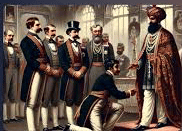
Abolition of Titles – Purpose
- Within the Constituent Assembly, Ambedkar explained that Article 18 did not constitute a justiciable right:
- “ Non-acceptance of titles may be a condition of continuing citizenship; it is not a privilege; rather, it is a demand put on the individual who, if he wants to remain a citizen of this country, must comply with specific requirements."
- "One of the requirements is that he must not accept a title; if he does, Parliament may be able to decide by legislation what should be done to those who breach the text's restrictions." One of the consequences could be that he loses his right to citizenship."
| Other Relevant Links | |
|---|---|
| Equality before Law and Equal Protection of Laws | Exceptions to Equality |
| Rule of Law | Abolition of Untouchability |
Abolition of Titles - Significance
- The abolition of titles is under Article 18 which prohibits the usage of different titles in India.
- Titles such as "Raja" and "Maharaja" are not permitted in India, and Indian individuals are not permitted to assume any other title from a foreign country.
- Aside from that, the "Padma Bhusan" and other honours are granted to Indian people in fields like art, science, literature, and others.
- The elimination of the title serves to maintain social equality, and equality serves to avoid damaging assumptions.
- If people are given titles, there will be insecurity among the general public, and it will not contribute to the development of solid interpersonal relationships.
- Even though it is listed in Part 3 of the Indian constitution as an extension of the right to equality, it does not safeguard any basic rights. The conferring of titles violates the equality principle required by Article 14.
- In medieval and British India, titles like Rai Bahadur, Sawai, Rai Sahab, Zamindar, Taluqdar, and others were common.
- Article 18 of the constitution removed all of these titles (Only natural titles of nobility are prohibited under Article 18).
- Titles and titular glories should not be created by democracy. There is no room for a few persons to possess titles, thereby creating artificial disparities among members of an analogous community, in the creation of a society that aims to achieve political, social, and economic equality and hence aspires to become really democratic.
Difference Between Awards and Titles
- The titles were offered to those who impressed Britishers with their administrative skills during British rule. People receive awards for their contributions to the progress of art, literature, and science, as well as for outstanding public service.
- While awards are granted on the basis of the job done by the person without discrimination based on religion, caste, sex, or race, Britishers bestowed these titles to particular person before independence in order to sow discord and disintegration among the people.
- Although the prizes are not forbidden, they cannot be used as a prefix or suffix. All honours given for outstanding achievements in the sphere of academia are not included in the titles. Validity of awards under the law
- The Government of India instituted four awards in 1954: the Bharat Ratna, Padma Vibhushan, Padma Bhushan, and Padma Shri for outstanding service in any discipline, including public service.
- The awarding of such a decoration was vigorously opposed by Acharya Kriplani, and it was removed by the Janta government in 1977, only to be reinstated by the Congress government in 1980.
Landmark Cases
| Case | Outcome |
|---|---|
| Balaji Raghavan vs. Union of India (1996) |
|
| Indira Jaising v. Supreme Court of India (2017) |
|
Conclusion
Article 18 of the Indian Constitution underscores the India's commitment to equality and the eradication of social hierarchies based on titles. By abolishing titles, except for military and academic distinctions, and prohibiting the acceptance of foreign titles and honors without presidential consent, this article reinforces the principle that no individual should be given preferential treatment or social superiority based on honorary titles. It reflects the democratic values of the Constitution, promoting a society where merit and equality prevail over inherited or conferred status, thus fostering a more just and inclusive nation.
FAQs
Q1: What is Article 18 of the Indian Constitution?
Answer: Article 18 of the Indian Constitution deals with the abolition of titles. It prohibits the state from conferring titles on citizens of India except for military or academic distinctions. The article aims to prevent the practice of granting hereditary titles that could create social inequality.
Q2: Are there any exceptions to the prohibition of titles under Article 18?
Answer: Yes, the only exceptions under Article 18 are military and academic distinctions. Titles like “Field Marshal” or “Doctor” are allowed, as they recognize individual merit and achievement rather than creating hereditary privileges.
Q3: What is the historical context behind the inclusion of Article 18 in the Constitution?
Answer: Article 18 was included in the Constitution to abolish the colonial practice of granting titles like “Sir” or “Rai Bahadur,” which created a class of privileged individuals. This move was part of the larger goal of establishing equality and removing remnants of feudalism and aristocracy in post-independence India.
Q4: Can foreign titles be accepted under Article 18?
Answer: No, Article 18(2) prohibits Indian citizens from accepting titles from any foreign state. However, if an Indian citizen wants to accept such a title, they must first obtain permission from the President of India.
Q5: How does Article 18 promote equality in India?
Answer: Article 18 promotes equality by preventing the creation of a privileged class through the conferral of titles. It ensures that no individual can claim social or political superiority based on a title, thus supporting the constitutional principle of equality for all citizens.
MCQs
- Which of the following titles is permitted under Article 18 of the Indian Constitution?
a) Rai Bahadur
b) Sir
c) Field Marshal
d) Raja
Answer: (C) See the Explanation
- Which part of the Constitution contains Article 18, which deals with the abolition of titles?
a) Fundamental Rights
b) Directive Principles of State Policy
c) Fundamental Duties
d) Preamble
Answer: (A) See the Explanation
- Can an Indian citizen accept titles from a foreign country under Article 18?
a) Yes, without restrictions
b) Yes, with prior permission from the President
c) No, under any circumstances
d) Only if the title is honorary
Answer: (B) See the Explanation
- The abolition of titles under Article 18 was introduced to eliminate the remnants of which colonial practice?
a) British education system
b) British taxation system
c) Granting of hereditary titles
d) Imperial trade practices
Answer: (C) See the Explanation
- Which Article of the Indian Constitution prohibits the conferring of titles by the state?
a) Article 14
b) Article 16
c) Article 18
d) Article 21
Answer: (C) See the Explanation
GS Mains Questions and Model Answers
Q1: Discuss the significance of Article 18 of the Indian Constitution in promoting the principle of equality.
Answer: Article 18 of the Indian Constitution is a crucial provision under the Right to Equality, aimed at abolishing titles that could create social and political hierarchies. It was introduced to eliminate the colonial practice of granting titles like “Sir” and “Rai Bahadur,” which created privileged classes and reinforced social divisions. By prohibiting such titles, the framers of the Constitution sought to ensure that all citizens are treated equally and that no individual can claim superiority based on a title conferred by the state. The article allows military and academic distinctions, recognizing merit and achievement without promoting hereditary privileges. Article 18, thus, upholds the democratic principle of equality before the law and promotes social justice in India.
Q2: Analyze the historical context and rationale behind the inclusion of Article 18 in the Indian Constitution.
Answer: The inclusion of Article 18 in the Indian Constitution was rooted in the desire to break away from the colonial legacy of social stratification. During British rule, titles like "Sir" and "Rai Bahadur" were awarded to individuals who were loyal to the colonial regime, creating a class of elites who enjoyed privileges over the general population. This practice perpetuated inequality and social division. The framers of the Constitution, committed to the principles of equality and democracy, included Article 18 to abolish these titles and promote a more egalitarian society. The abolition of titles was seen as a way to ensure that no citizen would claim superiority over others based on titles, thus aligning with the broader goal of social justice in independent India.
Q3: How does Article 18 of the Indian Constitution contribute to the idea of social justice? Discuss with relevant examples.
Answer: Article 18 contributes to the idea of social justice by eliminating the possibility of creating a privileged class through the conferral of titles, ensuring that all citizens are treated equally in the eyes of the law. It prevents the state from granting titles that could create social divisions, thereby promoting the idea of equality. For instance, during British rule, titles like "Sir" or "Raja" were often granted to individuals as rewards for loyalty to the colonial regime, reinforcing social hierarchies. By abolishing these titles, Article 18 ensures that citizens cannot be discriminated against or favored based on their titles. This provision supports social justice by promoting equal opportunities and discouraging practices that could lead to social stratification.
Previous Year Questions on Abolition of Titles
1. UPSC CSE 2017
Question: Examine the significance of Article 18 of the Indian Constitution in the context of the Right to Equality.
Answer: Article 18 of the Indian Constitution plays a pivotal role in the broader framework of the Right to Equality. It abolishes titles that could perpetuate social and political inequality, ensuring that no citizen can claim superiority based on state-conferred titles. This provision was introduced to dismantle the remnants of feudalism and colonialism, where titles like "Sir" and "Rai Bahadur" were used to create a privileged class. By prohibiting such titles, Article 18 promotes the principle of equality before the law and ensures that social justice prevails. The exceptions made for military and academic distinctions recognize individual merit without creating a hereditary elite, reinforcing the democratic ideals enshrined in the Constitution.
2. UPSC CSE 2019
Question: Discuss how Article 18 of the Indian Constitution ensures the promotion of democratic values and equality in Indian society.
Answer: Article 18 ensures the promotion of democratic values and equality by prohibiting the state from conferring titles that could lead to social stratification and privilege. Titles granted during the colonial period were often associated with loyalty to the British regime, creating a class of elites. By abolishing these titles, Article 18 eliminates any possibility of a privileged class based on state conferred honors, thus supporting the democratic ideal of equality before the law. Moreover, it prevents Indian citizens from accepting foreign titles without the President's consent, thereby upholding national dignity. The provision aligns with the Indian Constitution's commitment to a classless society, where social distinctions based on titles have no place.
*email: contactus@prepp.in
Download the PREPP App and attempt FREE IAS Exam Mock Tests and get complete study material!

Full Test - 04: UPSC CSE Prelims CSAT (Paper-II)
Full Test - 03: UPSC CSE Prelims CSAT (Paper-II)
UPSC CSE Prelims 2026 GS Paper 1 Question Paper (24-May-2026)
UPSC CSE Prelims 2026 CSAT Paper 2 Question Paper (24-May-2026)

17 February 2025 | The Hindu Must Read Articles | Current Affairs

16 February 2026 | The Hindu Must Read Articles | Current Affairs

13 February 2026 | The Hindu Must Read Articles | Current Affairs









Comments