Ensuring Women’s Right To The City
Relevance: GS1 - Role of women and women’s organization, Effects of globalization on Indian society, Social empowerment, GS2 - Issues Relating To Development; Inclusive growth and issues arising from it
(Source: Indian Express, 09/08/2023)
Click here for Daily Current Affairs
Why in the news?
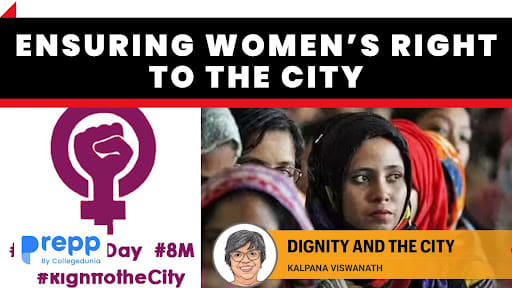
- This article highlights the challenges faced by women despite urbanization.
- In India, where urbanization is rapidly increasing, gender inequities persist due to fear, violence, and exclusion faced by women.
- Urban planning often neglects women's needs and realities, perpetuating their limited freedom and autonomy.
- The employment rate for women in India stands at less than 20%, in stark contrast to the rate of over 70% for men.
- The absence of a safe environment significantly impacts women's overall sense of well-being.
Table of Contents
Challenges Faced by Women
Violence and Fear
- The lack of safe public transport restricts women's access to opportunities, impacting their employment rates.
- In a 2021 ORF study across 140 Indian cities, 52% of women highlighted that they turned down opportunities for education and employment due to lack of safety.
- A 2017 World Bank study in Delhi showed that women were willing to travel for 27 minutes more to take a route that was considered to be safer.
- A 2019 Ola study revealed that only 9% of women from 11 cities felt it was safe to use public transport.
- In Mumbai, a study revealed that women commuters spent 21% more on transport than men due to personal safety.
Unequal burden of care
- Gender-based inequalities are exacerbated by the unequal distribution of care work. Indian women spend significantly more time on housework than men, contributing to their limited engagement in economic activities.
- The unacknowledged unpaid care work shapes women's urban experiences.
- A 2018 International Labour Organization (ILO ) stated that Indian women spend 297 minutes on housework a day, while men spend only 31.
- A 2021 Oxfam report showed that Indian women and girls put in 3.26 billion hours of unpaid care work daily.
- Recently, the Government has highlighted the issue of unpaid care and domestic work performed by women in India. Women, regardless of employment status, spend over 7 hours daily on domestic work, while men spend less than 3 hours.
What can be done?
- Holistic Perspective: Gender-responsive urban policies should be viewed as equity and inclusion issues, rather than just women's problems.
- Valuing Care Work: Awareness should be raised about the importance of unpaid domestic work, promoting gender equality and advocating for policy changes to recognize and value domestic work.
- Progressive Approaches: Cities have initiated measures like women-only transport and parks, free buses, and helplines. However, a comprehensive approach is needed that considers social and economic realities. Policymaking should be informed by diverse voices to create cities that benefit all residents.
Constitutional Safeguards for Welfare of Women
- Fundamental Rights: It guarantees all Indians the right to equality (Article 14), no discrimination by the State on the basis of gender (Article 15(1)) and special provisions to be made by the State in favour of women (Article 15(3)).
- Fundamental Duties: It ensures that practices derogatory to the dignity of women are prohibited under Article 51 (A).
Women Empowerment Schemes in India
- Beti Bachao Beti Padhao Scheme
- One Stop Centre Scheme
- UJJAWALA
- SWADHAR Greh
- NARI SHAKTI PURASKAR
- Mahila police Volunteers
- Mahila Shakti Kendras (MSK)
- NIRBHAYA Fund
(*Click this link to read prelims specific weekly current affairs articles)
FAQs
Question: What is Urbanization?
Answer:
Urbanization refers to the process by which an increasing proportion of a country's population migrates from rural areas to urban areas, leading to the growth and expansion of cities and towns.
Question: What is unpaid domestic work?
Answer:
Unpaid care and domestic work refers to work that is done in the home by family members for maintenance and well-being of family without pay. Such work includes household specific tasks like cooking, cleaning, washing clothes, household management and maintenance, child care, etc.
Question: What is the employment rate of women in India?
Answer:
Women’s employment in India is currently under 20 per cent compared to over 70 per cent for men.
UPSC Mains Practice Question:
|
Download the PREPP App and attempt FREE IAS Exam Mock Tests and get complete study material!

Full Test - 04: UPSC CSE Prelims CSAT (Paper-II)
Full Test - 03: UPSC CSE Prelims CSAT (Paper-II)
UPSC CSE Prelims 2026 GS Paper 1 Question Paper (24-May-2026)
UPSC CSE Prelims 2026 CSAT Paper 2 Question Paper (24-May-2026)

17 February 2025 | The Hindu Must Read Articles | Current Affairs

16 February 2026 | The Hindu Must Read Articles | Current Affairs

13 February 2026 | The Hindu Must Read Articles | Current Affairs









Comments