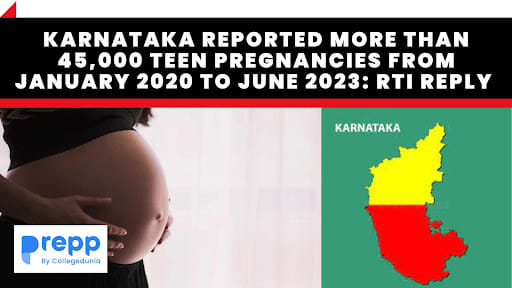
Karnataka Reported More Than 45,000 Teen Pregnancies From January 2020 To June 2023: RTI Reply
Relevance: GS 1 - Indian Society; GS 2 - Mechanisms, laws, institutions, and Bodies are constituted for the protection and betterment of these vulnerable sections; GS 4 - Right to Information
(Source: The Hindu, 08/09/23)
Click here for Daily Current Affairs
Why in the news?
- According to information obtained through an RTI request by Odanadi Seva Samsthe, an NGO dedicated to rescuing and rehabilitating sexually exploited women and children, the Commissionerate of Health and Family Welfare Services of Karnataka has revealed a significant increase in teenage pregnancies over the past three years.
- The total count of teenage pregnancies reported in Karnataka from January 2020 to June 2023 stands at 45,557.
- In the first half of 2023 alone, there have been an additional 2,736 reported cases of teenage pregnancies in the state.
- Teenage pregnancy is pregnancy in a woman 19 years of age or younger.
Table of Contents
Reasons
- Child marriage and child sexual abuse: Some families marry off their daughters to reduce their economic burden or earn income.
- Lack of access to contraceptives: In many places, barriers to obtaining and using contraceptives prevent adolescents from avoiding unintended pregnancies.
- Lack of information about sexual and reproductive health and rights.
- Lack of education or school drop-out.
Consequence of Teenage Pregnancy
- Pregnancy among underage girls will not only lead to discontinuation of their education
- Malnutrition: Teenage pregnancy poses a threat of malnutrition among mothers and children.
- Babies of adolescent mothers face higher risks of low birth weight, preterm birth, and severe neonatal condition.
- Health of Mother: Pregnant teens also have a higher chance of becoming anemic. Anemia is a reduction in the number of red blood cells (RBCs).
- Increases Inequity: Adolescent pregnancy tends to be higher among those with less education or of low economic status. Further, leading to increasing inequity.
Suggestions
- Family counseling and guidance: Underaged mothers not only require family counseling and guidance on taking care of the child, but also ensuring its survival and bringing them into the mainstream.
- The government needs to pay attention to these aspects arising out of teenage pregnancies.
- Awareness: Utilizing mass media campaigns to promote safer sex may reduce teen pregnancy and improve outcomes for youth who may be more likely to have a teen birth.
Steps taken by Government of Karnataka
- According to data from the Karnataka State Legal Services Authority (KSLSA), a total of 584 minor victims who suffered sexual violence were compensated over the last three years: 2020-21, 2021-22, and 2022-23.
- 2020-21: A compensation of ₹5.84 crore was provided to 219 minor victims, with 45 from Kalaburgi district alone.
- 2021-22: ₹5.29 crore was paid as compensation to 187 victims, including 23 from Ramanagaram district and 21 from Kalburgi district.
- 2022-23: In the most recent year, 2022-23, a compensation of ₹6.68 crore was disbursed to 178 victims, including 17 from each of the districts Mysuru, Dakshina Kannada, and Kolar.
Conclusion
- Preventing pregnancy among adolescents and pregnancy-related mortality and morbidity are foundational to achieving positive health outcomes across the life course and imperative for achieving the Sustainable Development Goals (SDGs) related to maternal and newborn health.
National Commission for Protection of Child Rights
|
(*Click this link to read prelims specific weekly current affairs articles)
FAQs
Question: What is Teenage Pregnancy?
Answer:
Teenage pregnancy is pregnancy in a woman 19 years of age or younger.
Question: What is the National Commission for Protection of Child Rights?
Answer:
It is a statutory body set up under the Commissions for Protection of Child Rights (CPCR) Act, 2005. It works under the Ministry of Women & Child Development.
The Commission ensures that all Laws, Policies, Programmes, and Administrative Mechanisms align with the Child Rights perspective as enshrined in the Constitution of India and also the UN Convention on the Rights of the Child.
Question: What is the Right to Information Act?
Answer:
The right to Information is a fundamental right embedded in article 19(1) of the Indian Constitution which specifies that every citizen has freedom of speech and expression.
UPSC Mains Practice Question:
|
MCQ
Question: With reference to the National Commission for Protection of Child Rights, Consider the following statements:
- The National Commission for Protection of Child Rights is a statutory body set up under the Commissions for Protection of Child Rights (CPCR) Act, 2005.
- It works under the Ministry of Women & Child Development.
Which of the above statements is/are correct?
(a) 1 only
(b) 2 only
(c) Both 1 and 2
(d) Neither 1 nor 2
Answer: (c) See the Explanation
- National Commission for Protection of Child Rights is a statutory body set up under the Commissions for Protection of Child Rights (CPCR) Act, 2005. It works under the Ministry of Women & Child Development. Hence, statement 1 is correct.
- The Commission ensures that all Laws, Policies, Programmes, and Administrative Mechanisms align with the Child Rights perspective as enshrined in the Constitution of India and also the UN Convention on the Rights of the Child. Hence, statement 2 is correct.
- Therefore, option (c) is the correct answer.
Download the PREPP App and attempt FREE IAS Exam Mock Tests and get complete study material!

Full Test - 04: UPSC CSE Prelims CSAT (Paper-II)
Full Test - 03: UPSC CSE Prelims CSAT (Paper-II)
UPSC CSE Prelims 2026 GS Paper 1 Question Paper (24-May-2026)
UPSC CSE Prelims 2026 CSAT Paper 2 Question Paper (24-May-2026)

17 February 2025 | The Hindu Must Read Articles | Current Affairs

16 February 2026 | The Hindu Must Read Articles | Current Affairs

13 February 2026 | The Hindu Must Read Articles | Current Affairs









Comments