How The Current Lunar Missions Differ From The Last Moon Rush
Relevance: GS 3 - Awareness in the field of Space
(Source: Indian Express, 08/09/23)
Click here for Daily Current Affairs
Why in the news?
Chandrayaan-3 is scheduled to land on the moon around August 23 or 24, followed closely by Russia's Luna 25 and Japan's SLIM, with its launch set for August 26. This article discussed how the current wave of missions is vastly different from the space race of the 1960s.
Table of Contents
How The Current Lunar Missions Differ From The Last Moon Rush?
Past lunar mission
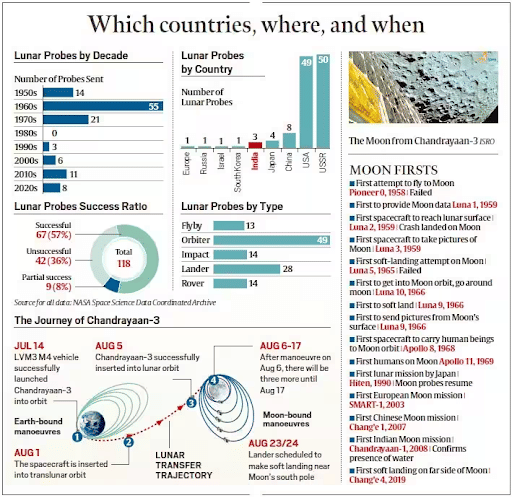
- Competition during the cold-war era: The space race ignited after the Soviet Union's Sputnik launch in 1957, resulting in multiple attempts to reach the moon within three years. Notable successes included Luna 3 capturing lunar images in 1959.
- The 1960s witnessed intense rivalry, climaxing with Apollo 11's historic moon landing in 1969. Over 55 missions were launched during this decade.
- However, lunar missions came to an abrupt halt after the Apollo 11 missions, and there were no further attempts until Japan's mission in 1990.
- More expensive and less efficient: Those missions were intrinsically unsustainable as they were extremely expensive, massively energy-intensive, and very risky.
- The failure rate was very high, almost 50 per cent.
Current lunar mission
- A Global Endeavor: The current wave of lunar exploration involves not just the United States and Russia, but also Japan, China, India, South Korea, and Israel, with other countries showing interest.
- From Competition to Cooperation: Unlike the earlier space race, the current lunar missions aim to harness the moon's resources and create sustainable pathways for deeper space exploration.
- Establishing a permanent lunar station is now within the realm of possibility in the next few decades.
- Advancement in technology: Advancements in technology and materials have made lunar missions more cost-effective and safer, with no complete failures since their resumption in 1990.
Conclusion
- The current wave of lunar missions signals a shift from a rivalry-driven space race to a cooperative pursuit of cosmic understanding. The focus on sustainable exploration, resource utilization, and potential colonization highlights the evolution of space exploration and humanity's quest to unravel the mysteries of the cosmos.
(*Click this link to read prelims specific weekly current affairs articles)
FAQs
Question: What is Chandrayaan-3 ?
Answer:
Chandrayaan-3 is a follow-on mission to Chandrayaan-2 to demonstrate end-to-end capability in safe landing and roving on the lunar surface.
Question: What is the significance of the South pole of the Moon?
Answer:
Moon's South Pole, also known as the lunar south pole is of special interest to scientists because of the occurrence of water ice in permanently shadowed areas around it. The lunar south pole has craters on its surface that are unique in their own way, as sunlight is not able to reach their interiors.
Question: What is Smart Lander for Investigating Moon (SLIM)?
Answer:
The Smart Lander for Investigating Moon (SLIM) is a Japanese Aerospace Exploration Agency (JAXA) mission designed to demonstrate accurate lunar landing techniques by a small explorer, with the objective of acceleration of the study of the Moon and planets using lighter exploration systems.
MCQ
Question: Which of the following pair(s) is/are correctly matched? (2014)
| Spacecraft | Purpose |
|---|---|
| 1.Cassini-Huygens | Orbiting the Venus and transmitting data to the Earth |
| 2.Messenger | Mapping and investigating the Mercury |
| 3.Voyager | Exploring the outer solar system |
Select the correct answer using the code given below.
(a) 1 only
(b) 2 and 3 only
(c) 1 and 3 only
(d) 1, 2 and 3
Answer: (b) See the Explanation
- Cassini a common name for Cassini-Huygens mission was a joint venture of NASA, the European space agency and Italian space agency. The motive behind was to study the Saturn and its system. Hence, pair 1 is incorrect
- MESSENGER (Mercury Surface, Space Environment, Geochemistry and Ranging) was the seventh Discovery-class mission, and the first spacecraft to orbit Mercury. Hence, pair 2 is correct.
- The mission objective of the Voyager Interstellar Mission (VIM) is to extend the NASA exploration of the solar system beyond the neighborhood of the outer planets to the outer limits of the Sun's sphere of influence, and possibly beyond. Hence, pair 3 is correct
- Therefore, option (b) is the correct answer.
Download the PREPP App and attempt FREE IAS Exam Mock Tests and get complete study material!

Full Test - 04: UPSC CSE Prelims CSAT (Paper-II)
Full Test - 03: UPSC CSE Prelims CSAT (Paper-II)
UPSC CSE Prelims 2026 GS Paper 1 Question Paper (24-May-2026)
UPSC CSE Prelims 2026 CSAT Paper 2 Question Paper (24-May-2026)

17 February 2025 | The Hindu Must Read Articles | Current Affairs

16 February 2026 | The Hindu Must Read Articles | Current Affairs

13 February 2026 | The Hindu Must Read Articles | Current Affairs









Comments