Issue Norms For Sex Selective Surgeries On Intersex Infants
Relevance: GS2 - Issues relating to development and management of Social Sector/Services relating to Health; Social Justice
(Source: The Hindu, 09/08/2023)
Click here for Daily Current Affairs
Why in the news?
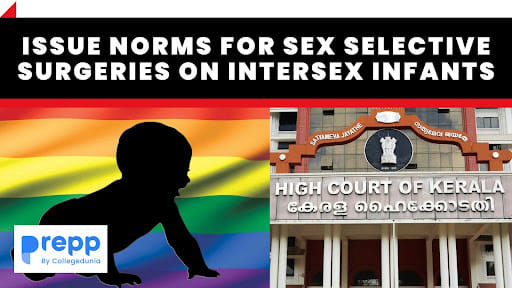
- Recently, the Kerala High Court has instructed the State Government to create a regulation within three months regarding sex-selective surgeries on intersex infants and children.
- The High Court issued this directive in response to a plea by a couple (petitioners) seeking permission for genital reconstructive surgery for their 7-year-old child.
- The child was born with ambiguous genitalia (congenital adrinal hyperplasia) and the parents wanted to raise the child as female.
Table of Contents
What does Intersex mean?
- Intersex refers to individuals born with diverse physical and biological characteristics that do not fit traditional male or female definitions.
- This condition arises from challenges in classifying reproductive organs as strictly male or female. While typical male and female genetics involve XY and XX chromosomes, intersex individuals exhibit over 40 variations.
- Gender assignment isn't solely determined by X and Y chromosomes; numerous genes influence development, and mutations in these genes can lead to atypical gender development in fetuses.
What is Sex-Selective Surgeries?
- Sex-selective surgeries involve medical procedures performed on intersex infants, who may not display all biological differences at birth.
- Parents often feel compelled to determine the baby's gender and choose one when certain differences are noticeable. However, they might not realize that the child will naturally develop a sexual identity as they grow.
- Rushing this decision can lead to physical and emotional challenges, causing confusion and identity-related issues for the child.
Challenges regarding Sex Selective Surgeries
- Informed Consent: Intersex infants are often unable to provide informed consent for these surgeries. Decisions made by parents or medical professionals may not align with the child's future identity and preferences.
- Long-Term Effects: Early surgeries can lead to long-term physical and emotional consequences, including pain, loss of sensation, sexual dysfunction, and psychological distress stemming from a mismatch between the assigned gender and personal identity.
- Human Rights Violation: These surgeries violate human rights principles, including the right to bodily integrity and the right to not be subjected to harmful medical procedures without full understanding and consent.
- The high court stated that allowing the petitioners to go ahead with the surgery on their child would impinge upon the child's rights under Articles 14 (equality before the law) 19 (freedom of speech) and 21 (protection of life and liberty) of the Constitution of India and conducting the surgery without consent would violate the child's dignity and privacy.
- Lack of Regulation: The lack of clear guidelines and regulations regarding sex-selective surgeries on intersex infants leaves room for arbitrary decision-making by medical professionals and parents.
Transgender Rights and Legal Framework
|
Way Forward
- There should be a growing call for more research, comprehensive guidelines, and ethical discussions surrounding sex-selective surgeries in intersex infants.
- Awareness campaigns should be launched to educate the public, parents, and medical professionals about intersex conditions, gender diversity, and the potential consequences of early sex-selective surgeries.
- Investment should be made in research to better understand the long-term physical, psychological, and social impacts of sex-selective surgeries on intersex individuals.
(*Click this link to read prelims specific weekly current affairs articles)
FAQs
Question: What is the difference between sex and gender?
Answer:
Sex refers to the biological characteristics of a person, particularly in relation to their reproductive anatomy and chromosomal composition.Gender is a social and cultural construct that encompasses the roles, behaviors, expectations, and identities associated with being male-female or non-binary.
Question: What is Sex-Selective Surgeries?
Answer:
Sex-selective surgeries involve medical procedures performed on intersex infants, who may not display all biological differences at birth.
Question: What is meant by Intersex?
Answer:
Intersex refers to individuals born with diverse physical and biological characteristics that do not fit traditional male or female definitions.
UPSC Mains Practice Question:
|
MCQ
Question: Right to Privacy is protected as an intrinsic part of Right to Life and Personal Liberty. Which of the following in the Constitution of India correctly and appropriately implies the above statement? (UPSC 2018)
(a) Article 14 and the provisions under the 42nd Amendment to the Constitution.
(b) Article 17 and the Directive Principles of State Policy in Part IV.
(c) Article 21 and the freedoms guaranteed in Part III.
(d) Article 24 and the provisions under the 44th Amendment to the Constitution.
Answer: (c) See the Explanation
Article 21: The right to privacy is protected as an inherent part of the right to life and personal liberty under Article 21 and as part of the freedoms guaranteed by Part III of the Constitution.
Therefore, option (c) is the correct answer.
Question: Granting permission for genital reconstructive surgery without consent could violate which rights guaranteed by the Indian Constitution?
(a) Freedom of religion and expression
(b) Right to education and equal treatment
(c) Right to life and liberty, and protection of dignity and privacy
(d) Right to property and self-defense.
Answer: (c) See the Explanation
Allowing permission for genital reconstructive surgery could infringe upon the rights outlined in Articles 14 (equality before the law), 19 (freedom of speech), and 21 (protection of life and liberty) of the Constitution. Performing such surgery without proper consent would also undermine the child's dignity and privacy.
Therefore, option (c) is the correct answer.
Download the PREPP App and attempt FREE IAS Exam Mock Tests and get complete study material!

Full Test - 04: UPSC CSE Prelims CSAT (Paper-II)
Full Test - 03: UPSC CSE Prelims CSAT (Paper-II)
UPSC CSE Prelims 2026 GS Paper 1 Question Paper (24-May-2026)
UPSC CSE Prelims 2026 CSAT Paper 2 Question Paper (24-May-2026)

17 February 2025 | The Hindu Must Read Articles | Current Affairs

16 February 2026 | The Hindu Must Read Articles | Current Affairs

13 February 2026 | The Hindu Must Read Articles | Current Affairs









Comments