Civil Court – Indian Polity Notes
Civil court is a judicial organisation that deals with civil cases. The civil court's goal is to hear civil cases. Civil courts hear civil matters. Except in criminal procedures, nearly all civil law matters. In each district, there are two types of legal courts: the Civil Court and the Criminal Court. A civil case is filed in a civil court. It comprises one person, or plaintiff, filing a complaint against another person, or defendant, whom they believe has harmed or injured them.
This article explains the Civil court is important for UPSC IAS exam preparation.
|
Table of Contents |
Civil court - Definition
- Civil courts deal with cases or offences committed against private individuals rather than the state, as opposed to criminal courts, which deal with offences committed against the state.
- Civil Courts have jurisdiction over cases committed within their jurisdiction as well as those that fall within the court's pecuniarylimits.
- When one person or entity sues another person or entity, civil law is applied. Civil litigation includes divorce, eviction, consumer problems, debt, and bankruptcy.
- Judges in civil and criminal courts have a variety of duties. While a criminal court judge can sentence a convicted person to jail, a civil court judge can order the guilty to pay fines, etc.
- Part VI of the Constitution (Articles 233–237) containtheprovisions to govern the organisation of subordinate courts and ensure their independence from the executive.
Hierarchy of Courts
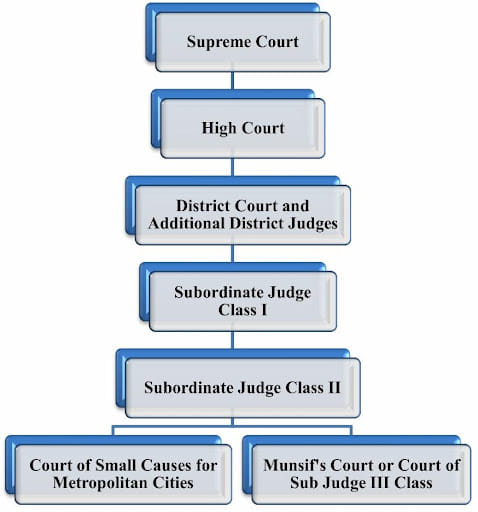
- In India, there are different levels of judiciary—different types of courts, each with varying powers based on the tier and jurisdiction bestowed upon them.
- They are arranged in a hierarchy of importance based on the order of the courts in which they sit, with the Supreme Court of India at the top, followed by High Courts of respective states, District Judges sitting in District Courts, Magistrates of Second Class, and Civil Judge (Junior Division) at the bottom.
- The district judges' court is the highest civil court in a district. It has both judicial and administrative authority.
- It has the authority to superintend the courts under its control.
- The District Judge's court is located at the district headquarters.
- It has the authority to hear both civil and criminal cases. As a result, he is appointed as the District and Sessions Judge.
- The courts of Sub-judge, Additional Sub-Judge, and Munsif are located in the sub-divisional and district headquarters and are beneath the District Judge's court. The majority of civil cases are filed in the Munsif court.
- A case can be appealed from the Munsif's court to the court of the Sub-Judge or the Additional Sub-Judge. Appeals from the courts of the sub-Judges and Additional sub-Judges will be heard in the District Court.
- The District Judge's Court has both original and appellate jurisdiction. An appeal may be filed in the High Court against the District Judge's decision.
Civil Courts - Provisions
- Under Article 235 of the Constitution of India, the administrative control over the members of subordinate judicial service vests with the concerned High Court.
- Further, in the exercise of powers conferred under Article 309 read with Article 233 and 234 of the Constitution, the State Government shall frame rules and regulations in consultation with the High Court exercising jurisdiction in relation to such state.
- Section 9 underthe Code of Civil Procedure addresses the jurisdiction of civil courts. It declares that the court shall have jurisdiction to try all civil lawsuits, except those whose cognizance is expressly or implicitly barred.
| Article | Provision |
|---|---|
| Article 233 | Appointment of district judges |
| Article 233A | Validation of appointments of, and judgments, etc., delivered by certain district judges |
| Article 234 | Recruitment of persons other than district judges to the judicial service |
| Article 235 | Control over subordinate courts |
| Article 236 | Interpretation |
| Article 237 | Application of the provisions of this Chapter to certain class or classes of Magistrates |
Civil Courts - Jurisdiction
- Subject Matter Jurisdiction: It is the authority vested in the court to try and hear cases of a specific type and pertaining to a specific subject matter.
- Territorial Jurisdiction: A court's authority is limited to its territorial and geographical boundaries, and it cannot exercise authority beyond those boundaries.
- Pecuniary Jurisdiction: Pecuniary Jurisdiction refers to whether a court has the authority to hear cases and suits based on the monetary value/amount of the case or suit in question.
- Appellate Jurisdiction: It refers to a court's authority to hear or review a case that has already been decided by a lower court. Higher courts generally have appellate jurisdiction. In India, both the High Courts and the Supreme Court have appellate jurisdiction to hear cases brought before them in the form of an appeal. They have the option of overturning the lower court's decision.
Civil Courts - Significance
- Civil cases are dealt within civil courts. Except in criminal cases, almost all cases arereferredto civil courts.
- It has judicial and administrative powers, as well as superintendence over the courts within its jurisdiction. He has original and appellate jurisdiction.
- Cases involving funds in excess of a specific threshold can be heard in his court. He also has the power to hear appeals from lower courts.
- When one person sues another person or entity, civil law is applied. Divorce, eviction, consumer problems, debt, or bankruptcy are all examples of civil cases.
- Judges in civil and criminal courts have varying levels of authority. While a judge in a criminal court can sentence the convicted person to prison, a judge in a civil court can order the guilty to pay fines, etc.
Civil Courts - Criticism
- There is a huge shortage of judges. In 2018, the subordinate courts were short 5748 judicial officers.
- The lower judiciary has a working strength of 16,726 while the approved strength is much higher at 22,474.
- In April 2018, over three crore cases were pending in the Supreme Court, High Courts, and subordinate courts (including district courts).
- Over 86 percent of these cases are pending in subordinate courts.
- The country's courts lack basic facilities for litigants. Most subordinate courts are devoid of basic infrastructure for judges, court personnel, and litigants.
- Subordinate Courts are also overburdened.
- They are frequently unduly influenced by the executive, which impedes the cause of impartial justice.
- The parties and their counsel's frequent adjournments cause the civil and criminal cases to drag on. The judges have a habit of granting adjournment on a regular basis.
- Litigation, particularly civil litigation, is prohibitively expensive and out of reach for the average person. People are sometimes forced to abandon legitimate claims in order to avoid suffering injustice as a result of the high cost of justice.
- Corrupt practices at the Bar and clerical level interference in the courts undermine the purpose of the rule of law and justice.
- Touts and professional witnesses are seen wandering around courts looking for their clients. The uninformed and illiterate litigant is easy prey for their shady tactics.
- Many of the existing laws, many of which are over a century old, have become obsolete and out of date. As a result, they must be repealed or amended.
Conclusion
The Indian Constitution established the basis for the existing legal system, and the judicial system gets its powers from it. In India, there are numerous levels of judiciary—different sorts of courts, each with distinct powers based on the tier and jurisdiction given upon it. Subordinate Courts are an important part of the Indian legal system. They help to ensure that the country's enormous population receives justice on schedule. As a result, the Constitution's framers gave Subordinate Courts an important role.
| Other Relevant Links | |
|---|---|
| Indian Polity UPSC Notes | Indian Judiciary |
| Supreme Court | High Court |
| Subordinate Courts | Tribunals |
| International Courts | Components of Redressal Mechanism |
FAQs
Question: What is a Civil Court in India?
Answer: A Civil Court in India is a legal institution that handles civil cases, which involve disputes between individuals or organizations relating to property, contracts, family matters, personal disputes, and more. These courts operate under the Indian judiciary system, ensuring the enforcement of legal rights, contracts, and agreements and providing a legal remedy for civil wrongs.
Question: What types of cases are handled by Civil Courts?
Answer: Civil Courts handle a variety of cases, including:
- Property disputes: Disputes related to ownership, possession, and inheritance of property.
- Family law matters: Cases concerning marriage, divorce, child custody, maintenance, and adoption.
- Contractual disputes: Cases involving breach of contracts or agreements.
- Torts and personal disputes: Civil wrongs such as defamation, negligence, or injury.
- Recovery of money: Cases involving loans, debts, or financial claims.
Question: What is the structure of Civil Courts in India?
Answer: The structure of Civil Courts in India is hierarchical:
- District Courts: The highest civil court in each district, headed by the District Judge, who has the authority to hear and decide appeals from lower courts.
- Subordinate Courts: These include Munsif Courts, Civil Judge Junior Division, and Civil Judge Senior Division, which handle cases depending on the value and nature of the dispute.
- High Courts: High Courts serve as appellate courts for cases that are heard in the District Courts and provide a final appeal in many civil matters.
Question: What is the role of the District Court in the Civil Court system?
Answer: The District Court plays a central role in the Civil Court system, acting as the highest civil court in the district. It is responsible for handling civil suits of a higher value, hearing appeals from subordinate courts, and providing a forum for resolving more complex or serious civil matters. The District Judge presides over the court and ensures that justice is delivered according to the law.
Question: What is the procedure followed in Civil Courts?
Answer: The procedure in Civil Courts is governed by the Civil Procedure Code (CPC), 1908, which lays down the process for filing suits, summons, evidence, and appeals. A typical procedure includes the filing of a plaint (complaint), issuance of summons to the defendant, the submission of written statements, evidence submission, and ultimately, a judgment by the court. The losing party may appeal the decision in a higher court.
MCQs
- What is the primary function of Civil Courts in India?
a) To hear criminal cases
b) To resolve disputes between individuals or organizations regarding property and personal matters
c) To conduct investigations into criminal offenses
d) To enforce criminal law
Answer: (B) See the Explanation
Civil Courts are responsible for resolving disputes related to civil matters such as property, contracts, family disputes, and personal rights.
- Who heads a District Civil Court in India?
a) Chief Justice
b) District Judge
c) Magistrate
d) High Court Judge
Answer: (B) See the Explanation
A District Court is headed by a District Judge, who oversees civil and criminal cases within the district and also hears appeals from subordinate courts.
- Which of the following acts governs the procedure of Civil Courts in India?
a) Indian Penal Code, 1860
b) Criminal Procedure Code, 1973
c) Civil Procedure Code, 1908
d) Indian Evidence Act, 1872
Answer: (C) See the Explanation
The Civil Procedure Code (CPC), 1908, governs the procedure to be followed by Civil Courts in India for filing suits, issuing summons, and conducting trials.
- What kind of disputes do Civil Courts NOT deal with?
a) Property disputes
b) Family law matters
c) Breach of contracts
d) Murder cases
Answer: (D) See the Explanation
Civil Courts do not deal with criminal cases like murder, which are handled by Criminal Courts. Civil Courts focus on non-criminal matters like property disputes, contracts, and family law.
- In which court can an individual appeal after a District Court judgment?
a) High Court
b) Subordinate Court
c) Sessions Court
d) Civil Judge Senior Division
Answer: (A) See the Explanation
After a District Court judgment, an individual can appeal to the High Court, which serves as the appellate court for civil matters.
GS Mains Questions and Model Answers
Q1: Discuss the role of Civil Courts in India’s judicial system.
Answer: Civil Courts play a vital role in India’s judicial system, providing an essential forum for resolving non-criminal disputes between individuals, organizations, or the state. The primary function of Civil Courts is to adjudicate matters related to property, family, contracts, torts, and other personal disputes. These courts ensure the enforcement of legal rights and the resolution of conflicts by applying the principles of civil law.
The Civil Court system is structured in a hierarchical manner, with District Courts at the top, followed by various subordinate courts, such as Munsif Courts and Civil Judge Courts, handling cases of different complexities and value. This structure ensures that cases are heard and resolved in an efficient and organized manner, with higher courts serving as appellate bodies for cases that require further examination.
The procedures followed in Civil Courts, as outlined by the Civil Procedure Code (CPC), provide a transparent and standardized process for filing suits, presenting evidence, and delivering judgments. The District Judge, heading the District Court, ensures that justice is delivered and also serves as the final authority in appeals from subordinate courts. The accessibility of Civil Courts to citizens ensures that they have the means to resolve disputes and seek legal remedies, which is a critical component of India’s democracy and rule of law.
Q2: Evaluate the significance of the Civil Procedure Code (CPC), 1908, in the functioning of Civil Courts in India.
Answer: The Civil Procedure Code (CPC), 1908, is a cornerstone of India’s civil justice system and plays a crucial role in the functioning of Civil Courts. The CPC lays down the procedural rules and regulations that govern civil litigation in India, ensuring a structured, systematic, and transparent approach to resolving disputes. It sets out the procedures for filing a suit, serving summons, submitting written statements, presenting evidence, and delivering judgments.
One of the most significant contributions of the CPC is that it provides a uniform and comprehensive framework for handling civil cases across the country, ensuring consistency in the application of law. This helps maintain fairness and transparency in the judicial process. The CPC also includes provisions for appeals, which are crucial for ensuring that justice is not only delivered but also reviewed for fairness. The appeal process ensures that higher courts can examine the decisions of lower courts and correct any judicial errors.
Q3: How do Civil Courts contribute to the maintenance of law and order in society?
Answer: Civil Courts play an essential role in the maintenance of law and order in society by ensuring that disputes between individuals, organizations, and the government are resolved in a lawful and orderly manner. The resolution of civil disputes through legal processes helps prevent the escalation of conflicts and promotes social harmony by upholding the rule of law.
By providing a legal forum for resolving property disputes, contractual issues, family matters, and tort cases, Civil Courts help maintain peace in society. For instance, family law cases such as divorce, maintenance, and child custody are settled through the courts, preventing individuals from resorting to extrajudicial measures or personal vengeance. Similarly, property disputes, which could lead to violence, are handled by the Civil Courts, ensuring that rightful ownership is determined through legal means rather than conflict.
Civil Courts also contribute to economic stability by enforcing contracts and ensuring that individuals and businesses adhere to legal agreements. This fosters trust in the legal system and encourages economic transactions. Moreover, the court’s ability to ensure the protection of property rights and personal freedoms reinforces the principles of justice and equity, which are foundational to law and order in society. Through their fair and impartial adjudication, Civil Courts contribute significantly to the peaceful resolution of disputes, thereby preventing the breakdown of societal order and promoting respect for the law.
Previous Year Questions on Civil Courts
1. UPSC CSE 2020
Question: Analyze the role of Civil Courts in ensuring justice and resolving disputes in India.
Answer: Civil Courts are central to ensuring justice and resolving disputes in India. They provide a structured, legal avenue for individuals and organizations to address grievances related to property, family matters, contracts, and other civil issues. The role of these courts is crucial in maintaining social harmony by ensuring that disputes are settled fairly and in accordance with the law.
The Civil Courts system is hierarchical, starting with lower courts such as the Munsif and Civil Judge Courts, progressing to District Courts, and finally, the High Courts. This structure ensures that disputes are heard at appropriate levels, with avenues for appeals and reviews. The procedure followed in these courts, governed by the Civil Procedure Code (CPC), ensures fairness and transparency in the resolution of cases.
Civil Courts also help in promoting economic stability by upholding the sanctity of contracts, enforcing property rights, and ensuring that individuals and businesses can operate within a framework of legal certainty. By resolving disputes in a timely and equitable manner, Civil Courts contribute significantly to the overall legal and social order in India.
2. UPSC CSE 2018
Question: What are the functions of Civil Courts in India, and how do they contribute to the Indian judicial system?
Answer: Civil Courts in India play a vital role in the Indian judicial system by handling disputes that arise between individuals, organizations, or the state on civil matters. These courts function to adjudicate on issues such as property disputes, contracts, torts, family matters, and money recovery, among others. The judicial process within Civil Courts ensures that legal rights and obligations are upheld, thus contributing to social order and harmony.
Civil Courts offer a structured legal platform for resolving disputes, and their decisions are binding, providing a sense of security and justice to citizens. The role of the District Courts, which serve as the highest civil courts in districts, is particularly significant as they handle a wide range of cases and appeals. The hierarchical structure of the Civil Court system ensures that cases are handled according to their complexity and value, with a clear process for appeals and reviews.
By enforcing laws, upholding property rights, and offering remedies for civil wrongs, Civil Courts contribute to the rule of law and maintain a legal framework that supports personal and economic growth. These courts are essential for safeguarding the rights of individuals and maintaining justice in the country.
Download the PREPP App and attempt FREE IAS Exam Mock Tests and get complete study material!

Full Test - 04: UPSC CSE Prelims CSAT (Paper-II)
Full Test - 03: UPSC CSE Prelims CSAT (Paper-II)
UPSC CSE Prelims 2026 GS Paper 1 Question Paper (24-May-2026)
UPSC CSE Prelims 2026 CSAT Paper 2 Question Paper (24-May-2026)

17 February 2025 | The Hindu Must Read Articles | Current Affairs

16 February 2026 | The Hindu Must Read Articles | Current Affairs

13 February 2026 | The Hindu Must Read Articles | Current Affairs









Comments