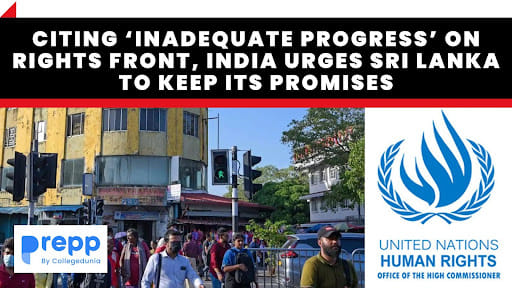
Citing ‘Inadequate Progress’ On Rights Front, India Urges Sri Lanka To Keep Its Promises
(Source: The Hindu, 09/13/2023)
Click here for Daily Current Affairs
Why in the news?
- Recently, India urged Sri Lanka to keep its promises to fulfill the aspirations of the Tamil people and ensure the protection of the fundamental freedoms and human rights of all its citizens.
- The Office of the United Nations High Commissioner for Human Rights (OHCHR) recently reported that Sri Lanka had not succeeded in reconciling the ethnic conflict that triggered the civil war in the country.
Table of Contents
What has India said on the Sri Lankan issue?
- At the 54th session of the UN Human Rights Council in Geneva, the Indian representative claimed during the Interactive Dialogue that Sri Lanka had not made adequate progress on its commitments to protect the human rights and fundamental freedoms of its citizens.
- India had previously highlighted the lack of measurable progress in Sri Lanka’s promised political solution to the long-pending Tamil national question in 2022.
- Voting: Although the ongoing session of the Human Rights Council will not include a vote on a resolution on Sri Lanka, it will review the country’s commitments and progress made.
Previous resolutions
- In 2009, after the end of the civil war, Sri Lanka moved a resolution urging the international community to help with financial assistance towards rebuilding.
- It also contained a commitment to finding a political solution to the 13th Amendment for lasting peace and reconciliation.
- India voted in favor of the resolution.
- In 2012, the US moved a resolution that the Lessons Learnt and Reconciliation Commission (LLRC) did not address the allegations of violations of international law and urged Sri Lanka to implement the “constructive” recommendations.
- India voted in favor of the resolution.
- In 2013, India voted against Sri Lanka and urged it to fulfill its commitments on political devolution and accountability for human rights violations and civilian deaths.
- In 2014, India abstained from resolution 25/1 which called for an independent and credible investigation and asked Sri Lanka to reveal the results of its investigations into alleged violations by security forces, attacks on journalists, human rights defenders, and religious minorities.
- In 2016, the United Nations Human Rights Council adopted by consensus a resolution calling on Sri Lanka to establish a credible accountability mechanism, with the involvement of Commonwealth and foreign judges, prosecutors, and investigators.
- In 2020 Sri Lanka announced that it was pulling out of the Resolution (30/1), and that it would set up its own justice and redressal mechanisms to address all issues.
- In 2021, India abstained from voting on a UNHRC resolution that criticized Sri Lanka and aimed to establish a central international database to enable future persecution of war crimes.
- In 2022, the UN Human Rights Council adopted a resolution urging Sri Lanka to fulfill its commitments related to the devolution of political authority and hold provincial elections.
- India abstained from voting.
Unresolved conflict
OHCHR report
- The latest report of the Office of the United Nations High Commissioner for Human Rights (OHCHR) on ‘Promoting reconciliation, accountability, and human rights in Sri Lanka’ had not been able to settle the ethnic conflict in the country fourteen years after the end of the civil war.
- The Report recognized the initiatives undertaken by the Sri Lankan government for truth-seeking and reconciliation and recommended urgent confidence-building actions to ensure a genuine reconciliation and transitional justice process.
- The High Commissioner’s Office also highlighted the 2022 economic crisis as a consequence of its past impunity for human rights abuses, economic crimes, and corruption.
- The ‘Janatha Aragalaya’ (Sinhala for People’s Struggle) which had successfully removed the Rajapaksas amid an economic crisis had demanded deep-seated democratic and political reforms.
- However, this desired transformation has not yet been achieved.
- The Sri Lankan government has rejected the report, and termed earlier resolutions of the UN HRC intrusive and polarising.
Unfolding crisis
- Economic troubles: Sri Lanka was still impacted by soaring poverty levels and the continued crisis.
- An estimated 37% of Sri Lankan households face acute food insecurity.
- Political troubles: Limits have been placed on the political participation and freedom of expression of Sri Lankan citizens.
- Sri Lanka has not conducted local government elections or reconstituted the Provincial Councils under the 13th Amendment.
- Ethnic tensions: Tensions have escalated in north and east Sri Lanka due to land acquisition for expansion of military installations, Buddhist heritage conservation at Hindu or Muslim sites, and forestry protection.
India’s position on the Tamil crisis
- India has supported political and economic stability in Sri Lanka and urged Sri Lankan authorities to fulfill the aspirations of the Tamils.
- India has recommended reconciliation and the implementation of the 13th Amendment to ensure the protection of the fundamental freedoms and human rights of all Sri Lankans.
- India has also urged Sri Lanka to fulfill its commitments and conduct Provincial Council elections while ensuring a life of respect and dignity for the Tamils.
- In a meeting between the Indian Prime Minister Narendra Modi and Sri Lankan President Ranil Wickremesinghe in July 2023, the PM raised the issue of Tamil aspirations and urged Sri Lanka to implement the 13th Amendment.
India-Sri Lanka relations
- India and Sri Lanka have a long history of cultural, religious, and trade ties dating back to ancient times.
- The two countries share a strong cultural relationship based on people-to-people ties and the common cultural link of Buddhism.
Economic
- India is Sri Lanka’s largest trading partner accounting for 16% of Sri Lanka’s total global trade and overall bilateral merchandise trade of US$ 5.45 billion in 2021.
- The India-Sri Lanka Free Trade Agreement (ISFTA) that provides duty-free access and duty preferences for goods was signed in 1998 and came into force in 2000.
Defense
- Mitra Shakti: Joint military exercise
- SLINEX: India-Sri Lanka bilateral naval exercise.
- Colombo Security Conclave: A maritime military grouping of India, Sri Lanka, Maldives, and Mauritius
Multilateralism
Sri Lanka is also a member of India-led regional multilateral fora such as BIMSTEC and SAARC.
Challenges
- One of the major challenges in India-Sri Lanka ties is the killing of Indian fishermen by the Sri Lankan Navy.
- Growing Chinese investments and financial assistance to Sri Lanka are a major concern for India.
- Recently, Tamil Nadu has raised the demand for the return of Katchatheevu from Sri Lanka. It is an uninhabited and barren 285-acre islet about 14 nautical miles off Rameswaram that was ceded to Sri Lanka through the 'Indo-Sri Lankan Maritime Agreement' in 1974.
UN HRC
Structure
Mandate
|
OHCHR
Functions
|
(*Click this link to read prelims specific weekly current affairs articles)
FAQs
Question: What are human rights?
Answer:
Human rights are rights possessed by humans by virtue of their existence as human beings. They are universal and inherent to all regardless of nationality, sex, national or ethnic origin, color, religion, language, or any other status. They include the right to life, and the rights to food, education, work, health, liberty, etc.
Question: What is ethnicity?
Answer:
Ethnicity refers to a shared culture and a way of life which can be reflected in language, religion, material culture such as clothing and cuisine, and cultural products such as music and art. It is based on shared culture and does not necessitate same religion and nationality.
UPSC Mains Practice Question:
|
MCQs
Question: Consider the following statements:
- The value of Indo-Sri Lanka trade has consistently increased in the last decade.
- “Textile and textile articles” constitute an important item of trade between India and Bangladesh.
- In the last five years, Nepal has been the largest trading partner of India in South Asia.
Which of the statements given above is/are correct? (UPSC CSE 2020)
(a) 1 and 2 only
(b) 2 only
(c) 3 only
(d) 1, 2 and 3
Answer: (b) See the Explanation
- According to the Department of Commerce, the value of bilateral trade between India and Sri Lanka continuously fluctuated between 2007 and 2016. Although there has been an overall increase in trade value, it has not been consistent. Hence statement 1 is incorrect.
- Bangladesh has been a major textile trading partner for India, with a share of more than 5% in exports and over 7% in imports.
- The major items of exports are fiber and yarn of cotton, man-made staple fibers, and man-made filaments while major import items include apparel and clothing, fabric, and other made-up textile articles. Hence, statement 2 is correct.
- In the period, Bangladesh was India’s largest trading partner in South Asia, followed by Nepal, Sri Lanka, Pakistan, Bhutan, Afghanistan and Maldives. Hence, statement 3 is incorrect.
Therefore, option (b) is the correct answer.
Question: Which one of the following statements is correct? [UPSC CSE 1999]
(a) Kacchativu and Tin Bigha were territories acquired by the Indian Republic from the French
(b) Kacchativu and Tin Bigha are territories handed over to Sri Lankan and Bangladesh sovereignty respectively by the Government of India
(c) Kacchativu and Tin Bigha are areas that were annexed by the Chinese in the 1962 Sino-Indian war
(d) Kacchativu and Tin Bigha are enclaves which were transferred to India by less arrangements with Sri Lanka and Pakistan respectively
Answer: (b) See the Explanation
Kacchativu was handed over to Sri Lanka by India and Tin Bigha was handed over to Bangladesh.
Therefore, option (b) is the correct answer.
Download the PREPP App and attempt FREE IAS Exam Mock Tests and get complete study material!

Full Test - 04: UPSC CSE Prelims CSAT (Paper-II)
Full Test - 03: UPSC CSE Prelims CSAT (Paper-II)
UPSC CSE Prelims 2026 GS Paper 1 Question Paper (24-May-2026)
UPSC CSE Prelims 2026 CSAT Paper 2 Question Paper (24-May-2026)

17 February 2025 | The Hindu Must Read Articles | Current Affairs

16 February 2026 | The Hindu Must Read Articles | Current Affairs

13 February 2026 | The Hindu Must Read Articles | Current Affairs









Comments