Nipah Breaks Out Again In Kerala, Claims 2 Lives
Relevance: GS2 - Issues relating to the development and management of Social Sector/Services relating to Health
(Source: The Hindu, 09/13/2023)
Click here for Daily Current Affairs
Why in the news?
- The Nipah virus has resurfaced in Kerala, as two fatalities were recorded in Kozhikode district recently.
- Nipah virus is considered a public health threat due to its potential for rapid transmission, high mortality rate (40%–70%), and lack of specific treatment.
Table of Contents

What is Nipah Virus?
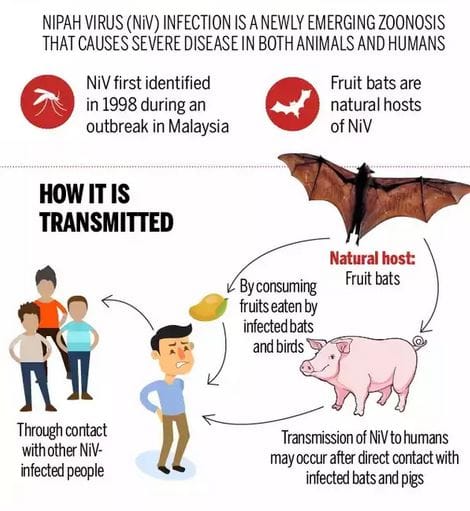
- Nipah is a zoonotic disease, which means it is transmitted to humans through infected animals or contaminated food.
- The virus belongs to a new genus termed Henipavirus (subfamily Paramyxovirinae).
- According to WHO, It can also be transmitted directly from person to person through close contact with an infected person.
- Currently, there are no vaccines for both humans and animals.
Origin and Discovery of Nipah Virus
- The first outbreaks of the Nipah virus among humans was reported from Malaysia (1998) and Singapore (1999).
- The virus takes its name from the village of Kampung Sungai Nipah in Malaysia where the person in whom the virus was first isolated died of the disease.
- In the Malaysian outbreak in 1999, a total of 265 people had been found infected, of whom 105 had died.
Transmission of the Virus
- Nipah virus is primarily transmitted to humans from animals, especially fruit bats (Pteropus species), which are considered the natural reservoir hosts. Pigs can also act as intermediate hosts.
- Human-to-human transmission can also occur through close contact with respiratory secretions, saliva, urine, or other bodily fluids of infected individuals.
- Consumption of fruits contaminated with bat saliva or urine has also been implicated in some cases.
What are the symptoms?
- Nipah virus infection can lead to a wide range of symptoms, including fever, headache, dizziness, drowsiness, and vomiting.
- In severe cases, it can progress to encephalitis (swelling of the brain), characterized by symptoms such as seizures, altered consciousness, and coma.
- Respiratory symptoms like cough and breathing difficulties may also occur.
What are the concerns?
- The Nipah virus is known to spread far more slowly than SARS-CoV-2, but it is its ability to kill that is the biggest concern.
- Since it was first identified in 1998-99, there have been multiple outbreaks of the Nipah virus, all of them in South and Southeast Asian nations. In Bangladesh, there have been at least 10 outbreaks since 2001.
- West Bengal: During the first outbreak in West Bengal’s Siliguri in 2001, 45 of the 66 people confirmed to have been infected died. That is a mortality rate of 68%.
- In the next outbreak, in Nadia district of West Bengal, in 2007, all the five infected people died.
- Kerala: During the 2018 outbreak in Kerala in 2018, 17 of the 18 patients confirmed to have been infected died. Recently, again there is an outbreak of the virus which has so far killed two people.
(*Click this link to read prelims specific weekly current affairs articles)
FAQs
Question: What is Nipah Virus?
Answer:
Nipah is a zoonotic disease, which means it is transmitted to humans through infected animals or contaminated food. The virus belongs to a new genus termed Henipavirus (subfamily Paramyxovirinae).
Question: Where was the first case of Nipah Virus reported?
Answer:
The first outbreaks of the Nipah virus among humans was reported from Malaysia (1998) and Singapore (1999). The virus takes its name from the village of Kampung Sungai Nipah in Malaysia where the person in whom the virus was first isolated died of the disease.
MCQ
Question: Consider the following statements: (UPSC 2017)
- In tropical regions, Zika virus disease is transmitted by the same mosquito that transmits dengue.
- Sexual transmission of Zika virus disease is possible.
Which of the statements given above is/are correct?
(a) 1 only
(b) 2 only
(c) Both 1 and 2
(d) Neither 1 nor 2
Answer: (c) See the Explanation
Zika virus is a flavivirus discovered in 1947 (monkeys) and 1952 (humans) in Uganda. It shares symptoms (fever, rash, conjunctivitis, joint pain, headache, malaise) and transmission (mosquitoes, mother-to-child, sexual) similarities with Dengue.
Therefore, option (c) is the correct answer.
Download the PREPP App and attempt FREE IAS Exam Mock Tests and get complete study material!

Full Test - 04: UPSC CSE Prelims CSAT (Paper-II)
Full Test - 03: UPSC CSE Prelims CSAT (Paper-II)
UPSC CSE Prelims 2026 GS Paper 1 Question Paper (24-May-2026)
UPSC CSE Prelims 2026 CSAT Paper 2 Question Paper (24-May-2026)

17 February 2025 | The Hindu Must Read Articles | Current Affairs

16 February 2026 | The Hindu Must Read Articles | Current Affairs

13 February 2026 | The Hindu Must Read Articles | Current Affairs









Comments