2,000 People Feared Dead In Flooding In Eastern Libya After Storm Daniel
Relevance: GS1 - Important Geophysical phenomena such as earthquakes, Tsunami, Volcanic activity, cyclone etc., GS3 - Disaster and disaster management
(Source: The Hindu, 09/12/2023)
Click here for Daily Current Affairs
Why in the news?
Recently, a Mediterranean storm named Daniel impacted Libya causing the death of nearly 2000 people in the eastern part of the country.
Table of Contents
Impact of Storm Daniel
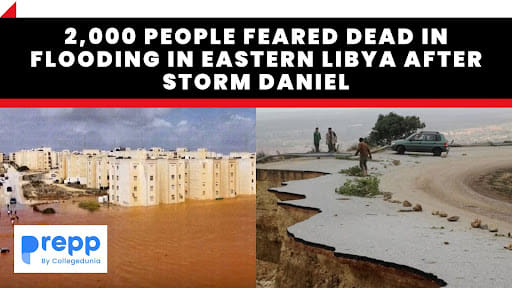
- The Mediterranean storm Daniel has caused devastating flash floods impacting large parts of Libya in North Africa.
- Daniel deposited 440 millimeters (15.7 inches) of rain on east Libya in a short span, possibly overwhelming the country’s infrastructure and causing the failure of the dam.
- Human-induced increases in water surface temperatures are likely to have intensified the effect of the storm.
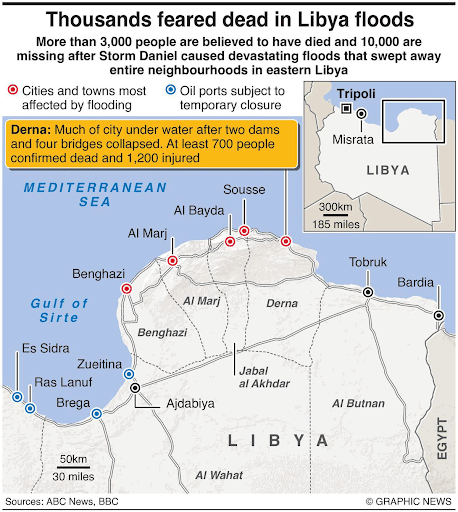
- As a result of the storm and consequent flash floods, two dams and four bridges in Derna collapsed.
- According to city officials of Derna, the floods have resulted in the destruction of at least 20% of the city.
- The Red Crescent claimed that around 10,000 people have been reported missing.
Relief work
- The US, Germany, Iran, Italy, Qatar, and Turkey have already promised or supplied aid.
- However, relief work in Libya is likely to be impacted by the Civil war between the Tripoli-based government and the east Libyan government controlled by military leader, Khalifa Hifter.
- Hifter is also backed by Egypt, Russia, Jordan, and the United Arab Emirates, while the West Libya administration is backed by Turkey, Qatar, and Italy.
- The Tripoli-based government has dispatched 14 tons of medical supplies and $412 million for reconstruction in the region while Egypt is coordinating with the Hifter regime to provide aid.
What are Medicanes?
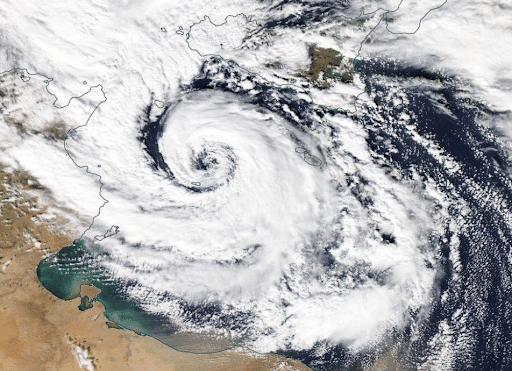
- Medicanes are extra-tropical hurricanes that are observed over the Mediterranean Sea.
- They are similar to hurricanes and have a central eye-like structure, which is the strongest part of the storm.
- Formation:
- Medicanes have been observed to form even at water temperatures of 15°C while normal hurricanes need temperatures of around 26°C to occur.
- They usually form between September and December.
- Impact of La Nina on formation:
- La Nina is characterized by the unusual cooling of the central and east-central equatorial Pacific Ocean.
- It produces more rain in the central-eastern part, where most of the Mediterranean cyclones develop.
- Characteristics:
- Medicanes occur more in colder waters than tropical cyclones, hurricanes, and typhoons.
- They have colder cores when compared to the warm cores of tropical cyclones.
- Therefore, tropical cyclones carry more moisture, are bigger in size, and have swifter winds.
- Destructive winds are not the major threat to life and property during a Medicane but heavy rains and flash floods are.
- Medicanes rarely achieve Category 1 hurricane strength (119 Kmph).
- Impact of climate change:
- Climate change is expected to make Medicanes less frequent but more stronger whenever they take place.
- The frequency of Medicanes will reduce as a result of global warming, as they are formed in cooler temperatures.
Flash floods
- Flash Floods are sudden surges in water levels during or after an intense spell of rain.
- They are highly localized events with short duration and very high peaks.
- There are usually less than six hours between the occurrence of the rainfall and peak flood when a flash flood occurs.
- They differ from river floods in terms of the scale of the event and the short time scales.
- This makes forecasting flash floods much more difficult than predicting traditional floods using conventional forecasting approaches.
- Flash floods are most likely to occur in urban areas as there are numerous hard surfaces in urban settlements that prevent rainwater from seeping into the ground.
Causes
- Flash floods are common in arid places that have just received precipitation.
- They also occur in areas close to volcanoes and soon after eruptions.
- Heavy rain caused by hurricanes, tropical storms, or the melting of ice dams can lead to flash floods.
- They can also be caused by human activity, such as dam discharge.
Effects
- It impacts the natural environment including vegetation, agriculture, geomorphology, and pollution.
- It causes humans to be trapped, injured, and killed when flash floods take place.
- It causes structural damage to bridges and roadways and makes travel impossible.
- Power, telephone, and cable lines are destroyed making communication difficult.
- It can contaminate groundwater and disrupt supplies, making tap water unfit for consumption.
Libya
|
(*Click this link to read prelims specific weekly current affairs articles)
FAQs
Question: What are hurricanes?
Answer:
Hurricanes are powerful and destructive tropical storms that are characterized by strong winds, heavy rainfall, and low atmospheric pressure. They are known as hurricanes in the Atlantic Ocean and eastern North Pacific, typhoons in the Northwestern Pacific, and cyclones in the South Pacific and Indian Ocean.
Question: What is La Nina?
Answer:
La Nina is the “cool phase” of the El Nino Southern Oscillation. It describes the unusual cooling of the tropical eastern Pacific and may last between one and three years. It tends to peak during the winter in the Northern Hemisphere.
UPSC Mains Practice Question:
|
MCQs
Question: La Nina is suspected to have caused recent floods in Australia. How is La Nina different from El Nino?
- La Nina is characterized by unusually cold ocean temperatures in the equatorial Indian Ocean whereas El Nino is characterized by unusually warm ocean temperatures in the equatorial Pacific Ocean.
- El Nino has an adverse effect on the southwest monsoon of India, but La Nina has no effect on the monsoon climate.
Which of the statements given above is/are correct? (UPSC CSE 2011)
(a) 1 only
(b) 2 only
(c) Both 1 and 2
(d) Neither 1 nor 2
Answer: (d) See the Explanation
- Both La Nina and El Nino are associated with the Pacific Ocean. Hence statement 1 is incorrect.
- La Nina is the opposite of El Nino and describes the situation when the West Equatorial Pacific becomes exceptionally warm and the East Equatorial Pacific becomes exceptionally cold.
- La Nina has an effect on the Indian monsoon and is associated with excess rainfall during the monsoon season. Hence statement 2 is incorrect.
Therefore, option (d) is the correct answer.
Download the PREPP App and attempt FREE IAS Exam Mock Tests and get complete study material!

Full Test - 04: UPSC CSE Prelims CSAT (Paper-II)
Full Test - 03: UPSC CSE Prelims CSAT (Paper-II)
UPSC CSE Prelims 2026 GS Paper 1 Question Paper (24-May-2026)
UPSC CSE Prelims 2026 CSAT Paper 2 Question Paper (24-May-2026)

17 February 2025 | The Hindu Must Read Articles | Current Affairs

16 February 2026 | The Hindu Must Read Articles | Current Affairs

13 February 2026 | The Hindu Must Read Articles | Current Affairs









Comments