Powerful Quake In Morocco Kills More Than 2,000 People And Damages Historic Buildings In Marrakech
Relevance: GS1 - Important Geophysical phenomena such as earthquakes, Tsunami, Volcanic activity, cyclone etc., GS3 - Disaster and disaster management
(Source: The Hindu, 09/09/2023)
Click here for Daily Current Affairs
Why in the news?
Recently, a 6.8 magnitude earthquake occurred in the northern part of Morocco on September 8th, 2023 causing around 3000 deaths.
Table of Contents
Impact of the earthquake
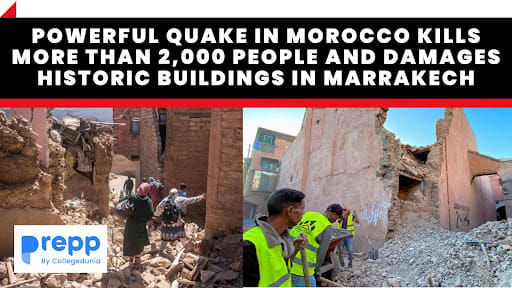
- The earthquake, which registered a magnitude of 6.8, was the biggest to hit the North African country in 120 years.
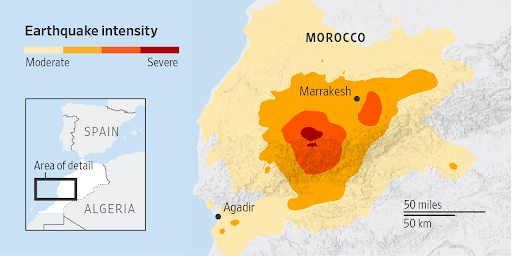
- Its epicenter was near the town of Ighil in Al Haouz Province, located in the Atlas mountains.
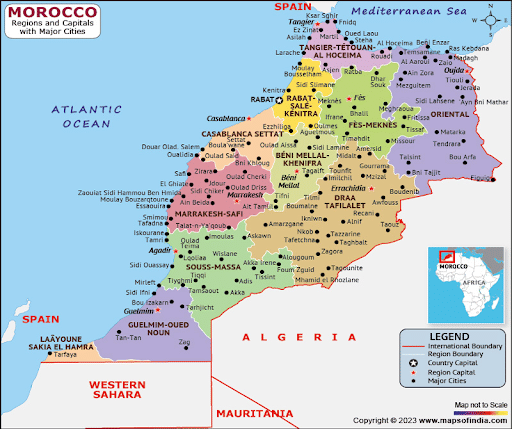
- It was felt in Ouarzazate, Marrakesh, Azilal, Chichaoua, and Taroudant and coastal cities like Rabat, Casablanca, Agadir, and Essaouira as well as Huelva and Jaen in southern Spain.
- In Marrakech, the 12th-century Koutoubia Mosque and the red walls surrounding the city, which is a UNESCO World Heritage Site, were damaged.
- The 69-meter (226-foot) minaret of the mosque is also known as the “Roof of Marrakech”.
- According to experts, the buildings in the region where earthquakes are not common were not constructed in an earthquake-resilient manner, resulting in high casualties.
What was the cause of the earthquake?
- According to researchers studying the High Atlas Mountains in Morocco, the earthquake was caused by a reverse fault, which is around 30 km long.
- The tectonic movement of the Eurasian and African plates towards each other is causing the High Atlas Mountains to be pushed together at a rate of about 1 millimeter per annum.
- This is evidenced by the presence of high peaks and steep slopes in the High Atlas Mountains.
- Earthquakes occur when there’s a sudden shift in rocks along a fault line, usually as a result of the release of stored energy that has been building up over time.
- No major earthquakes have been recorded previously in this region indicating that the stress from the plates pushing together has been building up.
- The built-up stress among the rocks is likely to have exceeded the capacity that the fault can handle, causing the earthquake to occur at Ighil, nearly 500 km from where the two plates meet.
- Experts suggest that aftershocks are likely to continue for months or years due to the extra stress experienced by faults.
Reverse fault
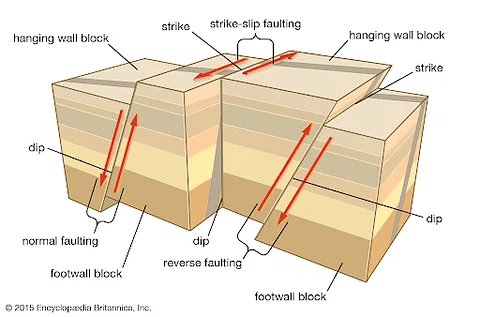
- A reverse fault occurs when one block of crust slides one on top of another.
- It occurs when tectonic plates collide which causes the Earth’s crust to thicken.
- They often occur at an angle to the surface of the Earth.
- Earthquakes are caused by the release of stress which is accumulated along these faultlines.
- These faults are usually found in collision zones, where tectonic plates push up mountain ranges such as the Himalayas and the Rocky Mountains.
Other types of faults
- Normal faults: This type of faulting involves the creation of space when two blocks of crust pull apart.
- This causes the crust to stretch into a valley stretching the crust into a valleylike shape.
- E.g.: Basin and Range Province in North America and the East African Rift Zone.
- Strike-slip faults: These involve rocks sliding past each other horizontally with little to no vertical movement.
- It is also known as transcurrent faults.
- E.g.: San Andreas and Anatolian Faults.
- Step Fault: These faults occur when the slopes of all the fault planes of all faults in an area are in the same direction.
- E.g.: The Rhine Valley is located on a step fault.
Mitigation measures
- It is difficult to predict the occurrence of earthquakes but their impact can be mitigated.
- Identify locations of active faults through integrated studies of the region’s geology, geophysics, and geodesy.
- Estimate how powerful the earthquakes on these faults could be and the frequency of their occurrence.
- This will help build an understanding of the strength of earthquakes in the area.
- Find and study faults that don’t have earthquakes often as a focus of seismic research so that the administration and the people can be well prepared.
- Infrastructure design and construction should be seismic resilient so that they can withstand the highest possible seismic activity.
- Traditional homes and rock constructions in the region must be reinforced to prevent future disasters and new constructions must be tested to satisfy seismic building standards.
Morocco
|
(*Click this link to read prelims specific weekly current affairs articles)
FAQs
Question: What is the fault?
Answer:
A fault refers to a fracture or zone of fracture between two blocks of rock. It occurs when a rock above an inclined fracture plane slides over the rock on the opposite side of the fracture as it slides. It may occur rapidly and slowly.
Question: What are plate tectonics?
Answer:
Plate tectonics is a scientific theory that describes the large-scale motion of plates on the Earth‘s lithosphere, over the last hundreds of millions of years. It is based on the concept of continental drift and was validated by the theory of seafloor spreading.
UPSC Mains Practice Question:
|
MCQs
Question: Consider the following:
- Electromagnetic radiation
- Geothermal energy
- Gravitational force
- Plate movements
- Rotation of the earth
- Revolution of the earth
Which of the above is responsible for bringing dynamic changes on the surface of the earth? (UPSC CSE 2013)
(a) 1, 2, 3 and 4 only
(b) 1, 3, 5 and 6 only
(c) 2, 4, 5, and 6 only
(d) 1, 2, 3, 4, 5 and 6
Answer: (d) See the Explanation
- Electromagnetic radiation causes changes in the field of microwaves wavelengths of radio UV rays, infrared rays X rays and gamma rays. Hence statement 1 is correct.
- Geothermal energy transfers to the surrounding layers of rock and heats up the nearby rocks and water which comes out as hot springs or geysers. Hence statement 2 is correct.
- Gravitational force constantly works on all physical bodies and causes them to fall to the ground when dropped. Hence statement 3 is correct.
- Plate movement is a dynamic change on the surface of the earth that affects earthquakes, volcanoes, etc. Hence statement 4 is correct.
- Rotation causes day and night while revolution causes seasons to change in the length of day and night. Hence statements 5 and 6 are correct.
Therefore, option (d) is the correct answer.
Question: Consider the following pairs:
Sea Bordering country
Adriatic Sea Albania
Black Sea Croatia
Caspian Sea Kazakhstan
Mediterranean Sea Morocco
Red Sea Syria
Which of the pairs given above are correctly matched? (UPSC CSE 2019)
(a) 1, 2 and 4 only
(b) 1, 3 and 4 only
(c) 2 and 5 only
(d) 1, 2, 3, 4 and 5
Answer: (b) See the Explanation
- The Adriatic Sea is a part of the Mediterranean Sea. It borders Slovenia, Croatia, Montenegro, Albania and Italy. Hence pair 1 is correct.
- The Black Sea lies between southeastern Europe and Asia Minor. It is bordered by Romania, Bulgaria, Ukraine, Russia, Georgia and Turkey. Hence pair 2 is incorrect.
- The Caspian Sea is bordered by Azerbaijan, Kazakhstan, Russia, Turkmenistan and Iran. Hence pair 3 is correct.
- The Mediterranean Sea is bordered by Spain, France, Monaco, Italy, Slovenia, Croatia, Bosnia and Herzegovina, Montenegro, Albania, Greece, Turkey, Syria, Lebanon, Israel, Egypt, Libya, Tunisia, Algeria, and Morocco while Malta and Cyprus are island countries in the sea. Hence pair 4 is correct.
- The Red Sea is bordered by Saudi Arabia, Yemen, Egypt, Sudan, Eritrea, and Djibouti. Hence pair 5 is incorrect.
Therefore, option (b) is the correct answer.
Download the PREPP App and attempt FREE IAS Exam Mock Tests and get complete study material!

Full Test - 04: UPSC CSE Prelims CSAT (Paper-II)
Full Test - 03: UPSC CSE Prelims CSAT (Paper-II)
UPSC CSE Prelims 2026 GS Paper 1 Question Paper (24-May-2026)
UPSC CSE Prelims 2026 CSAT Paper 2 Question Paper (24-May-2026)

17 February 2025 | The Hindu Must Read Articles | Current Affairs

16 February 2026 | The Hindu Must Read Articles | Current Affairs

13 February 2026 | The Hindu Must Read Articles | Current Affairs









Comments