IISc Develops Novel Approach To Detect, Kill Cancer Cells
Relevance: GS3 - Awareness in the field of bio-technology; Science and Technology- developments and their applications and effects in everyday life.
(Source: The Hindu, 09/12/2023)
Click here for Daily Current Affairs
Why in the news?
- Recently, scientists at the Indian Institute of Science (IISc) have developed a new approach to potentially detect and kill cancer cells, especially those which form a solid tumour mass.
- Data from the National Cancer Registry of the Indian Council of Medical Research had earlier revealed that nearly 14.6 lakh new cancer cases were reported in India in 2022.
Table of Contents
What is the new approach?
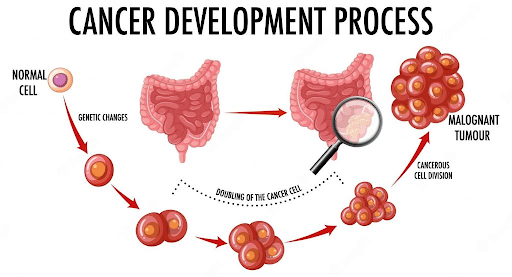
- Cancer is a generic term for a large group of diseases that can affect any part of the body. It is a serious disease wherein cells divide uncontrollably. Every year numerous deaths are caused by cancerous tumors.
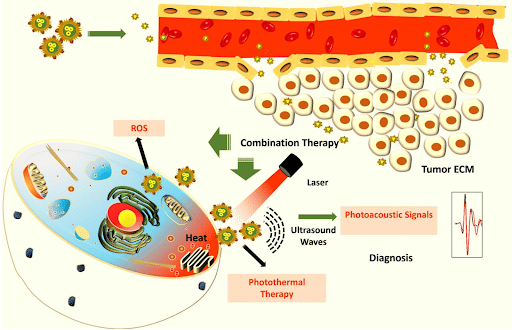
- Kill cancer cells: Scientists have created hybrid nanoparticles made of gold and copper sulphide which can kill cancer cells using heat, and enable detection of different types of cancer using sound waves.
- Size of the nano-particles: These hybrid nanoparticles, measuring less than 8 nm, show potential for easy tissue penetration and reaching tumors. The small size of these nanoparticles suggests they may naturally exit the human body without accumulating.
- The scientists decided to combine gold and copper sulphide into nanoparticles which were tested on lung cancer and cervical cancer cell lines.
- The copper sulphide nanoparticles have previously received attention for their application in cancer diagnosis, while gold nanoparticles, which can be chemically modified to target cancer cells, have shown anticancer effects.
- These particles have photothermal (light and heat), oxidative stress, and photoacoustic (light and sound) properties.
How are cancer cells detected through this approach?
- Hybrid nanoparticles aid in cancer detection through their photoacoustic (light and sound) property.
- They absorb light and generate ultrasound waves, allowing for high-contrast cancer cell detection.
- Ultrasound waves provide superior image resolution compared to light, enhancing clarity and oxygen saturation measurement in tumors.
Advantages of the new approach
- Enhanced Tissue Penetration: The small size of hybrid nanoparticles enables them to navigate through tissues more effectively, facilitating their ability to target tumors deep within the body.
- Minimized Accumulation: Due to their compact dimensions, these nanoparticles have a higher likelihood of being eliminated naturally from the human body, reducing concerns about long-term accumulation and potential toxicity.
- Versatile Integration: The hybrid nanoparticle system can seamlessly integrate with existing medical technologies and treatments. For instance, they can be activated to generate localized heat using endoscopic light sources commonly employed in cancer screening procedures.
- Research Advancement: The development of hybrid nanoparticles opens up new avenues for interdisciplinary research, fostering collaboration between nanotechnology, medicine, and oncology for innovative solutions in cancer care.
About Cancer
 |
What are the incidence and mortality rates of cancer in India?
- Data from the National Cancer Registry of the Indian Council of Medical Research had revealed that nearly 14.6 lakh new cases of cancer were reported in 2022 as compared to 14.2 lakh cases in 2021 and 13.9 lakh in 2020.
- Deaths due to cancer increased to 8.08 lakhs in 2022 from 7.9 and 7.7 lakhs in 2021 and 2020 respectively.
- The data predicted that the overall incidence of cancer cases in India would reach 15.7 lakhs cases by 2025.
- An ICMR research study based on population-based cancer registries has revealed that one in nine Indians will develop cancers during their lifetime.
- The study indicated that one in sixty-eight Indian men would develop lung cancer and one in 29 women would be affected by breast cancer.
- The rates of incidence of cancer were noted to be higher among women (103.6 per lakh people) than men (94.1 per lakh).
- The most common cancers among men were lung, mouth, prostrate, tongue and stomach while for women they were breast, cervix, ovary, uterus and lung.
Government initiatives related to cancer treatment
- National Programme for Prevention and Control of Cancer, Diabetes, Cardiovascular Diseases and Stroke (NPCDCS)
- National Cancer Grid
- National Cancer Awareness Day
- National Tobacco Control Programme
- Rashtriya Arogya Nidhi (RAN)
- Tertiary Care for Cancer Scheme
(*Click this link to read prelims specific weekly current affairs articles)
FAQs
Question: What is Cancer?
Answer:
It is a generic term for a large group of diseases that may affect any part of the body. One of its defining features is the rapid creation of abnormal cells that grow beyond their usual boundaries.
Question: What is the Indian Institute of Science (IISc)?
Answer:
IISc is a public, deemed, research university for higher education and research in science, engineering, design, and management. It is located in the southern Indian city of Bangalore, Karnataka.
UPSC Mains Practice Question:
|
MCQ
Question: Which one of the following statements best describes the role of B cells and T cells in the human body? (UPSC Prelims 2022)
(a) They protect the body from environmental allergens.
(b) They alleviate the body's pain and inflammation.
(c) They act as immunosuppressants in the body.
(d) They protect the body from diseases caused by pathogens.
Answer: (d) See the Explanation
- T-cells are a key component of the human adaptive immune system. They perform critical functions ranging from maintenance of immunologic memory and recognition of foreign antigens to the generation.
- T-cells originate in the bone marrow and mature in the thymus, a small gland in the lymphatic system. In the thymus, they multiply and differentiate into helper cytotoxic T-cells or memory T cells. They maintain immune homeostasis over decades.
Therefore, option (d) is the correct answer.
Download the PREPP App and attempt FREE IAS Exam Mock Tests and get complete study material!

Full Test - 04: UPSC CSE Prelims CSAT (Paper-II)
Full Test - 03: UPSC CSE Prelims CSAT (Paper-II)
UPSC CSE Prelims 2026 GS Paper 1 Question Paper (24-May-2026)
UPSC CSE Prelims 2026 CSAT Paper 2 Question Paper (24-May-2026)

17 February 2025 | The Hindu Must Read Articles | Current Affairs

16 February 2026 | The Hindu Must Read Articles | Current Affairs

13 February 2026 | The Hindu Must Read Articles | Current Affairs









Comments