Centre Asks States To Promote Heat Tolerant Wheat Seeds In The Rabi Season
Relevance: GS3 - Agriculture; Major crops-cropping patterns; Climate Change
(Source: The Hindu, 09/27/2023)
Click here for Daily Current Affairs
Why in the news?
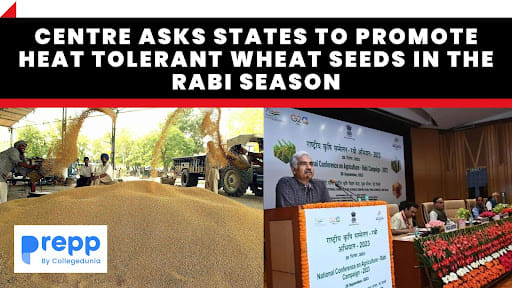
- Recently, at the National Conference on Agriculture for Rabi Campaign 2023-24, the central government engaged in discussions with various states to assess their readiness for the upcoming rabi crop season, taking into account a 5% reduction in monsoon rainfall this year.
- The central authority has urged states to encourage farmers to adopt heat-resistant and high-yield wheat varieties.
Table of Contents
Key Points
- There are certain changes in climate change, which is affecting agriculture, hence the government’s strategy is climate resilient seeds.
- After facing a heatwave in 2021, the government encouraged farmers in 2022 to go for heat-tolerant wheat varieties in 47% of the total wheat acreage of 30 million hectares.
- Hence, the target is to increase the coverage of area under heat-tolerant wheat varieties to 60% this year.
- There are more than 800 climate-resistant varieties available in the country. Hence, these seeds need to be put in the seed chain as part of the seed rolling plan.
- The Indian Council of Agricultural Research (ICAR) emphasized the promotion of climate-resilient crop varieties not only for wheat but also for other crops like rice and pulses.
Climate Change and Its Impact
- Climate change is drastically affecting sustainable crop production globally.
- Extreme weather events, especially temperature and rainfall fluctuations, are threatening the cultivation of field crops in many regions of the world, endangering food security.
- Heatwaves and droughts are expected to become more frequent and severe in many parts of the world.
- South Asia is specifically threatened by climate extremes, especially a heatwave, as it includes mainly tropical/sub-tropical areas, which are already experiencing higher temperatures.
- Most of these regions have very high population density; thus, increased frequency and intensity of climate extremes may pose a severe threat to food security for the burgeoning population.
- Rainfall deficit: There was also a severe deficit in the reservoirs in Bihar, Andhra Pradesh, Tamil Nadu, Uttar Pradesh, West Bengal, Kerala, and Karnataka compared with the 10-year average. This emphasizes the importance of managing water resources efficiently, especially in regions facing water scarcity.
- While there is still an expectation of monsoon in October-November in some states, the India Meteorological Department (IMD) has identified strong El Nino conditions, which could influence weather patterns.
Effect on Crop Production
- Sudden temperature spikes in March have a negative impact on rabi crops, causing premature grain maturity and reduced yields.
- Higher nighttime temperatures increase respiratory losses, disrupting the balance between source and sink, and decreasing net photosynthesis.
- This reduction in the grain formation period, combined with increased carbohydrate loss due to higher temperatures, hinders proper grain development, leading to shriveled grains and decreased crop yields.
- In March 2022, such hot weather conditions caused terminal heat stress, significantly affecting wheat productivity in the region.
About Wheat
- Wheat, an important rabi (winter) crop, is seeded from late October to December; it reaches maturity in mid-March, and harvesting of early-sown types normally begins by the end of March.
- Temperature: 10-15°C (sowing period) to 21-26°C (ripening and harvesting) with bright sunshine.
- Rainfall: Around 75-100 cm.
- Soil Type: Well-drained fertile loamy and clayey loamy (Ganga-Satluj plains and black soil region of the Deccan).
- The success of the Green Revolution contributed to the growth of Rabi crops, particularly wheat.
- Few government initiatives to support wheat cultivation include the Macro Management Mode of Agriculture, the National Food Security Mission, and the Rashtriya Krishi Vikas Yojana.
Significance of Wheat to Indian Economy
- Wheat is the second most important cereal crop. It is the main food crop in the north and north-western parts of the country.
- India is the second-largest producer of wheat, accounting for about 14% of the world's total production.
- Every year, India produces around 110 MT of wheat. A large portion of it is used for domestic consumption. India exports less than 1% of the world's wheat.
Promoting Heat-Tolerant Wheat Varieties
- To promote heat tolerant wheat seeds, India has developed approximately 800 climate-resistant wheat varieties.
- The Indian government is actively promoting the cultivation of heat-resistant wheat varieties to mitigate the impact of rising temperatures on crop yields.
- Two such varieties, DBW187 and DBW222, have demonstrated superior heat tolerance compared to HD-3086, resulting in yield gains of 3.6% and 5.4%, respectively, during the 2021-22 crop season, as reported by the AICRP on Wheat and Barley.
- To facilitate the adoption of these heat-resistant varieties, the government is fostering partnerships between the public and private sectors and facilitating direct seed distribution to farmers.
- The Indian Institute of Wheat and Barley Research (IIWBR), operating under the ICAR, has entered into agreements with private firms for the production of DBW187 and DBW222 seeds.
- The ICAR-IIWBR has initiated a project titled 'Breeding high-yielding wheat genotypes for stress conditions of warmer regions of India.'
- This project aims to develop wheat varieties that are not only high-yielding but also well-suited to the challenging environmental conditions of India's warmer regions.
Strategies and Technologies for Climate Change Adaptation
- Tolerant Crops and Breeds: Farmers are adopting crops and livestock breeds that are resilient to climate stresses. For instance, drought-tolerant crop varieties like early maturing green gram and indigenous livestock breeds with resistance to drought and diseases are being utilized.
- Feed Management: Improving livestock feed management practices not only enhances production efficiency but also helps animals cope with changing environmental conditions.
- Water Management and Water-Smart Technologies: Employing efficient water management practices such as micro-irrigation, cover-crop methods, deficit irrigation, and precision estimation of crop water needs helps conserve water resources and adapt to changing precipitation patterns.
- Agro-Advisory Services: Integrative approaches like response farming, which involve farming based on expert advisories, are being implemented to provide farmers with timely information and guidance on climate-smart practices.
- Soil Organic Carbon: Soil management practices are being used to increase soil organic carbon levels, which enhance soil stability and functionality. These practices include conservation agriculture (reduced tillage, crop rotations, and cover crops), soil conservation techniques like contour farming, and nutrient recharge strategies.
What is the Rabi Season?
|
(*Click this link to read prelims specific weekly current affairs articles)
FAQs
Question: What is the purpose of the National Conference on Agriculture for Rabi Campaign?
Answer:
It aims to review crop performance in previous seasons, set specific crop targets for the upcoming rabi season in consultation with state governments, and create a roadmap for ensuring the supply of critical agricultural inputs and the adoption of innovative technologies to enhance production.
Question: What are rabi crops?
Answer:
Rabi crops are also known as winter crops. These are the crops planted at the start of the winter season. Rabi crops include wheat, barley, oats, gram, mustard, and linseed.
Question: What is the main difference between Rabi and Kharif crops?
Answer:
The primary distinction is that Rabi crops are grown during the winter season, whereas Kharif crops are grown during the monsoon season.
UPSC Mains Practice Question:
|
MCQ
Question: With reference to pulse production in India, consider the following statements: (UPSC 2021)
- Black gram can be cultivated as both Kharif and rabi crops.
- Green gram alone accounts for nearly half of pulse production.
- In the last three decades, while the production of Kharif pulses has increased, the production of rabi pulses has decreased.
Which of the statements given above is/are correct?
(a) 1 only
(b) 2 and 3 only
(c) 2 only
(d) 1, 2, and 3
Answer: (a) See the Explanation
- India is the world's largest producer (25% of global production), the consumer (27% of global consumption), and importer (14%) of pulses in the world.
- Although pulses are grown in both the Kharif and Rabi seasons, Rabi pulses account for more than 60% of total production.
- Gram is the most important pulse, accounting for approximately 40% of total production.
- Black Gram is a pulse that can be grown in both the Kharif and Rabi seasons.
Therefore, option (a) is the correct answer.
Download the PREPP App and attempt FREE IAS Exam Mock Tests and get complete study material!

Full Test - 04: UPSC CSE Prelims CSAT (Paper-II)
Full Test - 03: UPSC CSE Prelims CSAT (Paper-II)
UPSC CSE Prelims 2026 GS Paper 1 Question Paper (24-May-2026)
UPSC CSE Prelims 2026 CSAT Paper 2 Question Paper (24-May-2026)

17 February 2025 | The Hindu Must Read Articles | Current Affairs

16 February 2026 | The Hindu Must Read Articles | Current Affairs

13 February 2026 | The Hindu Must Read Articles | Current Affairs









Comments