Limited Phosphorus Resources: Does The Solution Lie In Our Sewage?
Relevance: GS3 - Agriculture; Transport and marketing of agricultural produce and issues and related constraints; Food Security
(Source: The Hindu, 09/27/2023)
Click here for Daily Current Affairs
Why in the news?
- Recently, the global phosphorus problem is gaining attention with limited phosphorus reserves, contamination issues, and disruptions in the fertilizer market.
- Phosphorus is a critical element for plant growth and is an essential component of fertilizers used in agriculture.
- However, there are several challenges associated with phosphorus use in agriculture, and hence finding sustainable solutions has become a critical priority.
Table of Contents
Historical Evolution of Fertilization
- Fertilizing Land Through the Ages: Throughout agricultural history, sustaining fertile soil has been a persistent challenge. Early societies realized that continuous farming depleted nutrients, leading to decreased yields. They employed natural fertilizers like using fish remnants and bird droppings (guano) as fertilisers.
- Fertilizer Revolution: In the 19th century, chemistry breakthroughs birthed synthetic fertilizers and the discovery of vital nutrients like nitrogen, phosphorus, and potassium. These innovations laid the foundation for modern chemical fertilizers, boosting agricultural productivity.
- Green Revolution's Impact: The mid-20th century saw the Green Revolution, marked by high-yield crop varieties and intensive synthetic fertilizer use, ensuring global food production's sustainability.
Challenges Surrounding Phosphorus
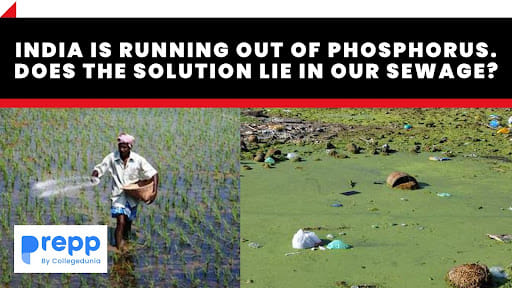
- Phosphorus Scarcity and Pollution: Today, phosphorus, a key nutrient, is becoming scarce and causing environmental pollution. It doesn't exist as a gas, limiting its movement from land to water, where it triggers algal blooms and harms aquatic ecosystems.
- Limited Reserves and Cadmium Contamination: Phosphorus is scarce and primarily found in specific geological formations. This is a major geopolitical concern.The global phosphorus supply chain is dominated by a few countries, mainly Morocco and the Western Sahara, which hold the largest reserves.
- However, these reserves contain cadmium, a harmful heavy metal that can accumulate in human and animal kidneys. Removing cadmium from phosphorus is costly.
- Consequently, cadmium-laden fertilizers are used, leading to its absorption by crops and bioaccumulation in humans, potentially accelerating heart disease.
- Limited sources of cadmium-free phosphorus: The EU has enacted regulations to limit cadmium levels in fertilizers. Out of all the countries, only six have significant reserves of cadmium-free phosphorus.
- Among them, China imposed export restrictions in 2020, and several EU nations stopped purchasing from Russia, leading to a surge in demand for safe phosphorus.
- Sri Lanka's decision to ban synthetic fertilizers in 2021 resulted in a drop in crop yields and a political crisis.
- Phosphorus loss and pollution: Approximately only one-fifth of mined phosphorus is used for food production, with the rest being lost to water bodies through agricultural runoff due to excessive fertilizer use. This leads to environmental pollution.
- Sewage contamination: Most phosphorus consumed by people ends up in sewage. In India, much of the sewage is untreated or treated only at a basic level, resulting in the discharge of effluents containing nitrates and phosphates. While nitrates can be safely processed by denitrifying bacteria, phosphorus remains in water bodies, contributing to harmful algal blooms.
- These blooms deplete oxygen levels in the water, leading to fish deaths, and can also be toxic to humans, causing various health issues.
About Phosphorus
Phosphorus in India
|
Potential Strategies for Managing Phosphorus Usage
- Precision Agriculture: There is a need to implement precision agriculture techniques to optimize the use of chemical fertilizers. This involves using technology like GPS-guided equipment and sensors to apply fertilizers only where and when they are needed, reducing over-application and nutrient runoff.
- Union Budget 2023–24 launched the PM-PRANAM scheme to promote the balanced use of chemical and alternative fertilizers, generating awareness of regenerative agriculture (RA).
- Phosphorus Recovery from Sewage: Investment should be made in technologies that extract phosphorus from urban sewage and wastewater treatment plants. This recovered phosphorus can be processed into high-quality fertilizers and used in agriculture, reducing the dependence on mined phosphorus.
- An innovative solution is emerging in the form of sludge-mining from STPs by companies like EasyMining in Europe. This approach recovers valuable nutrients from sewage, producing a high-quality fertilizer similar to conventional ones and making sewage treatment profitable.
- Source-Separating Toilets: There is a need to encourage the adoption of source-separating toilets that separate urine and feces. Urine is rich in phosphorus and can be collected and processed into a local fertilizer source.
- Circular Phosphorus Economy: There is a need to establish a circular economy for phosphorus, where products containing phosphorus are designed for easy recovery and recycling, reducing the need for mining and reducing environmental impact.
(*Click this link to read prelims specific weekly current affairs articles)
FAQs
Question: What is a Fertilizer?
Answer:
A fertilizer is a natural or artificial substance that contains the chemical components necessary to increase plant growth and productivity. The fertilizers include nitrogen, potassium, and phosphorus, which are necessary minerals for plants.
Question: What is Phosphorus?
Answer:
Phosphorus is a chemical element with the symbol "P" and atomic number 15. It is an essential element for life and has various important properties and applications.
Phosphorus readily forms compounds with other elements, especially oxygen, forming various phosphates.
MCQ
Question: Consider the following organisms: (UPSC 2013)
- Agaricus
- Nostoc
- Spirogyra
Which of the above is/are used as biofertilizer/ biofertilizers?
(a) 1 and 2 only
(b) 2 only
(c) 2 and 3 only
(d) 3 only
Answer: (b) See the Explanation
- The mushroom, or Agaricus, is a genus of which many species are edible.
- Ponds, pools, ditches, and similar habitats are where spirogyra is most commonly found. It is frequently referred to as pond-scum or water silk due to the threads' (plant body's) slick feel. It is not typically utilized as a biofertilizer; if it were, the plants would have to compete with it.
- Nostoc transforms atmospheric nitrogen into ammonia, which can either be consumed directly or changed into a form that is conducive to plant growth.
- During dry spells, the free-living organisms desiccate and rehydrate to photosynthesize and fix nitrogen showing the potential of Nostoc as a sustainable biofertilizer.
Therefore, option (b) is the correct answer
Question: With reference to chemical fertilizers in India, consider the following statements: (UPSC 2020)
- At present, the retail price of chemical fertilizers is market-driven and not administered by the Government.
- Ammonia, which is an input of urea, is produced from natural gas.
- Sulphur, which is a raw material for phosphoric acid fertilizer, is a by-product of oil refineries.
Which of the statements given above is/are correct?
(a) 1 only
(b) 2 and 3 only
(c) 2 only
(d) 1, 2 and 3
Answer: (b) See the Explanation
- To ensure that farmers have easy access to fertilizers and that India's agricultural production remains self-sufficient, the government of India provides subsidies for fertilizers. The same has essentially been accomplished by regulating the cost of fertilizer and the volume of production. Hence, statement 1 is incorrect.
- Natural gas has been used to create ammonia (NH3). Natural gas molecules are broken down into carbon and hydrogen in this process. After being cleaned, the hydrogen is combined with nitrogen to create ammonia.
- This artificial ammonia is utilized as fertilizer, either directly as ammonia or indirectly through the creation of urea, ammonium nitrate, and mono- or diammonium phosphates after the synthesis of the ammonia. Hence, statement 2 is correct.
- Sulfur is a significant by-product of gas processing and oil refining. Most crude oil grades contain some sulphur, but to meet rigorous sulphur content restrictions in refined goods, the majority of this sulphur must be removed during the refining process. This is accomplished through hydrotreating, which generates H2 S gas, which is then transformed into elemental sulphur. Hence, statement 3 is correct.
Therefore, option (b) is the correct answer.
Download the PREPP App and attempt FREE IAS Exam Mock Tests and get complete study material!

Full Test - 04: UPSC CSE Prelims CSAT (Paper-II)
Full Test - 03: UPSC CSE Prelims CSAT (Paper-II)
UPSC CSE Prelims 2026 GS Paper 1 Question Paper (24-May-2026)
UPSC CSE Prelims 2026 CSAT Paper 2 Question Paper (24-May-2026)

17 February 2025 | The Hindu Must Read Articles | Current Affairs

16 February 2026 | The Hindu Must Read Articles | Current Affairs

13 February 2026 | The Hindu Must Read Articles | Current Affairs









Comments