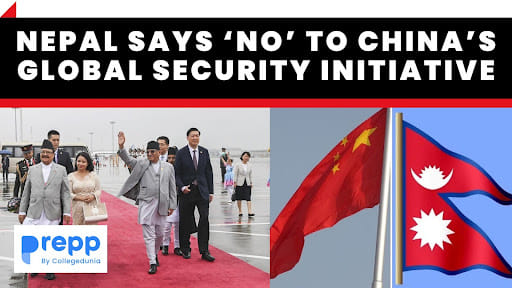
Nepal Says ‘No’ To China’s Global Security Initiative
(Source: The Hindu, 09/27/2023)
Click here for Daily Current Affairs
Why in the news?
- Recently, a joint statement released by Nepal and China mentioned numerous border infrastructure projects but did not mention the China-led Global Security Initiative.
- Nepal has agreed to cooperate with China on the Global Development Initiative, indicating that Nepal will take a cautious approach to security cooperation with China while cooperating on developmental projects.
Table of Contents
What did the joint statement by Nepal and China say?
- GDI: The joint statement stated that Nepal would support the Global Development Initiative (GDI) and would consider joining the Group of Friends of the GDI.
- BRI: It said that the two countries would work to finalize the text of the agreement to implement the China-led Belt and Road Initiative (BRI).
- GSI: The statement did not mention the Global Security Initiative (GSI).
- However, Nepal agreed that some elements of security cooperation as envisioned by the GSI are necessary.
Kathmandu’s balancing act
- Security cooperation: Both countries agreed to conduct a joint inspection of the China-Nepal boundary.
- They agreed that cooperation in law enforcement is crucial for the security of both countries.
- They also committed to strengthening information exchange, capacity building, and cooperation on training between the law enforcement agencies of both countries.
- On development and security: The joint statement reflects Nepal’s adoption of a balanced approach to its bilateral ties with China.
- Nepal has indicated that it will cooperate with China on development projects while exercising caution in security cooperation.
- On Tibet and territorial sovereignty: Nepal committed to preventing separatist activities against China on its soil.
- It also reaffirmed its stance on Tibet which supported China’s position.
- China committed to supporting Nepal in upholding its sovereignty, independence, and territorial integrity.
Nepal-China collaboration
- Cross-border transport: They agreed to strengthen connectivity across ports, roads, railways, airways, and grids.
- They agreed to jointly build the Trans-Himalayan Multi-Dimensional Connectivity Network.
- The opening of ports such as the Lizi-Nechung port and the Zhangmu-Khasa port was recognized and committed to the early opening of border ports such as Chentang-Kimathanka and Riwu-Olangchungola.
- China agreed to support work on the Araniko Highway maintenance project and repair the Syaphrubesi-Rasuwagadhi Highway.
- They agreed to construct a 220 KV Cross-Border Power Transmission line from Jilong/Keyrung(Tibet) to Rasuwagadhi/Chilime(Nepal).
- Beijing also announced an initiative to train Nepal railway professionals.
- Panda diplomacy: Nepal gifted China with two unicorn rhinos as a symbol of the long-lasting friendship between the two countries.
- It was an adaptation of China’s “panda diplomacy” under which China gifted pandas to other countries as a tool of diplomatic policy.
Other highlights of the Nepal PM’s visit to China
- In the recent visit by Nepali Prime Minister Pushpa Kamal Dahal Prachananda to China, the two countries signed 12 agreements including 7 MoUs to improve bilateral cooperation.
- MoU for a Joint Technical Working Group to review and modify the Nepal-China trade and payment agreement.
- Protocol of phytosanitary requirements to export plant-derived medicinal materials from Nepal to China.
- MoUs on the Hilsa-Simkot Road Project and the Nepal-China Power Grid Interconnection Project (Chilime-Kerung).
- Other agreements in the fields of science, technology, innovation, and Human Resources Development.
- They also discussed strengthening and consolidating mutual understanding and cooperation between the two countries and boosting economy, trade and people-to-people contact.
GSI
GDI
GCI
|
(*Click this link to read prelims specific weekly current affairs articles)
FAQs
Question: What is the Group of the Friends of the GDI?
Answer:
It is a group of around 100 countries that have expressed support for the China-led Global Development Initiative. It aims to achieve greater complementarity between the GDI and the 2030 Agenda, support the UN’s developmental work, and help developing countries fight the pandemic and implement the 2030 Agenda through strengthening of dialogue, sharing of best practices, and promoting practical cooperation.
Question: What is the Belt and Road Initiative?
Answer:
The Belt and Road Initiative is an investment program for infrastructural development and economic integration of countries along the historic Silk Road. It is a transcontinental approach that aims to accelerate infrastructure development that is balanced and sustainable.
UPSC Mains Practice Question:
|
MCQs
Question: ‘Belt and Road Initiative is sometimes mentioned in the news in the context of the affairs of (UPSC CSE 2016)
(a) African Union
(b) Brazil
(c) European Union
(d) China
Answer: (d) See the Explanation
The Belt and Road Initiative also known as the One Belt, One Road (OBOR) is a development strategy and framework that focuses on connectivity and cooperation among countries along the Old Silk Road.
Therefore, option (d) is the correct answer.
Question: With reference to India's projects on connectivity, consider the following
statements :
- East-West Corridor under the Golden Quadrilateral Project connects Dibrugarh and Surat.
- Trilateral Highway connects Moreh in Manipur and Chiang Mai in Thailand via Myanmar.
- Bangladesh-China-India-Myanmar Economic Corridor connects Varanasi in Uttar Pradesh with Kunming in China. ·
How many of the above statements are correct? (UPSC CSE 2023)
(a) Only one
(b) Only two
(c) All three
(d) None
Answer: (d) See the Explanation
- The East-West Corridor is a part of the National Highways Development Project (NHDP) in India, which aims to connect Silchar in Assam to Porbandar in Gujarat.
- It does not connect Dibrugarh in Assam and Surat in Gujarat. Hence statement 1 is incorrect.
- The Trilateral Highway is a connectivity project connecting Moreh in Manipur, India, with Mae Sot in Thailand via Myanmar to enhance trade, connectivity, and people-to-people ties among the three countries. Hence statement 2 is incorrect.
- The Bangladesh-China-India-Myanmar Economic Corridor (BCIM) is a proposed economic corridor that aims to connect Kunming in China with Kolkata in India, through Myanmar and Bangladesh.
- Varanasi is not directly connected to this corridor. Hence statement 3 is incorrect.
Therefore, option (d) is the correct answer.
Download the PREPP App and attempt FREE IAS Exam Mock Tests and get complete study material!

Full Test - 04: UPSC CSE Prelims CSAT (Paper-II)
Full Test - 03: UPSC CSE Prelims CSAT (Paper-II)
UPSC CSE Prelims 2026 GS Paper 1 Question Paper (24-May-2026)
UPSC CSE Prelims 2026 CSAT Paper 2 Question Paper (24-May-2026)

17 February 2025 | The Hindu Must Read Articles | Current Affairs

16 February 2026 | The Hindu Must Read Articles | Current Affairs

13 February 2026 | The Hindu Must Read Articles | Current Affairs









Comments