Supreme Court To Examine If Onscreen Profanity Amounts To A ‘Sexually Explicit Act’
Relevance: GS 2- Government policies and interventions for development in various sectors and issues arising out of their design and implementation. GS1 - Effects of globalization on Indian society.
(Source: The Hindu, 09/27/2023)
Click here for Daily Current Affairs
Why in the news?
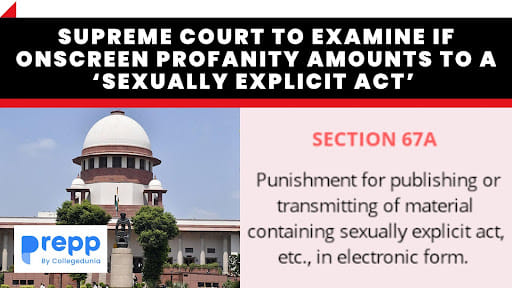
- Recently, the Supreme Court of India agreed to examine if the use of profanity onscreen amounts to a “sexually explicit act” under Section 67A of the IT Act.
- The Delhi High Court had in March, found that the language used in the College Romance web series was profane and vulgar and warned that it could negatively impact the country’s youth.
Table of Contents
What has the Judiciary said about the use of profanity in online content?
- Supreme Court: The SC has agreed to examine if the use of profanity and vulgar language amounts to a sexually explicit act under Section 67A of the IT Act.
- It will consider whether the term “act” under Section 67A includes spoken words as well.
- The SC cast doubt on the argument put forward by the makers of the web series that vulgar language is not a case of obscenity.
- They also argued that the offense under Section 67A is not made out as there was no depiction of a sexually explicit physical act on screen.
- However, the SC noted that the Delhi HC had ruled that Section 67A also applied to spoken words.
- Delhi HC: The Delhi High Court had ruled that the content used in the web series streamed over an OTT platform was vulgar and profane.
- The HC also raised the charge of Section 67 of the IT Act against the producers and actor despite the charge being dropped by the Sessions Court.
- It ruled that profanities cannot be presented to the general public or portrayed to the world as if commonly practiced by the youth of the country.
- Unrestricted, unfettered freedom of profane, indecent, and obscene speech and expression could not be permitted in web series.
- The Court flagged the power and reach of online platforms on all age categories including young children.
Union government’s stance
- The Union Government had told the Delhi High Court that it consider its recommendations during its regular policy-making exercises for the techno-legal ecosystem.
- In July 2023, the Union government told streaming giants Netflix and Disney that the content on their platforms must be reviewed independently for obscenity and violence before being aired.
Section 67A of IT Act, 2000
Section 67 of IT Act, 2000
|
Other laws related to vulgarity
IPC
- Section 292 of the IPC which is related to the sale, etc of obscene books, etc.
- Section 294 which is related to obscene acts and songs.
- Section 504 of IPC which seeks to prevent the intentional use of abusive language amounts to insult, giving rise to provocations causing the person against whom such words are used to commit a breach of peace.
IT Act, 2000
- Section 69(A) of the IT Act gives the government takedown powers to block public access to an intermediary “in the interest of sovereignty and integrity of India, defense of India, security of the State, friendly relations with foreign States or public order or for preventing incitement to the commission of any cognizable offense relating to above”.
IT Rules, 2021
- Information Technology (Intermediary Guidelines and Digital Media Ethics Code), Rules 2021 which sought to regulate intermediaries and digital news media.
- It stipulates that a classification or warning must be provided regarding the profanity of language or excessive use of expletives.
Cinematograph Act
The Cinematograph Act, of 1952 deals with the censorship of movies in India with respect to certain rules and regulations established by law in order to make the content suitable for the target audience.
(*Click this link to read prelims specific weekly current affairs articles)
FAQs
Question: What is obscenity?
Answer:
Obscenity refers to utterances or acts that offend the prevalent morality and social politics of the time and region. In legal terms, it refers to graphic depictions of people engaged in sexual and excretory activity, related utterances of profanity, or the display of exploited children, human beings, or situations.
Question: What is the freedom of speech and expression?
Answer:
Freedom of speech and expression is a fundamental right that grants citizens the right to freely express their ideas and opinions. It is granted by Article 19(1)(a) of the Indian Constitution.
UPSC Mains Practice Question
|
MCQs
Question: Consider the following statements.
- Section 67A of the IT Act outlines the punishment for transmitting material consisting of sexually explicit material in electronic form.
- Section 69A of the IT Act was used by the government to ban certain Chinese apps.
Which of the above is/are correct?
(a) 1 only
(b) 2 only
(c) Both 1 and 2
(d) None of the above
Answer: (c) See the Explanation
- Section 67A of the IT Act, 2000 mentions the punishments for publishing or transmitting of material containing sexually explicit acts, etc., in electronic form. Hence statement 1 is correct.
- It prescribes a fine of up to ₹10 lakhs and a jail term of up to 5 years for the first conviction and in subsequent convictions jail term of up to 7 years and a fine of up to ₹10 lakhs.
- Section 69A empowers the authorities to intercept, monitor or decrypt any information generated, transmitted, received, or stored in any computer resource in the interest of the sovereignty or integrity of India, the defense of India, the security of the State, friendly relations with foreign states or public order or for preventing incitement to the commission of any cognizable offense or for investigation of any offense.
- It also empowers the government to block internet sites in the interests of the nation and was used by the government in the recent banning of certain Chinese applications. Hence statement 2 is correct.
Therefore, option (c) is the correct answer.
Download the PREPP App and attempt FREE IAS Exam Mock Tests and get complete study material!

Full Test - 04: UPSC CSE Prelims CSAT (Paper-II)
Full Test - 03: UPSC CSE Prelims CSAT (Paper-II)
UPSC CSE Prelims 2026 GS Paper 1 Question Paper (24-May-2026)
UPSC CSE Prelims 2026 CSAT Paper 2 Question Paper (24-May-2026)

17 February 2025 | The Hindu Must Read Articles | Current Affairs

16 February 2026 | The Hindu Must Read Articles | Current Affairs

13 February 2026 | The Hindu Must Read Articles | Current Affairs









Comments