World Food Day
Relevance: GS3 - Food security, GS1 - Distribution of key natural resources across the world GS3 - Conservation, environmental pollution and degradation,
(Source: The Hindu, 10/16/2023)
Click here for Daily Current Affairs
Why in the news?
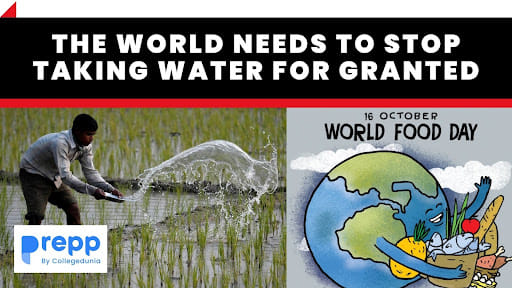
- World Food Day is observed on October 16th every year.
- The theme for this year is ‘Water is Life, Water is Food’ which calls for urgent action in responsible water management as the frequency of water-related challenges like drought, floods, unseasonal rains and prolonged dry spells have increased.
Table of Contents
- History of World Food Day
- Water's Crucial Role in Indian Agriculture
- Assessment of Climate Change Impact on Indian Crop Yields
- What are the challenges associated with poor water management?
- What is FAO’s Crop Forecasting Framework?
- Supporting Climate Change Adaptation in Agriculture
- What steps can be taken?
- Some of the Initiatives taken
- FAQs
- MCQs
History of World Food Day
- The member countries of the Food and Agriculture Organisation established World Food Day in November 1979 at the organisation's 20th General Conference and called for the observance of World Food Day on 16 October 1981.
- This decision was ratified by the UN General Assembly on 5 December 1980 and urged governments and international, national and local organizations to contribute to celebrating World Food Day.
- Since 1981, World Food Day has been held every year.
Water's Crucial Role in Indian Agriculture
- In the context of India, where approximately 60% of the cultivated land relies on rainfed agriculture, contributing significantly to 40% of the overall food production, the reliance on water availability becomes particularly evident.
- Rainfed agriculture is directly influenced by the presence of water, and fluctuations in rainfall and soil moisture can have severe repercussions on food production and nutrition security.
- Irrigated agriculture is responsible for a substantial 72% of global freshwater withdrawals, often resulting in long-term detrimental impacts on the sustainability of vital ecosystems like seasonal rivers and deep aquifers.
Assessment of Climate Change Impact on Indian Crop Yields
- The Government of India has conducted an assessment of the impact of climate change in the years 2050 and 2080 using climate projections and crop simulation models.
- Rainfed rice yields in India are expected to decrease significantly, with a 20% reduction in 2050 and a more substantial 47% reduction in 2080.
- Irrigated rice yields will also be negatively affected, albeit to a lesser extent, with a projected decline of 3.5% in 2050 and 5% in 2080.
- Wheat yields are anticipated to see a substantial decrease of 19.3% in 2050 and a more severe decline of 40% in 2080.
- Kharif maize yields could face reductions of 18% in 2050 and 23% in 2080.
What are the challenges associated with poor water management?
- Water scarcity and pollution: Decades of poor water management, misuse and pollution, and the climate crisis have degraded freshwater supplies and ecosystems. This makes it more difficult for farmers to grow crops, and can also lead to waterborne diseases.
- Climate change: Extreme weather events and variability in water availability are severely affecting agricultural production. Changes in rainfall and higher temperatures can reduce crop yields and lower the nutritional quality of produce.
- Land degradation: About 40% of the planet's total land area is degraded, leaving farmers with less productive land. This is due to a number of factors, including deforestation, overgrazing, and unsustainable agricultural practices.
- Lack of access to finance, technology, and irrigation: Small-scale farmers, who make up more than 80% of farmers globally, are especially affected by the challenges of water and crop production. They often lack access to the resources they need to adapt to climate change and produce enough food to sustain their livelihoods.
- Effects on crop productivity: Changes in rainfall patterns and rising temperatures have adverse effects on crop productivity. Reduced yields and food availability can result from these climate-related factors, which can contribute to food insecurity and hunger.
What is FAO’s Crop Forecasting Framework?
- The FAO (Food and Agriculture Organization) Crop Forecasting Framework is an important initiative aimed at improving agricultural planning and management, especially for rainfed farmers in various Indian states.
- This project seeks to address food security challenges by developing a comprehensive model that incorporates various data sources to forecast crop yields accurately.
- The FAO's work is centered around a pilot project conducted in several Indian states, including Andhra Pradesh, Karnataka, Himachal Pradesh, and Maharashtra. These states have diverse climatic and geographical conditions, which makes them ideal for testing and refining the crop forecasting framework.
- The project involves the integration of different types of data, including climate data, soil characteristics, and market information. This comprehensive dataset allows for a more accurate and holistic understanding of the factors affecting crop production.
Supporting Climate Change Adaptation in Agriculture
- FAO: It supports the sustainable transformation of agrifood systems and climate-smart agriculture practices to improve water-use efficiency. Supported the farmer water school programme in Uttar Pradesh, which helped smallholder farmers, and the Andhra Pradesh Farmer Managed Groundwater Systems project, which reached out to 638 habitations in seven drought-prone districts and included a hydrological monitoring programme.
- IFAD: International Fund for Agricultural Development (IFAD) prioritizes climate change adaptation in its core strategies and invests in preserving soil health, water resources, and integrating modern technologies with indigenous systems. IFAD supported projects in Maharashtra, Odisha, Uttarakhand, Nagaland and Mizoram incorporating climate-resilient seed varieties and crops, including millets, and trained farmers in climate-sensitive agricultural practices and soil management to cope with increased water stress.
- WFP: World Food Programme is collaborating with the Government of Odisha to develop solutions for smallholder farmers, focusing on women. The goal is to enhance resilience through solar technologies, establish community-based climate advisory services to help manage climate impacts and promote a millet-value chain that reduces water usage and improves nutrition.
What steps can be taken?
- Innovative Farming Technologies: Supporting farmers with innovative and proven technologies to increase productivity, adapt to climate change, and build resilience to shocks.
- Sustainable Water Management: Implementing environmentally and socially sustainable, financially viable irrigation and water management strategies to ensure efficient water use in agriculture.
- Climate-Friendly Agriculture: Encouraging practices that reduce the climate footprint of agricultural production, while also addressing bio-hazards and environmental pollution.
- Improved Sanitation and Water Access: Bringing sanitation and clean drinking water supplies closer to rural households to enhance overall living conditions.
- Food and Water Recycling: Promoting efficient food and water recycling strategies to minimize waste and resource use.
- Institutional Strengthening: Strengthening institutional arrangements and capacity for sustainable and equitable water regulations, management, access, and ownership.
Some of the Initiatives taken
- The International Fund for Agricultural Development (IFAD) helps Indian states make MGNREGA schemes sustainable by ensuring environmentally and socially responsible micro-irrigation infrastructure with financial viability.
- The World Food Programme (WFP) supports soil and water conservation, irrigation, and flood prevention through food assistance in exchange for labor. In 2021, 8.7 million people in 49 countries benefited from this support.
- The UN’s food agencies are working closely with the Government of India and State governments on innovations such as Solar 4 Resilience, Secure Fishing, and the revival of millets for renewable energy promotion, food security and nutrition.
Conclusion
World Food Day serves as an opportunity to address the worldwide issues of hunger and malnutrition. It underscores the importance of ensuring equal access to food and water, advocating for sustainable agricultural practices, and increasing awareness about food-related concerns. In 2023, World Food Day highlights the collective responsibility of society in promoting healthy and sustainable food systems.
(*Click this link to read prelims specific weekly current affairs articles)
FAQs
Question: When is World Food Day observed?
Answer:
World Food Day is observed on October 16th every year. The theme for this year is ‘Water is Life, Water is Food’ which calls for urgent action in responsible water management as the frequency of water-related challenges
Question: What is Food and Agriculture Organisation (FAO)
Answer:
It is a specialised agency of the United Nations that works towards defeating hunger via international efforts. FAO aims to achieve food security for all and to make sure that people have regular access to enough high-quality food to lead active healthy lives.
MCQ
Question: The FAO accords the status of ‘Globally Important Agricultural Heritage Systems (GIAHS)’ to traditional agricultural systems. What is the overall goal of this initiative? (UPSC 2016)
- To provide modern technology, training in modern farming methods and financial support to local communities of identified GIAHS so as to greatly enhance their agricultural productivity.
- To identify and safeguard eco-friendly traditional farm practices and their associated landscapes, agricultural biodiversity and knowledge systems of the local communities.
- To provide Geographical Indication status to all the varieties of agricultural produce in such identified GIAHS.
Select the correct answer using the code given below:
(a) 1 and 3 only
(b) 2 only
(c) 2 and 3 only
(d) 1, 2 and 3
Answer: (b) See the Explanation
- In order to safeguard and support the world’s agricultural heritage systems, FAO started an initiative for the identification and the dynamic conservation of the Globally Important Agricultural Heritage Systems (GIAHS) in 2002. So it is not about providing modern technologies or modern practices to enhance agricultural productivity. Hence, statement 1 is not correct.
- GIAHS aims to identify, support and safeguard globally important agricultural heritage systems and their livelihoods, agricultural and associated biodiversity, knowledge systems, cultures and landscapes around the world. Hence, statement 2 is correct.
- GI tag is accorded to products from a certain origin and not to traditional agricultural systems. Hence, statement 3 is not correct.
Therefore, option (b) is the correct answer.
Download the PREPP App and attempt FREE IAS Exam Mock Tests and get complete study material!

Full Test - 04: UPSC CSE Prelims CSAT (Paper-II)
Full Test - 03: UPSC CSE Prelims CSAT (Paper-II)
UPSC CSE Prelims 2026 GS Paper 1 Question Paper (24-May-2026)
UPSC CSE Prelims 2026 CSAT Paper 2 Question Paper (24-May-2026)

17 February 2025 | The Hindu Must Read Articles | Current Affairs

16 February 2026 | The Hindu Must Read Articles | Current Affairs

13 February 2026 | The Hindu Must Read Articles | Current Affairs









Comments