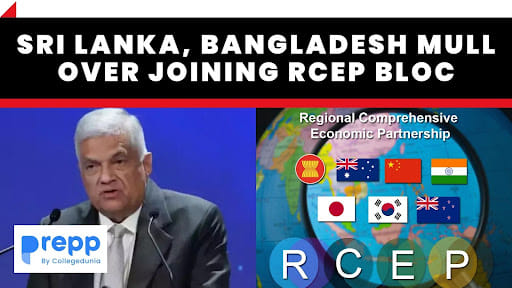
Sri Lanka, Bangladesh Mull Over Joining RCEP Bloc
(Source: The Hindu, 10/16/2023)
Click here for Daily Current Affairs
Why in the news?
- Recently, Sri Lanka has sought support for its membership in the Regional Comprehensive Economic Agreement.
- Bangladesh has also expressed interest in joining the forum which India left without joining in 2019.
Table of Contents
Prospective new members of the RCEP
- Sri Lanka: Sri Lanka has already applied for RCEP membership.
- It has sought support from China, Malaysia, Indonesia, Japan and Thailand.
- Bangladesh: Bangladesh has expressed interest in joining the forum but will take a final decision on membership only after the national elections in the country in 2024.
Why are Sri Lanka and Bangladesh interested in RCEP membership?
- Potential for growth: According to Sri Lanka, the RCEP is a vast trade bloc with vast potential for economic growth.
- Bangladesh is expected to move out of the list of Least Developed Countries by 2026, which would reduce its access to markets resulting in export earnings dropping by 14% and average tariffs increasing by 9%.
- Joining RCEP is projected to increase Bangladesh’s exports by $5 billion.
- Sri Lanka’s financial crisis: Sri Lanka is presently negotiating with the IMF and other creditors for loans in order to manage the country’s economic crisis.
- It views the RCEP and its members as a viable source of credit to tackle these challenges.
- Importance of regional trade: Sri Lanka and Bangladesh have recognized the importance of regional trade partners.
- Membership in the RCEP will insulate them from the challenges in subcontinental trade and increase their access to the ASEAN group of countries including China, Japan, South Korea, Australia, and New Zealand.
- Move away from protectionism: Sri Lanka and Bangladesh are attempting to move away from protectionist policies, which will make them more competitive in the international market.
- Bangladesh is negotiating FTAs with six of the fifteen RCEP countries, which will make the accession process easier.
What is the RCEP?
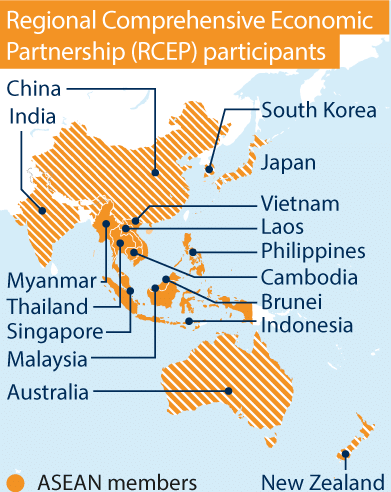
- The Regional Comprehensive Economic Agreement is a free trade agreement between 15 Asia-Pacific countries.
- Members: Australia, Brunei, Cambodia, China, Indonesia, Japan, Laos, Malaysia, Myanmar, New Zealand, Philippines, Singapore, South Korea, Thailand, Vietnam
- Signing and enactment:
- The RCEP was signed on November 15, 2020 after negotiations began in 2012.
- The RCEP came into force in January 2022.
- Secretariat: The provisional Secretariat of the RCEP is located in Jakarta as a special unit within the ASEAN Secretariat.
- Objectives:
- Achieve a modern, comprehensive, high-quality, and mutually beneficial economic partnership among ASEAN Member States and their FTA partners.
- This includes lowered trade barriers and enhanced economic cooperation and growth.
- Features:
- Trade facilitation: It will reduce tariffs, open trade in services, and improve rules of origin, customs procedures, and trade remedies.
- Access to markets: It will help improve access to markets for goods and services among member countries.
- Process for Membership: According to the RCEP Agreement, the RCEP secretariat is mandated to accept membership applications from July 2023.
- Officials have claimed that accession rules will be finalized by 2024 opening the way for negotiation for accession with potential members.
Significance of the RCEP
- Economic: The RCEP presently accounts for 30% of the global GDP.
- The RCEP is expected to eliminate around 90% of tariffs imposed on goods within the bloc within the first 15 years.
- Strategic: The RCEP is the first agreement of its kind among the big Asian economies.
- It is expected to promote integration of economies within the region and strengthen relations between member nations.
- Wide scope: The RCEP will also cover new areas such as e-commerce, competition policy, and Intellectual Property Rights (IPR).
Why did India withdraw from the RCEP?
- India was a founder member of the RCEP grouping but withdrew in 2019 due to various concerns listed below:
- Transparency: India claimed that China's use of subsidies and state capitalism gave Chinese industry an unfair advantage and was counter to the ideals of free trade.
- Rules of Origin: India emphasized the need for robust rules of origin in order to prevent an influx of Chinese products exported indirectly through member countries with reduced tariffs.
- This could inundate domestic markets and hurt domestic producers.
- Mobility in Services: India argued for provisions in support of free trade in services in order to benefit its strong services sector.
- India claimed that this was vital to ensure that India's economic needs were satisfied.
- Non-member status: India wanted to protect its rights to engage in trade agreements with other countries without being forced to apply the same terms to RCEP members.
- Consider, an India-UAE investment agreement with a higher rate of return on investment. In such a case, India required that RCEP countries should not be obligated to impose the same rate of interest.
- Changing economic trends: India also expressed concerns over the increasing trends of protectionism across the globe which has led to countries favoring their domestic industries over international trade.
- Domestic objections: The domestic agriculture sector and smaller businesses in the country have opposed the RCEP due to fears it could lead to an influx of products from other countries, particularly dairy, meat, and agricultural products.
What does this mean for India?
- Although India has been invited to return to the RCEP on several occasions, the government has not yet indicated a change in its position.
- Chinese influence on subcontinental markets: According to Indian officials, the participation of its neighboring states in the RCEP would be a development of concern for the country.
- This would open India’s neighboring markets to the Chinese-dominated RCEP.
- Global competitiveness: It was possible that these markets may become more globally competitive than India’s due to improved economic integration and trade facilitation.
To learn more about the RCEP, click the link
Conclusion
- Sri Lanka and Bangladesh’s interest in joining the RCEP is a reflection of its economic and strategic significance in the Asia-Pacific region and the opportunities for economic growth, trade facilitation, and enhanced global competitiveness it provides.
- However, India's valid concerns regarding RCEP membership continue to shape its stance.
(*Click this link to read prelims specific weekly current affairs articles)
FAQs
Question: What is the ASEAN?
Answer:
The Association of Southeast Asian Nations or ASEAN is a regional organization that was established to promote political and social stability among the post-colonial states of the Asia Pacific region. Its Secretariat is located in Jakarta. ASEAN is significant for India as it is the country’s fourth-largest trading partner.
Question: What is protectionism?
Answer:
The term “Protectionism” refers to government policies that restrict international trade in order to assist domestic industries. Some of the tools of a protectionist policy are tariffs, import quotas, product standards, and subsidies.
UPSC Mains Practice Question:
|
MCQs
Question: The term ‘Regional Comprehensive Economic Partnership’ often appears in the news in the context of the affairs of a group of countries known as (UPSC CSE 2016)
(a) G20
(b) ASEAN
(c) SCO
(d) SAARC
Answer: (b) See the Explanation
The Regional Comprehensive Economic Partnership (RCEP) is a proposed free trade agreement (FTA) between the ten ASEAN member states - Brunei, Myanmar, Cambodia, Indonesia, Laos, Malaysia, the Philippines, Singapore, Thailand, and Vietnam.
Therefore, option (b) is the correct answer.
Question: Consider the following countries : [2018-I]
- Australia
- Canada
- China
- India
- Japan
- USA
Which of the above are among the 'free-trade partners' of ASEAN?
(a) 1, 2, 4 and 5
(b) 3, 4, 5 and 6
(c) 1, 3, 4, and 5
(d) 2, 3, 4 and 6
Answer: (c) See the Explanation
- ASEAN has five FTAs with six dialogue partners.
- These include India, China, Japan, South Korea, Australia, and New Zealand.
Therefore, option (c) is the correct answer.
Download the PREPP App and attempt FREE IAS Exam Mock Tests and get complete study material!

Full Test - 04: UPSC CSE Prelims CSAT (Paper-II)
Full Test - 03: UPSC CSE Prelims CSAT (Paper-II)
UPSC CSE Prelims 2026 GS Paper 1 Question Paper (24-May-2026)
UPSC CSE Prelims 2026 CSAT Paper 2 Question Paper (24-May-2026)

17 February 2025 | The Hindu Must Read Articles | Current Affairs

16 February 2026 | The Hindu Must Read Articles | Current Affairs

13 February 2026 | The Hindu Must Read Articles | Current Affairs









Comments