UN Approved Kenya-led Security Mission to Haiti
(Source: The Hindu, 16/10/2023)
Click here for Daily Current Affairs
Why in the news?
- The United Nations Security Council has authorized international involvement in the shape of a foreign security operation led by Kenya to restore security, preserve essential infrastructure, and keep the country under control of spiralling violence.
- Over the past year, armed groups have taken control of vast portions of Haiti, including the capital Port-au-Prince, resulting in an increase in bloodshed.
- While the United States has stated that it will not send troops, it has offered $100 million in support services like as intelligence, communications, airlift operations, and medical help.
Table of Contents
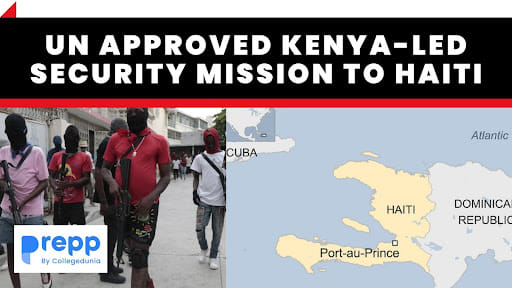
Where is Haiti?
- Haiti occupies the western one-third of Hispaniola, which it shares with the Dominican Republic and is located between Cuba and Puerto Rico.
- The Atlantic Ocean borders the northern beaches of Haiti, while the Caribbean Sea borders the west and south.
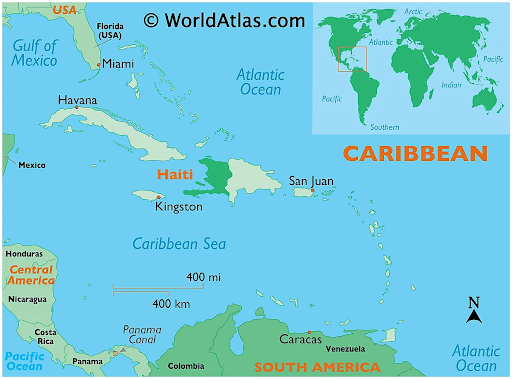
Haiti on World Map
Current Situation in Haiti
- Surge in violence over the past year due to armed groups taking over large areas, including Port-au-Prince.
- Almost 2,800 people killed, including 80 minors, between October 2022 and June 2023.
- Sexual assault and crimes against women have been on the rise, according to human rights organizations.
- Furthermore, mass looting and house burning have displaced hundreds of people, with an estimated 200,000 fleeing their homes.
- According to estimates, about half of the population requires humanitarian help.
Why Haiti Sought International Intervention?
- In October 2022, Haitian Prime Minister Ariel Henry asked international assistance to aid the national police.
- This came when a pair of gangs known as G9 and Family took control of the key gasoline port Varreux in the city, plunging the country into chaos.
- They were protesting the Prime Minister's decision to reduce fuel subsidies.
- To make matters worse, there was a bottled water shortage in the midst of a fresh cholera outbreak.
- As the crisis worsened and the police force became overburdened, Haitian leaders looked to the international community for assistance.
- They were looking for a specialized armed squad to combat gangs and their backers.
International Response
- There was initial hesitance from the U.S. and the UN to intervene.
- Kenya proposed to lead the multinational force, breaking the stalemate.
- The resolution was then forwarded to UNSC.
United Nations Security Council (UNSC)
|
Details of the Proposed Mission
- This is distinct from the UN peacekeeping mission to Haiti that ended in 2017.
- It is led by Kenya with support from Bahamas, Jamaica, and Antigua and Barbuda.
- The aim of the mission is:
- Offer "operational support" to the Haitian National Police.
- Build capacity to counter gangs, improve security.
- Secure critical infrastructures like ports and airports.
- Assist in creating conditions for future elections.
- Forces will have authority to make arrests in coordination with Haitian police. Expected force strength is 2,000 personnel.
- It also intends to foster favorable conditions in the country in order to facilitate elections. Haiti has not held elections since 2016.
- U.S. pledges $100 million for logistical support but won't send troops.
Reasons for Delay in Intervention
- Haiti's troubled history with foreign military interventions.
- UN peacekeeping mission from 2004 to 2017 faced allegations such as:
- Cholera epidemic blamed on sewage runoff from a peacekeeper camp.
- Allegations of sexual abuse against the UN peacekeepers.
- Skepticism among Haitians regarding foreign armed force intervention.
- International hesitance due to PM Ariel Henry's lack of popular support.
Conclusion
Haiti's escalating crisis has necessitated international intervention. Despite initial hesitations and historical complications, the UNSC has approved a Kenya-led security mission to stabilize Haiti and assist the national police. The mission has distinct aims and operational capabilities, setting it apart from previous interventions.
(*Click this link to read prelims specific weekly current affairs articles)
FAQs
Question: What is UNSC?
Answer:
The UNSC, or the United Nations Security Council, is one of the six main organs of the United Nations (UN). It holds the primary responsibility for the maintenance of international peace and security. The Security Council has 15 members in total.
Question: What is the aim of the UN approved Kenya-led security mission to Haiti?
Answer:
The aim of the mission is:
- Offer "operational support" to the Haitian National Police.
- Build capacity to counter gangs, improve security.
- Secure critical infrastructures like ports and airports.
- Assist in creating conditions for future elections.
Question: Where is Haiti located?
Answer:
Haiti occupies the western one-third of Hispaniola, which it shares with the Dominican Republic and is located between Cuba and Puerto Rico. The Atlantic Ocean borders the northern beaches of Haiti, while the Caribbean Sea borders the west and south.
MCQs
Question: Which country is leading the international security mission to Haiti approved by the UN?
(a) The United States
(b) The Bahamas
(c) Jamaica
(d) Kenya
Answer: (d) See the Explanation
The United Nations Security Council approved a foreign security mission to Haiti, which will be led by Kenya. This mission aims to restore security, protect critical infrastructure, and control the increasing violence in Haiti.
Therefore, option (d) is the correct answer.
Question: Consider the following statements regarding United Nation Security Council (UNSC):
- The non-permanent members of the UNSC are elected by the General Assembly for three-year terms.
- Among the most significant powers of the UNSC is the veto held by the five permanent members.
Which of the statements given above is/are correct?
(a) 1 only
(b) 2 only
(c) Both 1 and 2
(d) Neither 1 nor 2
Answer: (b) See the Explanation
The UNSC, or the United Nations Security Council, is one of the six main organs of the United Nations (UN). It holds the primary responsibility for the maintenance of international peace and security.
The Security Council has 15 members in total. There are five permanent members, often referred to as the P5. These are the United States, the United Kingdom, France, Russia (formerly the Soviet Union), and China. These members have the power to veto any substantive Security Council resolution.
In addition to the P5, there are 10 non-permanent members elected by the General Assembly for two-year terms. These members don't possess veto power. Hence, statement 1 is incorrect.
Among the most significant powers of the UNSC is the veto held by the five permanent members. If any of these members cast a negative vote in the 15-member Security Council, the resolution or decision will not be adopted. Hence, statement 2 is correct.
Therefore, option (b) is the correct answer.
Download the PREPP App and attempt FREE IAS Exam Mock Tests and get complete study material!

Full Test - 04: UPSC CSE Prelims CSAT (Paper-II)
Full Test - 03: UPSC CSE Prelims CSAT (Paper-II)
UPSC CSE Prelims 2026 GS Paper 1 Question Paper (24-May-2026)
UPSC CSE Prelims 2026 CSAT Paper 2 Question Paper (24-May-2026)

17 February 2025 | The Hindu Must Read Articles | Current Affairs

16 February 2026 | The Hindu Must Read Articles | Current Affairs

13 February 2026 | The Hindu Must Read Articles | Current Affairs









Comments