Kaziranga Sanctuary Reopens With Tribute To British-Era Officer
Relevance: Prelims; GS3 - Biodiversity & Conservation
(Source: The Hindu, 10/16/2023)
Click here for Daily Current Affairs
Why in the news?
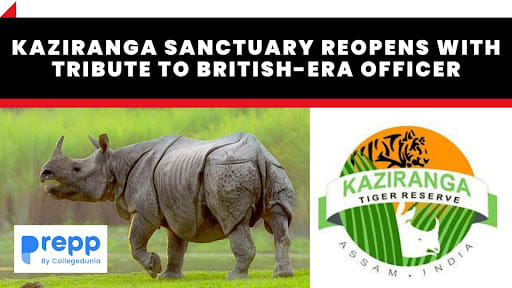
- Recently, Kaziranga National Park and Tiger Reserve, a UNESCO World Heritage Site known as the safest haven for one-horned rhinoceros, reopened with a literary tribute to a British-era forest officer Patrick D. Stracey who rid its name from any hunting connotations.
- It was closed from May to October due to warnings of Brahmaputra river floods.
Table of Contents
Surge in Tourist Visits to Kaziranga National Park
- In the 2022-23 season, Kaziranga National Park welcomed a remarkable 3,14,796 tourists, a substantial increase compared to the 1,76,181 visitors recorded in 2018-19.
- The majority of these tourists flocked to the Kohora area, totaling 1,53,233 visitors, while Bagori also saw a significant influx, with 1,38,511 visitors.
- The park encompasses not only its well-known ranges but also includes the less-visited Agoratoli and Burapahar areas on the southern bank of the Brahmaputra.
About Kaziranga National Park and Tiger Reserve
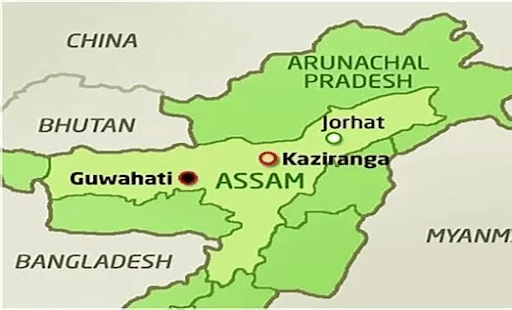
- Kaziranga National Park is a renowned conservation area in India, located in the northeastern region within the districts of Golaghat and Nagaon in the state of Assam.
- It has a significant rich history, with its establishment dating back to 1904, and was officially designated as a National Park in 1974 and later gained recognition as a tiger reserve in 2007.
- Kaziranga was recognised as a UNESCO World Heritage site in 1985.
- Kaziranga National Park is also acknowledged as an Important Bird Area by Birdlife International, a testament to its diverse avian population, which includes both migratory and resident bird species.
- Rivers and Highways: National Highway 37 passes through the park area. The park also has more than 250 seasonal water bodies, besides the Diphlu River running through it.
- Fauna: Situated along the banks of the mighty Brahmaputra River, this park is particularly renowned for its "big four" species, namely the Indian Rhinoceros, Asian Elephant, Royal Bengal Tiger, and Asiatic Water Buffalo.
- It is also one of the last remaining homes of the endangered and endemic western hoolock gibbon, the only species of apes found in India.
- It is one of the last homes of the critically endangered Bengal florican.
- Flora: It is a mix of eastern wet alluvial grasslands, semi-evergreen forests and tropical moist deciduous forests. It is primarily famous for its dense and tall elephant grasses intermixed with small swamplands. It also includes an abundant cover of water lilies, water hyacinths and lotus.
Who is Patrick D. Stracey?
|
(*Click this link to read prelims specific weekly current affairs articles)
FAQs
Question: What is Kaziranga National Park?
Answer:
Kaziranga National Park, a UNESCO World Heritage Site, is known for its sheer woodland, thick elephant grass, rough reeds, marshes, and tiny lakes. It was designated a national park in 1974.
Question: What are one-horned rhinoceros?
Answer:
The Indian rhinoceros (Rhinoceros unicornis) is a rhinoceros species native to the Indian subcontinent. It is also known as the Indian rhino, greater one-horned rhinoceros, or great Indian rhinoceros. The IUCN Red List classifies it as Vulnerable.
MCQ
Question: Match List I (National Park/Sanctuary) with List II (State) and select the correct answer using the codes given below: (UPSC 2004)
| List-I | List-II |
|---|---|
| A. Kanger Ghati National Park |
|
| B. Nagerhole National Park |
|
| C. Kugti Wildlife Sanctuary |
|
| D. Sultanpur Bird Sanctuary |
|
Codes:
(a) A-3; B-2; C-1; D-4
(b) A-1; B-4; C-3; D-2
(c) A-3; B-4; C-1; D-2
(d) A-1; B-2; C-3; D-4
Answer: (b) See the Explanation
National Park/ Sanctuary:
- Kanger Ghati National Park - Chhattisgarh
- Nagerhole National Park - Karnataka
- Kugti Wildlife Sanctuary – Himachal Pradesh
- Sultanpur Bird Sanctuary – Haryana
Therefore, option (b) is the correct answer.
Download the PREPP App and attempt FREE IAS Exam Mock Tests and get complete study material!

Full Test - 04: UPSC CSE Prelims CSAT (Paper-II)
Full Test - 03: UPSC CSE Prelims CSAT (Paper-II)
UPSC CSE Prelims 2026 GS Paper 1 Question Paper (24-May-2026)
UPSC CSE Prelims 2026 CSAT Paper 2 Question Paper (24-May-2026)

17 February 2025 | The Hindu Must Read Articles | Current Affairs

16 February 2026 | The Hindu Must Read Articles | Current Affairs

13 February 2026 | The Hindu Must Read Articles | Current Affairs









Comments