Baiga Tribal Group Gets Habitat Rights In Chhattisgarh
Relevance: GS2 - Government policies and interventions for development in various sectors; Welfare schemes for vulnerable sections of the population by the Centre and States and the performance of these schemes
(Source: Indian Express, 10/12/2023)
Click here for Daily Current Affairs
Why in the news?
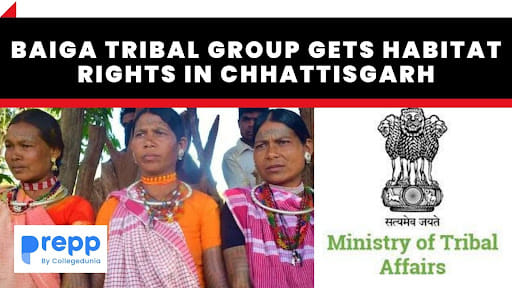
Recently, Baiga Particularly Vulnerable Tribal Group (PVTG) became the second community in Chhattisgarh to get habitat rights in the state, after the Kamar PVTG.
Table of Contents
What are Habitat Rights?
- Habitat rights encompass granting a community the power to govern their traditional dwelling places, customs, sustainable livelihood practices, indigenous ecological wisdom, and responsible utilization of natural resources.
- The recognition of habitat rights represents a significant milestone in the protection of their surroundings and cultural heritage, preserving the legacy of traditional livelihoods and ecological wisdom that has been transmitted through generations.
- Habitat rights are extended to Particularly Vulnerable Tribal Groups (PVTGs) through section 3(1)(e) of the Scheduled Tribes and Other Traditional Forest Dwellers (Recognition of Forest Rights) Act, 2006, commonly referred to as the Forest Rights Act (FRA).
- This provision pertains to community tenures of habitat and habitation for primitive tribal groups and pre-agricultural communities.
- According to Section 2(h) of FRA:“Habitat includes the area comprising the customary habitat and such other habitats in reserved forests and protected forests of primitive tribal groups and pre-agricultural communities and other forest dwelling Scheduled Tribes.”
- States which have recognised habitat rights: Out of 75 PVTG in India, only three have habitat rights. The Bharia PVTG in Madhya Pradesh was the first, followed by the Kamar tribe and now the Baiga tribe in Chhattisgarh.
How does the Government fix a Habitat?
- The government fixes a habitat in consultation with traditional tribal leaders, following guidelines provided by the Ministry of Tribal Affairs in 2014.
- These guidelines involve consulting with tribal leaders to understand the culture, traditions, and occupation of the tribe.
- Once the information is verified and supported by the government, a specific area is officially declared as a habitat for the tribe.
About Baiga PVTG
- The Baiga are an ethnic group found in central India primarily in the state of Madhya Pradesh, and in smaller numbers in the surrounding states of Uttar Pradesh, Chhattisgarh and Jharkhand.
- The largest number of Baiga is found in Baiga-chuk in Mandla district and Balaghat district of Madhya Pradesh.
- Traditionally, the Baiga lived a semi-nomadic life and practised slash-and-burn cultivation. Now, they are mainly dependent on minor forest produce for their livelihood. They practice a form of shifting cultivation called, "Bewar."
PVTGs in Chhattisgarh
- There are seven PVTGs in Chhattisgarh, who live in 17 of the state’s 33 districts, which include Kamar, Baiga, Pahadi Korba, Abujhmadiya, Birhor, Pando and Bhujia.
- The total population of PVTG tribes in Chhattisgarh as per the 2015-2016 survey is 2.50 lakh while the population of tribals in Chhattisgarh as per the 2011 census is 78.22 lakh.
- The Kamar tribes, with a population of 26,622 across four districts, have seen 22 Para/Tola (hamlets) in the Magarlod sub-region of the Magarlod development block, Dhamtari district, comprising around 2,500 people, receive these rights.
- In addition, out of the 88,317 Baiga tribes, 6,483 have also obtained these rights.
Who are Particularly Vulnerable Tribal Groups (PVTGs)?
- PVTGs, or Particularly Vulnerable Tribal Groups, are tribal communities identified by the Ministry of Tribal Affairs as technologically backward, with stagnant or declining population growth, extremely low literacy rates, and subsistence-level economies.
- They typically have poor health indices and inhabit remote and isolated regions in small and scattered settlements.
- In 1973, the Dhebar Commission created Primitive Tribal Groups (PTGs) as a separate category, which are less developed among the tribal groups. In 2006, the Government of India renamed the PTGs as PVTGs.
- The Ministry has identified 75 PVTGs in 18 states and one Union Territory out of 705 Scheduled Tribes.
Government’s Initiatives for PVTGs
- In 2019, the Ministry of Tribal Affairs started a scheme for their protection and improvement in terms of social indicators like livelihood, health, nutrition and education to decrease their vulnerability.
- In the budget of 2023, the Government announced a mission to develop Particularly Vulnerable Tribal Groups. 22,544 villages with about 28 lakh PVTG population have been identified to saturate essential services under the scheme.
Constitutional Provisions related to Tribes in India
- The Constitution of India recognizes certain tribes as Scheduled Tribes, based on criteria such as their distinctiveness, primitive traits, geographical isolation, and socio-economic backwardness.
- Article 342 of the Constitution empowers the President to notify Scheduled Tribes in consultation with the Governor of the concerned state.
- Protection from Discrimination: Article 15(4) of the Constitution allows for special provisions to be made for the advancement of socially and educationally backward classes, including Scheduled Tribes.
- Political Representation: Article 330 reserves seats for Scheduled Tribes in the Lok Sabha (the lower house of the Parliament of India), while Article 332 provides for the reservation of seats in state legislative assemblies for STs. This ensures political representation for tribes at both the national and state levels.
- Protective Measures: Article 46 of the Constitution directs the state to promote the educational and economic interests of the weaker sections of society, including Scheduled Tribes, and protect them from social injustice and exploitation.
- Cultural and Educational Rights: Article 29(1) and Article 30 of the Constitution protect the cultural and educational rights of all citizens, including Scheduled Tribes.
- Fifth Schedule: The fifth Schedule contains provisions as to the Administration and Control of Scheduled Areas and Scheduled Tribes.
- Sixth Schedule: To protect the rights of tribal people, the Sixth Schedule allows the formation of Autonomous District Councils in Assam, Meghalaya, Tripura, and Mizoram.
(*Click this link to read prelims specific weekly current affairs articles)
FAQs
Question: What are Habitat Rights?
Answer:
Habitat rights encompass granting a community the power to govern their traditional dwelling places, customs, sustainable livelihood practices, indigenous ecological wisdom, and responsible utilization of natural resources.
Question: Who are Particularly Vulnerable Tribal Groups (PVTGs)?
Answer:
PVTGs, or Particularly Vulnerable Tribal Groups, are tribal communities identified by the Ministry of Tribal Affairs as technologically backward, with stagnant or declining population growth, extremely low literacy rates, and subsistence-level economies.
Question: What is the Selection Criteria for PVTGs?
Answer:
- Pre-agriculture level of technology.
- Stagnant or declining population.
- Extremely poor literacy
- Subsistence level of the economy.
MCQs
Question: Consider the following statements about Particularly Vulnerable Tribal Groups (PVTGs) in India: (UPSC 2019)
- PVTGs reside in 18 States and one Union Territory.
- A stagnant or declining population is one of the criteria for determining PVTG status.
- There are 95 PVTGs officially notified in the country so far.
- Irular and Konda Reddi tribes are included in the list of PVTGs.
Which of the statements given above are correct?
(a) 1, 2 and 3
(b) 2, 3 and 4
(c) 1, 2 and 4
(d) 1, 3 and 4
Answer: (c) See the Explanation
- Particularly Vulnerable Tribal Groups (PVTGs) are centrally recognized special category from among the Scheduled Tribe.
- Such groups were identified by one or more of the following features:
- Pre-agricultural level of technology,
- Low level of literacy,
- Economic backwardness,
- A declining or stagnant population. Hence, statement 2 is correct.
- There are a total 75 tribal groups that have been categorized by the Ministry of Home Affairs as Particularly Vulnerable Tribal Groups (PVTG)s. Hence, statement 3 is not correct.
- PVTGs reside in 18 States and UT of A&N Islands. Hence, statement 1 is correct.
- Konda reddy of Khammam district of Telangana and Irular of Tamil Nadu are in the list of PVTGs. Hence, statement 4 is correct.
Therefore, option (c) is the correct answer.
Download the PREPP App and attempt FREE IAS Exam Mock Tests and get complete study material!

Full Test - 04: UPSC CSE Prelims CSAT (Paper-II)
Full Test - 03: UPSC CSE Prelims CSAT (Paper-II)
UPSC CSE Prelims 2026 GS Paper 1 Question Paper (24-May-2026)
UPSC CSE Prelims 2026 CSAT Paper 2 Question Paper (24-May-2026)

17 February 2025 | The Hindu Must Read Articles | Current Affairs

16 February 2026 | The Hindu Must Read Articles | Current Affairs

13 February 2026 | The Hindu Must Read Articles | Current Affairs









Comments