What Is Heat Index And Why Is It Important To Measure?
Relevance: GS1 - Important geophysical phenomena; GS2 - Issues related to Health; GS3 - Environment and Climate Change; Disaster Management
(Source: The Hindu, 09/08/2023)
Click here for Daily Current Affairs
Why in the news?
- Recently, in August, Iran experienced an extremely high heat index of 70 degrees Celsius in its coastal region, reaching a level that makes survival difficult or nearly impossible.
- This extreme heat event was not an isolated incident, as in July, the Persian Gulf Airport reported a heat index of 66.7 degrees Celsius, indicating a recurring pattern of severe heat waves in the region.
Table of Contents
What is the Heat Index?
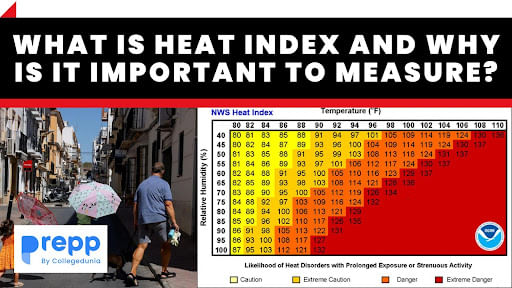
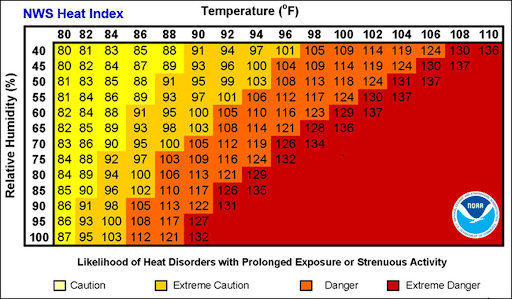
- Heat index, also known as apparent temperature, is a measure of how the temperature feels to humans.
- Relative humidity is an important factor that determines heat index, along with air temperature.
- It helps in understanding the impact of humidity on high temperatures and how it contributes to human discomfort during hot weather.
- In 2024, India is scheduled to launch its own heat index to quantify the impact of heat on its population and generate impact-based heatwave alerts for specific locations.
- Various countries have their own heat index measurement systems.
- For instance, Canada uses the Humidex, and the U.S. National Weather Service (NWS) has its own heat index chart.
- A heat index value of 67°C or above can be extremely dangerous for people and animals who have direct and prolonged exposure.
How is the heat index calculated?
- A complex formula to calculate heat index was published by Dr. Robert Steadman, a professor in the textiles and clothing department of Colorado State University, in 1979.
- His formula considers factors like temperature, humidity, wind, extra radiation, and barometric pressure to determine the apparent temperature or heat index.
- Dr. Steadman's calculations are based on the physiology of a typical adult human with specific height and weight parameters.
- The dew point, which signifies the temperature at which air becomes saturated with moisture and condensation occurs, is a crucial component in his formula, with Dr. Steadman using a dew point of 14°C in his calculations.
What is a Heatwave?
Factors that contribute to the intense heatwave
|
Why is it important to measure the heat index?
- Understanding human comfort and health: Measuring the heat index is crucial for understanding how hot weather conditions affect human comfort and health. It provides a more accurate representation of how the temperature feels to people, taking into account the combined impact of temperature and humidity.
- Heat stress and health risks: High heat index values indicate increased risk of heat stress and heat-related illnesses such as heat exhaustion and heatstroke. This information is vital for public health and safety, as it helps authorities and individuals take necessary precautions during heat waves.
- Impact of humidity on cooling: Humidity plays a significant role in the body's cooling mechanism. Measuring the heat index highlights the challenge of cooling through perspiration when humidity is high, emphasizing the increased risk of heat-related illnesses. Conversely, low humidity can enhance evaporative cooling, making it easier for the body to cope with high temperatures.
- Variation in risk levels: The heat index allows for differentiation of risk levels based on temperature and humidity combinations. This differentiation helps people understand the severity of heat-related risks, enabling them to make informed decisions about outdoor activities and safety measures.
- Adaptation to climate change: With the increasing impact of climate change, heatwaves are becoming more frequent and severe. Monitoring the heat index is essential for adapting to these extreme conditions by providing early warnings, adjusting work schedules, and developing sustainable cooling solutions.
(*Click this link to read prelims specific weekly current affairs articles)
FAQs
Question: What are heat waves?
Answer:
Heat waves are prolonged periods of excessively hot weather that can cause adverse impacts on human health, the environment, and the economy. India, being a tropical country, is particularly vulnerable to heat waves, which have become more frequent and intense in recent years.
Question: What is dew point?
Answer:
Dew point is the temperature at which air can no longer hold additional water vapor, causing the formation of liquid droplets. It serves as an indicator of atmospheric moisture levels.
Question: What is relative humidity?
Answer:
The ratio between the entire capacity of the air to contain moisture at a particular temperature and the actual amount of moisture carried by it is known as relative humidity. It's measured in percentages. The relative humidity drops as the temperature rises.
UPSC Mains Practice Question:
|
Download the PREPP App and attempt FREE IAS Exam Mock Tests and get complete study material!

Full Test - 04: UPSC CSE Prelims CSAT (Paper-II)
Full Test - 03: UPSC CSE Prelims CSAT (Paper-II)
UPSC CSE Prelims 2026 GS Paper 1 Question Paper (24-May-2026)
UPSC CSE Prelims 2026 CSAT Paper 2 Question Paper (24-May-2026)

17 February 2025 | The Hindu Must Read Articles | Current Affairs

16 February 2026 | The Hindu Must Read Articles | Current Affairs

13 February 2026 | The Hindu Must Read Articles | Current Affairs









Comments