At G-20, Japan Backs India, Not China, As Bridge To Global South: Japanese Experts
(Source: The Hindu, 09/07/2023)
Click here for Daily Current Affairs
Why in the news?
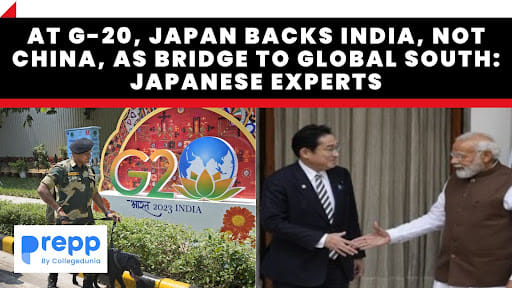
- Recently, the Japanese Prime Minister Fumio Kishida had stated that India and Japan, as presidents of the G-20 and G-7 respectively could collaborate on shared interests and common ground.
- Japan views India as a bridge to the countries of the Global South in opposition to claims from China that it represents the interests of the Global South.
Table of Contents
What has Japan said about India’s role in the Global South?
- Japanese experts have claimed that India is the bridge between the Global South and Japan and the West.
- Japanese interests: Japan has recognized the contest between India and China for leadership of the Global South.
- However, Japan’s interests can be better secured by positioning India as the leader of the Global South.
- This is mainly due to its adversarial relationship with China over border disputes, economic interests, maritime, and freedom of navigation concerns.
- G-7 Presidency: Japan is the current President of the G-7 and had invited India to the summit in Hiroshima in May 2023.
- Japan has expressed interest in collaborating with India to resolve differences of opinion between the G-7 and the G-11 (members of the G-20 excluding the G-7, Russia, and China).
- Japan claims that China and Russia are attempting to counter the G-7 world order.
- Areas of cooperation: Mutual interests including transparency, sustainable investments, tackling debt crises, climate financing, and other key issues that will be reflected in the G-20 outcomes.
India-China divide
- In the lead-up to the G-20 summit, there has been an increase in focus on the widening divide between India and China on global and multilateral matters.
- Global crises such as climate change are a major concern for both India and China.
- However, climate change is no longer a major component of the bilateral agenda between the two countries.
- Border issue: The unresolved border dispute between India and China, and reports of Chinese military incursions, and the establishment of military infrastructure along border areas have led to a divide in the bilateral relationship.
- Debt crises: India has claimed that aggressive Chinese lending, especially under its flagship Belt and Road initiative, is a cause for the debt crisis faced by developing countries.
- Other concerns include geopolitical contests between the two including Chinese expansionism and unbalanced bilateral trade.
China’s position
- According to China, the focus was not on the divide between India and China but on the ability of other Asian countries to manage and influence global governance.
- It has pointed out that multilateral bodies such as the G-20 have been primarily controlled by Western nations and have sidelined the Asian nations.
- Concerns have also been expressed about the politicization of multilateral bodies which were established to foster multilateral dialogue and economic cooperation.
- In the last three years, the communication channels between India and China have broken down, adversely impacting cooperation on global platforms.
- India has repeatedly stated that wider bilateral cooperation is not possible until the border issue is not resolved.
Significance of Global South
- Economic Potential: The Global South comprises countries with vast populations and substantial economic capabilities. These nations, such as India, China, Brazil, and South Africa, have experienced significant economic growth in recent years.
- By 2030 it is projected that three of the four largest economies will be from the Global South, with the order being China, India, the U.S., and Indonesia.
- Unleashing Untapped Potential: The growing economies of the Global South possess immense untapped potential. By collaborating and sharing knowledge, expertise, and best practices, these countries can accelerate their development further.
- With the addition of the new members, the GDP in terms of purchasing power of the Global South-dominated BRICS will surpass that of the G-20.
- Addressing Common Concerns: The Global South faces common challenges and concerns, including energy security, energy justice, and sustainable energy transition.
- By coming together as a united front, these countries can amplify their voices and advocate for the interests of developing nations on the global stage.
- South-South Cooperation: The Global South emphasizes South-South cooperation, which involves collaboration and exchange of resources, expertise, and technology among developing nations.
- By fostering stronger ties and partnerships within the Global South, countries can enhance their collective bargaining power, share experiences, and collectively address development challenges.
India’s approach towards Global South
- India has adopted a collaborative approach towards the nations of the Global South to create a strong collective front and implement effective strategies for the development of these countries.
- With its vast population and robust economy, India possesses significant resources to contribute to the world, particularly to the countries of the Global South.
- India's Role and G20 Presidency: India, as a prominent member of the Global South, is actively working to unite nations within this region and facilitate an action-oriented approach. As a leader in the G20, India seeks to amplify the voices of the Global South, bringing their concerns to the forefront of global discussions.
India-Japan Relationship
- Origin of ties: India and Japan established diplomatic ties in 1952 but the two countries share ancient ties of spirituality, cultural, and civilizational relationships.
- India agreed on a separate peace treaty with Japan in 1952 after its sovereignty was fully restored following the Second World War.
- Status of relationship: In 2006, the Indo-Japan relationship was elevated to a "Global and Strategic Partnership" and in 2014 it was upgraded into a Special Strategic and Global Partnership.
- Economic:
- Trade: India was the 18th largest trading partner for Japan, and Japan was the 13th largest trading partner for India in 2021.
- Bilateral trade totaled US$ 20.57 billion during FY 2021-22 with Japanese exports accounting for $14.39 billion and imports $6.18 billion.
- Japan’s exports to India were 2.35% of India’s total imports and India’s exports to Japan were 1.46% of India’s total exports.
- Investment: Japan was the 5th largest investor for India in FY2021 and India was the largest recipient of Japanese ODA Loan in the past decade.
- In 2021, India, Japan, and Australia launched the Supply Chain Resilience Initiative to share best practices on supply chain resilience and promote investments.
- Defense and Security: India and Japan jointly participate in a number of military exercises such as:
- JIMEX- Bilateral naval exercise
- SHINYU Maitri- Bilateral air force exercise
- Dharma Guardian- Bilateral army exercise
- Ex. Malabar- Naval exercise of QUAD nations
- In 2021, the Acquisition and Cross-Servicing Agreement for reciprocal provision of supplies between the armed forces of the two counties came into force.
- The 2nd India-Japan Forum was held in July 2023 and was attended by representatives from governments, Parliament, industry, think tanks, and academia.
- It aimed to bolster cooperation, leverage opportunities, exchange ideas, build mutual trust, and develop a joint agenda for cooperation.
- Multilateral cooperation:
- Challenges faced:
- Unbalanced Trade: Indian exports have not been able to successfully enter the Japanese market due to high quality and service standards, and language barriers.
- Defense Exports: India has transitioned towards Aatmanirbharta and self-reliance in the production of defense equipment.
- The increase in focus on exports of Indian defense goods could lead to competition with Japan, which is a leading supplier of defense equipment for the region.
- Delayed projects: Many Indo-Japan projects have been delayed and economically impacted such as the Asia-Africa Growth Corridor and the Mumbai-Ahmedabad Bullet train project.
- Divergences: India and Japan have diverged in opinions on issues such as India’s exit from the RCEP and the trade pillar of the IPEF due to domestic considerations.
- According to experts, India and Japan must develop cooperation in mutual interests such as Trade, Science, and Technology Cooperation, etc. instead of focusing solely on a shared concern about Chinese aggression.
(*Click this link to read prelims specific weekly current affairs articles)
FAQs
Question: What is the Global South?
Answer:
The Global South is a term that was developed by political activist Carl Oglesby in 1969. It refers to various countries around the world that are sometimes described as ‘developing’, ‘less developed’, or ‘underdeveloped’. They are generally characterized by poor living conditions, inequality of income, low life expectancy, and more poverty in comparison to the developed countries of the Global North.
Question: What is the IPEF?
Answer:
The Indo-Pacific Economic Framework is a US-led initiative that was established to strengthen the economic partnership between participating countries in the Indo-Pacific region. This would help build resilience, sustainability, inclusiveness, economic growth, fairness, and competitiveness in the region. It has four pillars — trade, supply chains, clean energy-decarbonization infrastructure, and tax and anti-corruption. India is a member but has stayed out of the trade pillar.
UPSC Mains Practice Question:
|
MCQs
Question: With reference to the "G20 Common Framework", consider the following statements:
- It is an initiative endorsed by the G20 together with the Paris Club.
- It is an initiative to support low-income countries with unsustainable debt.
Which of the statements given above is/are correct? (UPSC CSE 2022)
(a) 1 only
(b) 2 only
(c) Both 1 and 2
(d) Neither 1 nor 2
Answer: (c) See the Explanation
- The G20 Common Framework is an initiative endorsed by the G20 and the Paris Club to provide structural support to Low-Income Countries with unsustainable debt. Hence statement 1 is correct.
- The G20 Common Framework is an initiative to support Low-Income Countries with unsustainable debt and ensure that they were able to continue to access financing during the COVID-19 pandemic. Hence statement 2 is correct.
- It includes a package of debt treatments such as relief on debt service, extended maturities, and a reduction in the stock of debt.
Therefore, option (c) is the correct answer.
Download the PREPP App and attempt FREE IAS Exam Mock Tests and get complete study material!

Full Test - 04: UPSC CSE Prelims CSAT (Paper-II)
Full Test - 03: UPSC CSE Prelims CSAT (Paper-II)
UPSC CSE Prelims 2026 GS Paper 1 Question Paper (24-May-2026)
UPSC CSE Prelims 2026 CSAT Paper 2 Question Paper (24-May-2026)

17 February 2025 | The Hindu Must Read Articles | Current Affairs

16 February 2026 | The Hindu Must Read Articles | Current Affairs

13 February 2026 | The Hindu Must Read Articles | Current Affairs









Comments