Modi Presents A 12-Point Proposal To Expand India-ASEAN Relations
Relevance: GS2 - India and its neighborhood- relations, Bilateral, regional, and global groupings and agreements involving India and/or affecting India’s interest
(Source: The Hindu, 09/08/2023)
Click here for Daily Current Affairs
Why in the news?
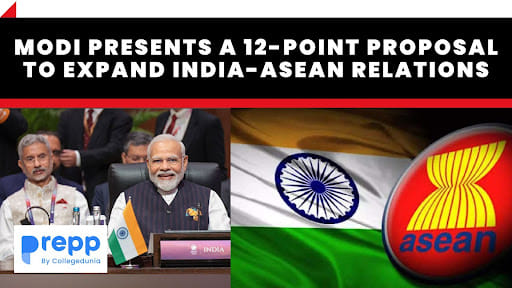
- Recently, the Prime Minister attended the 20th ASEAN-India Summit and the 18th East Asia Summit (EAS) in Jakarta on 7 September 2023.
- At the ASEAN-India Summit, the Prime Minister held extensive discussions with ASEAN partners on further strengthening of ASEAN-India Comprehensive Strategic Partnership and charting its future course.
- The Prime Minister presented a 12 point proposal to expand cooperation between India and the Association of Southeast Asian Nations (ASEAN).
Table of Contents
Key highlights of ASEAN-India summit
- PM Modi underscored the significance of ASEAN by emphasizing ASEAN's Centrality. He reaffirmed the central role of ASEAN in the Indo-Pacific region, recognizing its pivotal position in regional affairs.
- It was reiterated that ASEAN stands as a central pillar of India's Act East Policy, highlighting the importance of India's engagement with ASEAN nations.
- It was pointed out that the alignment and synergies between India's Indo-Pacific Ocean's Initiative (IPOI) and ASEAN’s Outlook on the Indo-Pacific (AOIP), indicate a shared vision for regional stability and growth.
- Theme of ASEAN Summit: PM Modi acknowledged that the theme of this year's ASEAN Summit, 'ASEAN Matters: Epicentrum of Growth,' underscores the significance of ASEAN's role as a focal point for economic development and regional progress.
About the 12-point proposal for strengthening India - ASEAN cooperation
- Multi-modal connectivity: A plan to establish a multi-modal connectivity and economic corridor connecting South East Asia, India, West Asia, and Europe.
- Digital infrastructure sharing: The offer to share India's digital public infrastructure stack with ASEAN partners, promoting digital cooperation.
- Collective fight against threats: A call for collective action against terrorism, terror financing, and cyber-disinformation, emphasizing the importance of addressing security challenges.
- Multilateral engagement: The proposal to collectively raise issues faced by countries in the Global South in multilateral forums, highlighting the need for global solidarity.
- Maritime cooperation: Adoption of a joint statement on maritime cooperation, fostering collaboration in maritime security and trade.
- Food security: Adoption of another joint statement on food security, indicating a commitment to addressing food-related challenges.
- ASEAN-India digital fund: Establishment of an ASEAN-India fund for the digital future, focusing on digital transformation and financial connectivity.
- Support for research institute: Announcement of renewed support for the Economic and Research Institute of ASEAN and East Asia (ERIA), promoting research and cooperation.
- Traditional medicine center: An invitation to ASEAN countries to join the Global Centre for Traditional Medicine being established by the World Health Organisation in India.
- Affordable medicines: offer to share India's experience in providing affordable and quality medicines through Jan-Aushadhi Kendras.
- Disaster resilience: Invitation to ASEAN countries to join the Coalition for Disaster Resilient Infrastructure, emphasizing preparedness for natural disasters.
- Mission LiFe: Called for working together on Mission LiFE.
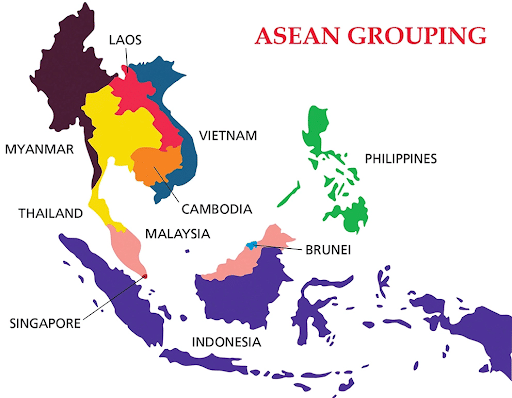
What is the Association of Southeast Asian Nations (ASEAN)?
About East Asia Summit
|
Significance of ASEAN for India
- ASEAN’s centrality in India’s foreign policy: ASEAN is a key pillar of India’s Act East Policy and Indo-Pacific Vision. A cohesive, responsive, and prosperous ASEAN is crucial for India’s regional ambitions.
- Maritime engagement: India and ASEAN collaborate to address both traditional and non-traditional security threats in the region, such as piracy and drug trafficking. Their cooperation also enables India to bypass critical choke points like the Malacca Strait in the Indian Ocean Region (IOR).
- Security: ASEAN and India are jointly working to establish a rules-based security architecture in the region, countering China's assertive policies.
- Economic: India is one of ASEAN’s top trading and investment partners. ASEAN countries offer a conducive environment for Indian businesses to invest and trade, and the region presents a lucrative market opportunity for Indian companies.
- Connectivity and development of northeast: India prioritizes enhancing connectivity and infrastructure in its Northeast region through the ASEAN-India connectivity project. This project is expected to drive progress and development in the Northeastern region of India.
- Cultural Connections: India shares deep historical and cultural connections with ASEAN countries. Examples include the spread of Hinduism and Buddhism from India to Southeast Asia and the influence of Indian languages on the region's scripts.
(*Click this link to read prelims specific weekly current affairs articles)
FAQs
Question: What is India’s Act East Policy?
Answer:
The Act East Policy was launched in 2014 at the East Asia Summit as an upgrade of the previous Look East Policy. It focuses on economic and security integration and widens its scope to East Asia and South-East Asia.
Question: What is East Asia Summit?
Answer:
The East Asia Summit (EAS) was established in 2005 as an Association of Southeast Asian Nations (ASEAN)-led initiative. The first EAS summit was held in Kuala Lumpur, Malaysia in 2005 and India is a founding member.
Question: What is ASEAN?
Answers:
It is a regional grouping that promotes economic, political, and security cooperation. It was established in August 1967 in Bangkok, Thailand with the signing of the ASEAN Declaration (Bangkok Declaration) by the founding fathers of ASEAN, namely Indonesia, Malaysia, Philippines, Singapore and Thailand.
UPSC Mains Practice Question:
|
MCQ
Question: The term ‘Regional Comprehensive Economic Partnership’ often appears in the news in the context of the affairs of a group of countries known as (UPSC 2016)
(a) G20
(b) ASEAN
(c) SCO
(d) SAARC
Answer: (b) See the Explanation
Regional Comprehensive Economic Partnership (RCEP) is a proposed trade agreement between the member states of the Association of Southeast Asian Nations (ASEAN) and its free trade agreement (FTA) partners.
Therefore, option (b) is the correct answer.
Download the PREPP App and attempt FREE IAS Exam Mock Tests and get complete study material!

Full Test - 04: UPSC CSE Prelims CSAT (Paper-II)
Full Test - 03: UPSC CSE Prelims CSAT (Paper-II)
UPSC CSE Prelims 2026 GS Paper 1 Question Paper (24-May-2026)
UPSC CSE Prelims 2026 CSAT Paper 2 Question Paper (24-May-2026)

17 February 2025 | The Hindu Must Read Articles | Current Affairs

16 February 2026 | The Hindu Must Read Articles | Current Affairs

13 February 2026 | The Hindu Must Read Articles | Current Affairs









Comments