Humidity and Types of Humidity - Geography Notes
Humidity is basically the amount of water vapour in the air. The amount of water vapour that the air can hold is determined by its temperature. Humidity is of three types namely absolute, relative, and specific humidity. This article will explain to you about humidity, their types, dew point and related concepts which will be helpful in preparing Geography for the UPSC Civil service exam.
|
Table of Contents |
Humidity - Concept
- Humidity is a measurement of the amount of water vapour present in the air, regardless of temperature.
- It's measured in gallons of water per cubic metre of air (g/m3).
- At different times of the day, it varies drastically from place to place.
- Humidity Capacity refers to the greatest quantity of moisture that the air can contain at a given temperature.
|
|
|
|---|---|
| Latent heat of Condensation | Clouds and Classification of Clouds |
| Convectional Rainfall | Global Distribution of Rainfall |
Types of Humidity
- Humidity is classified into three types namely
- Absolute Humidity
- Relative Humidity
- Specific Humidity
Absolute Humidity
- Absolute humidity represents the weight of the actual amount of water vapour contained in a unit volume of air.
- It is measured in grams per cubic metre.
- Absolute humidity varies from location to place on the earth's surface.
- As volume changes as an air mass ascends or descends, the absolute humidity varies with contraction or expansion of air, it is less commonly utilized by meteorologists.
- The numerators and denominators of a unit of measurement differ significantly, making it unsuitable for mathematical manipulation.
Relative Humidity
- The ratio between the entire capacity of the air to contain moisture at a particular temperature and the actual amount of moisture carried by it is known as relative humidity.
- It's measured in percentages.
- The relative humidity drops as the temperature rises.
- Over the oceans, relative humidity is higher, whereas, over the continental, it is lower.
- Dew point temperature is the temperature at which relative humidity reaches 100% and the air is said to be saturated.
- In other terms, the dew point temperature is the temperature at which moisture condensation begins when air is cooled. The saturation temperature of water vapour at its partial pressure is the same as this temperature.
Specific Humidity
- Specific humidity is measured by the weight of water vapour per unit weight of air.
- The specific humidity is unaffected by changes in pressure or temperature because it is measured in weight units (typically grammes per kilogramme).
- Specific Humidity is a constant, whereas Absolute and Relative Humidity are variable.
Dew Point
- At a certain temperature, the air is considered to be at a dew point when it contains moisture to its full capacity, i.e. when the air is saturated to 100 percent, or when the relative humidity is 100 %.
- It means that at that point, the air at that temperature is incapable of holding any extra moisture.
- Dew point is the temperature at which a given sample of air becomes saturated.
- Vapour condenses when the air temperature falls below the dew point temperature.
- When the dew point exceeds 0 degrees, the vapour condenses into a liquid droplet.
- When the dew point falls below zero degrees, the vapour condenses into ice crystals.
- Condensation occurs in free air when microscopic particles known as hygroscopic condensation nuclei cool.
- Due to their ability to absorb water, dust, smoke, and sea salt are particularly suitable nuclei.
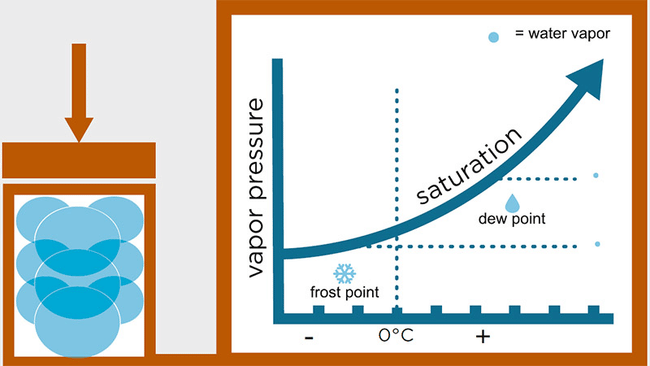
Dew Point
Dew point temperature
- The dew point temperature is the temperature at which humid air or gas must be cooled at constant pressure to the point where condensation begins to form.
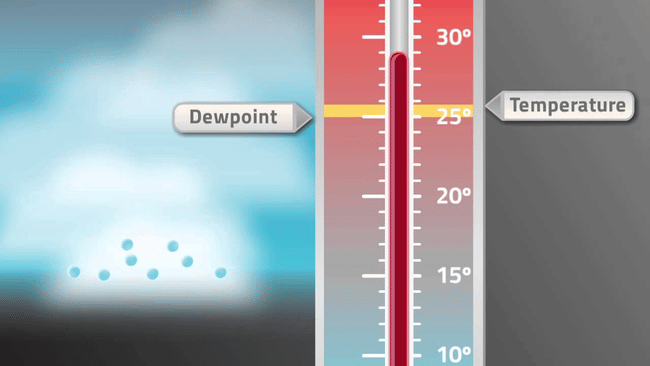
Dew Point Temperature
Significance of Humidity
- Humidity has a huge impact on human health because it affects our thermal comfort.
- Humidity can store a lot of energy and then release it when it converts to a liquid state, like rain.
- Humidity in the air stabilises our climate and avoids severe temperature swings due to its qualities.
Conclusion
Humidity thus impacts almost the majority of observable weather phenomena starting from clouds through the fog, rain to storms and finally to such dramatic weather phenomena as hurricanes. It is not even possible to forecast the weather exactly without comprehensive knowledge of humidity in all layers of the atmosphere. Thus humidity is the most important factor which has a huge impact on climatology.
|
|
|
|---|---|
| Geography Notes | Physical Geography |
| Elements of Weather and Climate | Climatology |
| Atmosphere | Lakes and Its Types |
| Geomorphology | Geomorphic Processes |
FAQs
Question: What is humidity?
Answer: Humidity refers to the amount of water vapor present in the air. It plays a significant role in weather patterns and human comfort. Higher humidity levels indicate more moisture in the air, leading to feelings of stickiness and potential precipitation.
Question: What are the different types of humidity?
Answer: The main types of humidity are Absolute Humidity, Relative Humidity, and Specific Humidity. Absolute Humidity is the total mass of water vapor in a given volume of air, Relative Humidity is the ratio of the current amount of water vapor to the maximum possible amount, and Specific Humidity refers to the mass of water vapor per unit mass of air.
Question: How is relative humidity measured?
Answer: Relative Humidity is measured using a hygrometer or psychrometer. It is expressed as a percentage, representing the current amount of moisture in the air compared to the maximum amount the air can hold at a given temperature.
Question: What happens when relative humidity reaches 100%?
Answer: When relative humidity reaches 100%, the air is fully saturated with water vapor, and condensation begins. This can result in the formation of dew, fog, or precipitation, depending on the temperature and atmospheric conditions.
Question: Why is humidity important for weather prediction?
Answer: Humidity plays a critical role in weather prediction as it affects cloud formation, precipitation, and temperature. High humidity levels often indicate the likelihood of rain or storms, while low humidity can lead to dry conditions and clear skies.
MCQs
1. Which of the following is the best description of absolute humidity?
A) The total mass of water vapor in a given volume of air
B) The mass of water vapor per unit mass of air
C) The ratio of water vapor present in the air to the maximum amount it can hold
D) The total amount of moisture that the air can hold at a specific temperature
Answer: A See the Explanation
Explanation: Absolute Humidity refers to the total mass of water vapor present in a given volume of air, without accounting for temperature changes.
2. What happens when the relative humidity is 100%?
A) The air feels cooler
B) The air is saturated with water vapor
C) The air cannot hold more water vapor
D) Both B and C
Answer: D See the Explanation
Explanation: At 100% relative humidity, the air is fully saturated with water vapor, and no more moisture can be held. Condensation occurs, leading to precipitation, fog, or dew.
3. Which instrument is commonly used to measure relative humidity?
A) Barometer
B) Thermometer
C) Hygrometer
D) Anemometer
Answer: C See the Explanation
Explanation: A hygrometer is an instrument used to measure relative humidity by determining the moisture content in the air. A psychrometer is also used for this purpose.
4. Specific humidity is defined as:
A) The total mass of water vapor in a volume of air
B) The ratio of water vapor to the total mass of air
C) The percentage of water vapor in the air
D) The amount of water vapor at saturation point
Answer: B See the Explanation
Explanation: Specific Humidity refers to the mass of water vapor per unit mass of air, indicating how much moisture is present in the air relative to the total air mass.
5. What type of humidity is most commonly used in weather forecasts?
A) Absolute Humidity
B) Relative Humidity
C) Specific Humidity
D) Saturation Humidity
Answer: B See the Explanation
Explanation: Relative Humidity is most commonly used in weather forecasts because it provides information on how close the air is to being saturated with moisture, which affects weather patterns like precipitation.
GS Mains Questions and Answers
Q1: Explain the role of humidity in the formation of clouds and precipitation.
Answer: Humidity, particularly relative humidity, plays a crucial role in cloud formation and precipitation. When air contains high levels of water vapor and cools to its dew point, the water vapor condenses to form cloud droplets. These droplets coalesce, and when they become too heavy to remain suspended, precipitation occurs. The process is driven by the availability of moisture in the atmosphere, making humidity a key factor in predicting rain, storms, and weather patterns.
Q2: Discuss how changes in humidity affect human comfort and health.
Answer: Humidity directly affects human comfort and health. High humidity levels make it difficult for sweat to evaporate, leading to a feeling of stickiness and discomfort. In extreme cases, high humidity can cause heat-related illnesses such as heat exhaustion or heatstroke. Low humidity, on the other hand, can lead to dry skin, respiratory issues, and dehydration. Optimal indoor humidity levels are between 30% and 50%, where the body can regulate temperature efficiently.
Q3: Evaluate the importance of measuring humidity in weather forecasting and climate studies.
Answer: Measuring humidity is essential in weather forecasting as it influences cloud formation, precipitation, and temperature. Humidity levels help forecasters predict rain, snow, storms, and fog, all of which are critical for agriculture, travel, and public safety. In climate studies, long-term changes in humidity patterns can indicate shifts in regional climates, such as the expansion of deserts or increased precipitation in certain areas. Understanding humidity trends is vital for preparing for weather extremes and climate change.
Previous Year Questions on Humidity
1. UPSC CSE Prelims 2021:
Question: Which instrument is used to measure relative humidity?
A) Barometer
B) Anemometer
C) Hygrometer
D) Thermometer
Answer: C
Explanation: A hygrometer is used to measure relative humidity, providing an indication of how much moisture is in the air relative to what the air can hold at a specific temperature.
2. UPSC CSE Mains 2020 (GS Paper 1):
Question: Discuss the impact of relative humidity on the occurrence of monsoons in the Indian subcontinent.
Answer: Relative humidity plays a critical role in the onset and intensity of monsoons in the Indian subcontinent. As moisture-laden winds from the Indian Ocean reach land, the high relative humidity in the air contributes to heavy rainfall, particularly along the Western Ghats and northeastern regions. The interaction between temperature, humidity, and wind patterns drives the monsoon system, making the measurement of humidity crucial for monsoon predictions and agricultural planning in India.
Download the PREPP App and attempt FREE IAS Exam Mock Tests and get complete study material!

Full Test - 04: UPSC CSE Prelims CSAT (Paper-II)
Full Test - 03: UPSC CSE Prelims CSAT (Paper-II)
UPSC CSE Prelims 2026 GS Paper 1 Question Paper (24-May-2026)
UPSC CSE Prelims 2026 CSAT Paper 2 Question Paper (24-May-2026)

17 February 2025 | The Hindu Must Read Articles | Current Affairs

16 February 2026 | The Hindu Must Read Articles | Current Affairs

13 February 2026 | The Hindu Must Read Articles | Current Affairs









Comments