Universe and Solar System - Geography Notes
The universe is a vast expanse of free space that contains everything from the tiniest particle to the most massive galaxies. The Solar system is a planetary system that occurs in the Milky Way galaxy, which is part of the Universe itself. It includes all galaxies, clusters of galaxies, etc. The solar system is 4.6 billion years old. The solar system has a diameter more than 40 times greater than the distance to the sun, but the solar system is a tiny part of a much larger galaxy. This article will explain the concepts of the Universe and Solar System which is an integral part of the UPSC Exam Geography syllabus.
|
Table of Contents |


Infographic of the Universe and the Solar System
The Universe
- All the existing matter and space including stars, planets, galaxies, etc. is termed as Universe.
- The word "universe" is derived from the Latin word "universum," which was used by the Romans to describe the globe and cosmos.
- The Universe is made up of everything that exists, from Galactic Mega Clusters to subatomic particles.
- Scientists agree that the Universe is roughly 13.79 billion years old as of 2015.
- The Universe is made up of a large number of galaxies.
- The visible universe contains about 100 billion galaxies, according to optical and radio telescope studies.
- For the origin of the Universe, the Big Bang Theory is the most acceptable one.
|
|
|
|---|---|
| The Universe | Earth and Its Properties |
| The Solar System | Geomagnetism |
| Formation of Planets | Paleomagnetism |
| Origin of Earth | Big Bang Theory |
Composition of the Universe

The cosmological composition of the Universe
- Dark Energy (73%): A mysterious form of energy that is spread out uniformly throughout space and which has anti-gravitational properties.
- Dark Matter (23%): We can't see matter since it doesn't emit visible radiation, but it can be detected gravitationally.
- Hydrogen & Helium Gas (4%): Hydrogen and helium are the most abundant elements in the universe.
- Stars (0.5%): A brightly shining ball made largely of hydrogen and helium gas. Our Sun is a celestial body.
- Neutrino (0.3%): A small particle that has no charge and is thought to have very little mass. Neutrinos are created in energetic collisions between nuclear particles.
- Heavy elements (0.03%): It includes planets, etc.
Galaxy
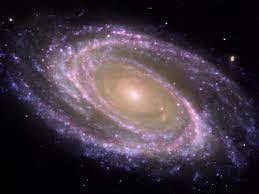
- A galaxy is made up of millions or billions of stars and planets held together by gravity.
- One of these galaxies is our Milky Way. This galaxy contains the planet Earth.
- It is known as the Milky Way because it resembles a river of milky light flowing from one corner of the sky to another.
- It takes the form of a spiral.
- Andromeda is the closest galaxy to our own.
- Andromeda is a spiral galaxy 2.5 million light-years away from Earth.
The Solar System
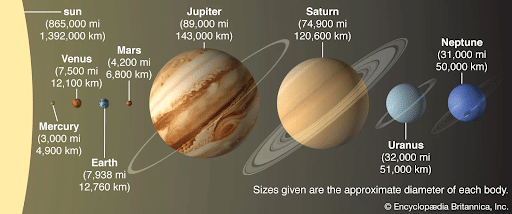
- The solar system is enormous, with a diameter of at least 100 Astronomical Units (15 trillion km). Our Solar System is thought to be over 4.6 billion years old, according to several experts.
- The enormous gravitational force of the sun holds it together, keeping planets and asteroids in orbit around it. The earth is the densest of all the planets in our solar system.
- The nine known planets and their moons, as well as smaller objects orbiting the sun known as comets, asteroids, and meteoroids, make up the solar system's largest and most important components.
Formation of Solar System
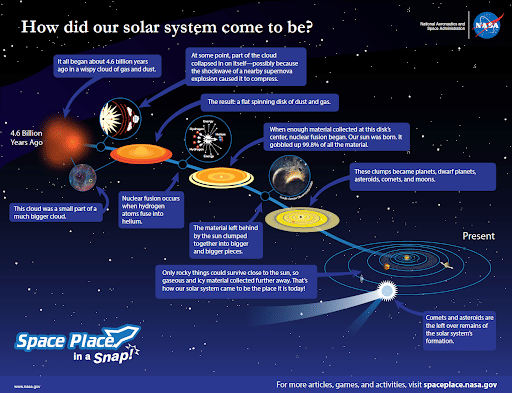
- Supernova Explosion: The solar system, according to scientists, was formed when a cloud of gas and dust in space was disturbed, possibly by the explosion of a nearby star known as SUPERNOVA.
- This explosion sent shockwaves into space, compressing the gas and dust cloud.
- Formation of Nebula: Gravity drew the gas and dust together, forming a solar nebula, as the cloud began to collapse.
- Nuclear Fusion: At the dense center of this nebula, the sun's nuclear flames erupted. In the churning currents of the vast cloud, the planets were created.
- Clumps of material to Planets: Mercury, Venus, Earth, and Mars all began as rock globes orbiting the Sun. It was impossible to capture them since they were too small and had weak gravitational fields.
- The enormous planets Jupiter and Saturn, which are far from the sun and have powerful gravitational fields, did, nevertheless, draw and hold thick gaseous atmospheres of Hydrogen and Helium.
The Sun
- Our solar system's largest object is the sun. It is roughly 109 times the size of Earth.
- The Sun has a diameter of 1,392,000 kilometres. It comprises 99.8% of the mass of the solar system.
- The sun is a star with a surface temperature of 60000 degrees Celsius. It is largely made up of hydrogen gas, with a minor quantity of helium thrown in for good measure.
- The Sun is the solar system's closest star. It belongs to the Milky Way galaxy. It's thought to be more than 4 billion years old.
- The Sun is a yellow dwarf, a medium-sized star. As it rotates around the galaxy, the Sun spins gently on its axis.
- The Earth would be a dead sphere of rock and ice if it were not for the Sun. The Sun warms our globe, influences our weather, and provides energy to plants, which provides food and energy for life on Earth.
- The Sun's energy reaches the Earth and other planets in all directions. The planet absorbs less energy as it gets further away from the Sun.
Other Objects in the Solar System
- Asteroids: Asteroids are rocky and metallic objects that orbit the Sun but aren't large enough to be termed planets. Minor planets are what they're called.
- The majority of the asteroids in our solar system orbit the Sun between Mars and Jupiter's orbits. The "asteroid belt" is a term used to describe this region.
- A few asteroids are getting closer to the Sun.
- Asteroid belt: The asteroid belt is a doughnut-shaped cluster of asteroids orbiting the Sun between Mars and Jupiter's orbits, closer to Mars' orbit.
- Meteors, Meteoroids, Meteorites:
- Meteoroids: Aside from asteroids, the Sun is also orbited by smaller rocks and dust particles. These particles of rock or dust make their way into the atmosphere.
- Meteors: Meteoroids come into contact with a lot of friction as they pass through the atmosphere, which causes them to heat up and burn out.
- Almost all the material is vaporized in Earth's atmosphere, leaving a bright trail fondly called "shooting stars."
- Meteorites: Some are so massive that a piece of it falls to Earth as a meteorite. It is a piece of debris that collides with the Earth. When it collides with the ground, it can create a hole or crater.
- The hole gets bigger as the meteorite gets bigger. Lonar Lake in Maharastra is believed to be the result of one such impact.
- Satellites: Satellites are celestial objects that orbit planets and are part of the solar system. The Moon is the Earth's satellite. Some satellites, like Ganymede (which orbits Jupiter), are larger than Mercury and have atmospheres.
- Artificial satellites: Artificial satellites, which are man-made, are also an important part of the solar system.
- These satellites orbit the Earth far closer than the moon, which is the Earth's natural satellite.
- Aryabhata is India's first artificial satellite.
- India has launched a number of other satellites, including INSAT, IRS, and EDUSAT.
- Comets: Comets are small icy objects with irregular shapes. They usually come from the Kuiper Belt, which is located beyond Neptune in the solar system's far reaches.
- When these objects approach the sun, the ice evaporates, leaving behind a lovely tail.
- Some of these comets return on a regular basis, such as Halley's Comet, which returns every 76 years.
- The Halley's Comet will be next seen in 2061.
Constellation
- A constellation is a group of stars in the night sky that form an imagined shape.
- It aids in the navigation of maritime vessels at night because they are visible in a fixed direction at a specific time of year.
- Constellations such as Orion, Big Dipper, Great Bear, and Cassiopeia are examples.
Formation of Planets
- Planets were formed at least 4.6 billion years ago when gravity caused discs of dust and gas orbiting the sun to collapse and clump together.
- This disc, known as the solar nebula, was primarily made up of hydrogen and helium, with minor amounts of other elements.
- Planets are divided into two categories: terrestrial and extra-terrestrial.
- Mercury, Venus, Earth, and Mars are rocky planets that are largely formed of solid rock and metal.
- Jupiter, Saturn, Uranus, and Neptune are gas giants that are largely made up of gases like hydrogen, helium, and methane.
- In comparison to rocky planets, these gas giants are enormous.
Earth and its Properties
- Earth, like the other planets, is thought to have formed 4.5 billion years ago from a solidified cloud of dust and gases left over from the Sun's formation.
- Almost every discipline of natural science has contributed to a better knowledge of the major events of Earth's history, which has been marked by ongoing geological change and biological development.
- The study of the record of the earth's magnetic field using magnetic fields preserved in rocks, silt, or archaeological materials is known as Palaeomagnetism.
- Geomagnetism, also known as the geomagnetic field, is the study of all aspects of the Earth's magnetic field which surrounds our planet in the magnetosphere.
- Earth has numerous characteristics that distinguish it from other planets and planetary bodies in the solar system and the Milky Way galaxy.
- Along with Venus, Mercury, and Mars, it is one of four rocky planets and the fifth largest planet after Neptune, Uranus, Saturn, and Jupiter.
- With a density of 5.52 grams per cubic inch, Earth is the densest large body in the solar system.
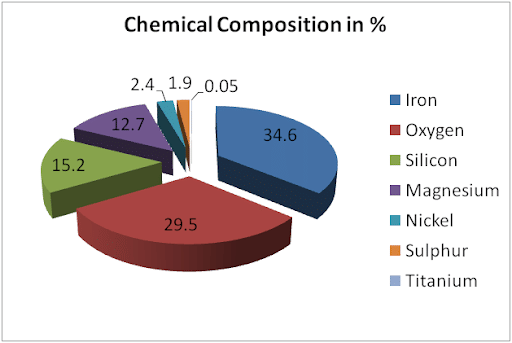
- 34.6 percent iron, 29.5 percent oxygen, 15.2 percent silicon, 12.7 percent magnesium, 2.4 percent nickel, 1.9 percent sulfur, and 0.05 percent titanium make up this alloy.
- The availability of water and oxygen are two distinguishing characteristics of the Earth.
- Water comprises around 71% of the Earth's surface, with the majority of that water being in the oceans.
- Oxygen, which is created by plants, makes up around a fifth of Earth's atmosphere.
- The temperature, pressure, and density of the Earth's interior gradually rise with depth.
- A specific Earth material may act as a brittle solid, distort like plastic, or melt and become liquid depending on the temperature and depth.
Theories of Earth’s and Universe’s Origin
Kantian Hypothesis:
- Central Idea: Kant proposed that the solar system's origin lay in a cloud of dispersed particles.
- Initiating Factors: He suggested that mutual gravitational attractions among the particles caused them to start moving and colliding.
- Chemical Forces: At the point of collision, chemical forces were believed to have kept the particles bonded together.
- Formation of Planets: Larger aggregates grew more rapidly, ultimately forming the planets.
- Limitations: Kant's limited expertise in physics and mathematics led to intrinsic limitations in his model.
- Observable Phenomena: The model fails to account for observed phenomena, such as planets moving in the same direction and plane around the Sun, and the revolution of planetary satellites.
Nebular Hypothesis of Laplace
- Kant's theory was revised in 1976 by mathematician Laplace.
- According to the nebular hypothesis, the Sun was encircled by a solar nebula made up primarily of hydrogen and helium, as well as dust.
- The development of a disk-shaped cloud is caused by particle impact and friction.
- Planets were formed from material associated with the young sun as a result of the accretion process.
Binary Theory or Planetesimal Hypothesis of Chamberlin
- In 1900, Chamberlain and Moulton gave this theory.
- Another wandering star, according to theory, approached the sun. As a result, the material's cigar-shaped extension from the solar surface was separated.
- The sun with its very high-temperature projects hot material called the prominences, thousands of kilometers away from it.
- The particles of this material coalesced to form the planets. A lot of heat was generated in the process.
- Separated material slowly condensed into a planet as the passing star moved away, and the sun continued to spin.

Big Bang Theory TimeLine
Big Bang Theory
- The expanding universe hypothesis is another name for this theory.
- Edwin Hubble demonstrated the expansion of the universe in 1920. The distance between galaxies is getting longer over time.
- According to the Big Bang theory, all of the matter that made up the universe resided in a single location with a volume smaller than an atom, an unlimited temperature, and an infinite density.
- Around 13.7 billion years ago, it burst with a huge bang. The first atom was produced within three minutes of the big bang event. The energy was transformed into matter over time.
- Around 3 lakh years after the Big Bang, the universe turned transparent due to the production of atomic matter
*To read more about this topic, click this link Big Bang Theory
Conclusion
With advancements in natural sciences, there has been evidence supporting the Big Bang theory. Expanding universe, Cosmic Microwave Background(CMB), and Gravitational waves are some of these evidence throwing light on the evolution of the Universe and solar system.
|
|
|
|---|---|
| Geography Notes | Theories of Origin of Earth |
| Physical Geography | Geomorphology |
FAQs
Question: What is the Big Bang Theory?
Answer: The Big Bang Theory is the most widely accepted explanation of the origin of the universe. It proposes that the universe began from a singular point about 13.8 billion years ago and has been expanding ever since.
Question: How many planets are there in the solar system?
Answer: The solar system consists of eight planets: Mercury, Venus, Earth, Mars, Jupiter, Saturn, Uranus, and Neptune. These planets revolve around the Sun.
Question: What is the significance of the Sun in the solar system?
Answer: The Sun is the central star of the solar system and provides the necessary light and energy to sustain life on Earth. It is also responsible for the gravitational force that keeps the planets in orbit.
Question: What are terrestrial planets and gas giants?
Answer: Terrestrial planets are rocky planets with solid surfaces, including Mercury, Venus, Earth, and Mars. Gas giants like Jupiter and Saturn are composed mainly of hydrogen and helium, with no solid surface.
Question: What is the difference between asteroids and comets?
Answer: Asteroids are rocky objects, mostly found in the Asteroid Belt between Mars and Jupiter. Comets are made of ice and dust and develop a glowing coma and tail when they approach the Sun due to the sublimation of their icy components.
MCQs
1. What is the estimated age of the universe according to the Big Bang Theory?
A. 4.5 billion years
B. 13.8 billion years
C. 8.7 billion years
D. 10.2 billion years
Answer: (B) See the Explanation
The Big Bang Theory estimates the age of the universe to be around 13.8 billion years, based on the observed expansion of the universe and cosmic background radiation.
2. Which galaxy does our solar system belong to?
A. Andromeda
B. Sombrero
C. Milky Way
D. Triangulum
Answer: (C) See the Explanation
Our solar system is part of the Milky Way Galaxy, which is a spiral galaxy containing billions of stars, including the Sun.
3. Which planet is known as the “Gas Giant”?
A. Mars
B. Earth
C. Jupiter
D. Mercury
Answer: (C) See the Explanation
Jupiter is known as a Gas Giant because it is composed mainly of hydrogen and helium and lacks a solid surface. It is the largest planet in the solar system.
4. Where is the Asteroid Belt located in the solar system?
A. Between Earth and Mars
B. Between Mars and Jupiter
C. Between Venus and Earth
D. Between Saturn and Uranus
Answer: (B) See the Explanation
The Asteroid Belt is located between the orbits of Mars and Jupiter and contains numerous rocky bodies, including asteroids of various sizes.
5. What is the main difference between terrestrial planets and gas giants?
A. Terrestrial planets have rings, while gas giants do not
B. Terrestrial planets have solid surfaces, while gas giants are composed mainly of gases
C. Terrestrial planets are larger than gas giants
D. Terrestrial planets are made of ice, while gas giants are made of rock
Answer: (B) See the Explanation
Terrestrial planets like Earth have solid rocky surfaces, whereas gas giants like Jupiter and Saturn are composed mainly of gases such as hydrogen and helium and lack solid surfaces.
GS Mains Questions and Model Answers
Q1: Discuss the significance of the Sun in the solar system and its impact on Earth’s climate and life.
Answer: The Sun is the central star of the solar system, and it plays a crucial role in sustaining life on Earth. It provides the necessary light and energy that drive biological processes such as photosynthesis, which supports life on Earth. The Sun’s gravitational force keeps the planets in orbit and maintains the stability of the solar system.
Moreover, the Sun influences Earth’s climate through solar radiation, which affects weather patterns and ocean currents. Variations in solar activity, such as solar flares, can also impact Earth’s magnetic field and technological systems. The Sun is essential for maintaining the balance of life, climate, and planetary motion in the solar system.
Q2: Explain the differences between terrestrial planets and gas giants in the solar system.
Answer: Terrestrial planets (Mercury, Venus, Earth, and Mars) are rocky planets with solid surfaces. They are smaller, denser, and have relatively thin atmospheres. Terrestrial planets are primarily composed of silicate rocks and metals, and they are located closer to the Sun.
Gas giants (Jupiter and Saturn) and ice giants (Uranus and Neptune) are much larger and composed mainly of gases like hydrogen and helium. They lack solid surfaces and have extensive atmospheres with strong winds and storms. Gas giants are located farther from the Sun and have numerous moons and ring systems. These differences highlight the diversity of planetary types in the solar system.
Q3: Describe the Big Bang Theory and its importance in understanding the origin of the universe.
Answer: The Big Bang Theory is the most widely accepted explanation of the origin of the universe. It proposes that the universe began as a singularity—a point of infinite density and temperature—approximately 13.8 billion years ago. The universe has been expanding ever since.
The theory is supported by evidence such as the cosmic microwave background radiation and the redshift of galaxies, which indicate that the universe is still expanding. The Big Bang Theory is important because it provides a framework for understanding the formation and evolution of galaxies, stars, and planets. It also helps scientists explore fundamental questions about the universe’s origins and future.
Previous Year Questions from Universe and Solar System
1. UPSC CSE Prelims 2020
Question: Which of the following correctly explains the composition of gas giants in the solar system?
A. Mostly made up of rock and metal
B. Composed mainly of hydrogen and helium
C. Made up of ice and ammonia
D. Composed of water and silicate materials
Answer: B
Explanation: Gas giants like Jupiter and Saturn are composed mainly of hydrogen and helium, which are the lightest and most abundant elements in the universe. These planets lack solid surfaces and have deep atmospheres.
2. UPSC CSE Mains 2019 (GS Paper 1)
Question: Discuss the impact of the Big Bang Theory on our understanding of the universe and the scientific evidence that supports it.
Explanation: The Big Bang Theory revolutionized our understanding of the universe by explaining its origin as a singular event that occurred approximately 13.8 billion years ago. It suggests that the universe has been expanding ever since, with galaxies moving away from each other.
Scientific evidence supporting the Big Bang Theory includes the cosmic microwave background radiation (CMB), which is the remnant heat from the Big Bang, and the redshift of galaxies, observed by astronomers, indicating the universe’s expansion. These discoveries have helped scientists better understand the universe's age, structure, and evolution.
Download the PREPP App and attempt FREE IAS Exam Mock Tests and get complete study material!

Live Test : UPSC CSE Prelims CSAT (Paper-II) (Oct 20 - 23)
Full Test - 04: UPSC CSE Prelims CSAT (Paper-II)
Full Test - 03: UPSC CSE Prelims CSAT (Paper-II)
UPSC CSE Prelims 2026 GS Paper 1 Question Paper (24-May-2026)
UPSC CSE Prelims 2026 CSAT Paper 2 Question Paper (24-May-2026)

17 February 2025 | The Hindu Must Read Articles | Current Affairs

16 February 2026 | The Hindu Must Read Articles | Current Affairs

13 February 2026 | The Hindu Must Read Articles | Current Affairs









Comments