Geomagnetism - Geography Notes
Geomagnetism is the study of the dynamism of the Earth's magnetic field. Geomagnetism is also known as the geomagnetic field. Geomagnetic field surrounds the earth in the form of the magnetosphere. It refers to Earth's magnetic field generated by the motions of the fluids in the planet's outer core. Geomagnetism impacts a wide range of phenomena from the navigation of birds to the functioning of our technological apparatus. Geomagnetism is an important part of the UPSC Geography Syllabus.
What is Geomagnetism?
- Geomagnetism is the study of Earth's magnetic field and its origin, nature, and effects.
- The Earth behaves like a giant magnet, with its field extending into space and influencing various terrestrial and celestial phenomena.
- It began in ancient China and Greece, when the properties of natural magnets (lodestones) were first identified.
- The geomagnetic field serves as both an umbrella, covering us from cosmic radiation, and a window, providing one of the few looks into the Earth's inner workings.
- The magnetosphere (zone where we can sense the magnetic effect) stretches around 60,000 kilometers above the earth's surface.
- The magnetic field of the Earth extends up to 3200 km, which can dispel solar wind and preserve the planet from destruction.
- It shields us from solar flares and plays a key role in preventing the sun's dangerous gamma rays.
- The solar wind would degrade our atmosphere without the magnetosphere, depriving our planet of the life-giving air we breathe.
- The magnetosphere also shields Earth from massive amounts of particle radiation released during coronal mass ejection (CME) events, as well as cosmic rays falling from outer space.
- The magnetosphere repels damaging energy and traps it in zones known as the Van Allen radiation belts.
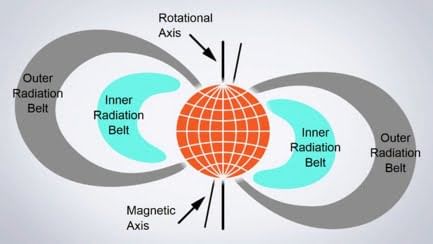
- Earth's magnetic field is disrupted during exceptionally severe space weather events, such as high solar winds or big CMEs, and geomagnetic storms can enter the magnetosphere, causing extensive radio and power outages and threatening astronauts and Earth-orbiting spacecraft.
- Through the investigation of oceanic magnetic anomalies, geomagnetism offers a highly important tool for retrieving historical plate motions.
- The Earth's magnetic field is known to have moved and reversed over time. Because it has generally strayed at a rate of only 9 km per year, scientists can easily follow its location.
- After the turn of the century, however, this speed increased to 50 kilometers each year.
- The Earth's continuous magnetic field is generated by a variety of sources, both above and below the surface of the planet.
- Magnetic reversal of Earth’s magnetic field:
- The Earth's magnetic field is known to have moved and reversed over time. Because it has generally strayed at a rate of only 9 km per year, scientists can easily follow its location.
- After the turn of the century, however, this speed increased to 50 kilometers each year.
- The Earth's continuous magnetic field is generated by a variety of sources, both above and below the surface of the planet.
Cause of Geomagnetism: Dynamo Theory
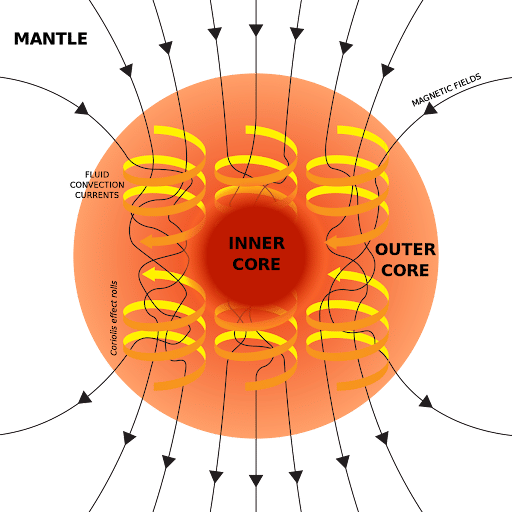
Convection currents in the outer core. Spiral motion is caused due to the Coriolis Effect
- The Dynamo Theory suggests that magnetic fields in large celestial bodies (like Earth) are generated by the movement of electrically conducting fluids.
- Primarily the molten Iron and Nickel in the outer core of Earth is the conducting fluid.
- Cause of convection current: Heat from the radioactive decay in the inner core and the heat from the mantle causes the liquid metal in the outer core to move in convection currents.
- As the conducting fluid (molten iron and nickel) moves, it generates electric currents.
- Coriolis effect: The rotation of the Earth affects the flow of the liquid metal, causing it to move in spirals due to the Coriolis effect. This spiral or helical motion of the conducting fluid, combined with the Earth's rotation, twists and contorts the generated electric currents.
- Amplification of magnetic field: The movement of these electric currents, combined with the existing magnetic field, amplifies the field and maintains it, ensuring that it doesn't decay over time.
- This phenomenon, where the motion of the electrically conducting fluid sustains the magnetic field, is the crux of the dynamo effect.
- The Dynamo Theory is crucial because it:
- Explains the presence of Earth’s magnetic field.
- Helps understand magnetic field reversals, where the North and South magnetic poles switch places.
- Provides insights into magnetic fields of other celestial bodies, like stars and other planets.
- Study of Interactions of Magnetic Field
| Other Relevant Links | |
|---|---|
| The Universe | Formation of Planets |
| The Solar System | Earth and Its Properties |
| Origin of Earth | Paleomagnetism |
| Formation of Earths Atmosphere | Theories of Origin of Earth |
Geomagnetism in Other Planets
- The magnetic field of Earth is not the only one in the solar system.
- Jupiter, Saturn, Uranus, and Neptune all have magnetic fields that are many times stronger than Earth's.
- The underlying mechanisms that drive these magnetic fields are not fully understood.
- Mars lacks both the inner heat and the liquid interior required to form a magnetic field.
- Venus, on the other hand, has a liquid core but spins too slowly to generate a magnetic field.
Magnetic and Geomagnetic Poles
- There are two types of poles on Earth: Geographic poles and Magnetic poles.
- Imagine a giant bar magnet inside our planet, roughly aligned with the Earth's axis, to represent the magnetic field.
- Each end of the magnet is located within 10 degrees of the geographic North and South poles.
- At each magnetic pole, the Earth's invisible magnetic field lines move in a closed, continuous loop and are nearly vertical.
Magnetic Poles
- When a magnet is suspended, its North pole is thought to be the pole that is pulled to the Earth's North Magnetic Pole.
- Because opposing poles attract, the Earth's North Magnetic Pole is also the South Magnetic Pole of its Magnetic Field.
- The rotation axis of the Earth and the magnetic dipole field are often aligned rather closely; in other words, the magnetic poles are typically close to the geographic poles (the earth's axis passes through these poles), which is why a compass works.
- However, the north and south magnetic poles invert when the dipole component of the field reverses after a few thousand years.
- The magnetic North Pole of the Earth is rapidly shifting from the Canadian Arctic to Russia.
Geomagnetic Poles
- The geomagnetic poles (dipole poles) are the intersections of the Earth's surface and the axis of a bar magnet that is hypothetically positioned at the planet's core.
- The poles are referred to as "the geomagnetic north pole" and "the geomagnetic south pole," with one in each hemisphere.
- The geomagnetic dipole is currently inclined at an angle of around 11 degrees to the Earth's spinning axis.
- Magnetic needles, on the other hand, revolve vertically at the magnetic poles (the magnetic north pole and the magnetic south pole).
- The disparity between the magnetic and geomagnetic poles is caused by the uneven and convoluted distribution of the Earth's magnetic field.

Geographic Pole vs Geomagnetic Pole
Geomagnetic Reversal
- A Geomagnetic Reversal, commonly referred to as a magnetic pole reversal or polarity reversal, is a change in the Earth's magnetic field where the magnetic north and south poles switch places.
- These reversals don't happen overnight. They can take thousands of years to complete.
- During this period, the strength of the magnetic field may decrease, and the field itself can become complex with multiple north and south magnetic poles around the Earth.
- There isn't a consistent frequency for geomagnetic reversals. Sometimes they can occur in quick successions, while at other times, there might be millions of years between reversals.
- The last reversal, named the Brunhes-Matuyama reversal, occurred approximately 780,000 years ago.
- The exact cause of geomagnetic reversals isn't completely understood. However, they are believed to be linked to convective motions within the Earth's outer liquid iron core, which generates the magnetic field through the dynamo effect.
- There's no strong evidence that geomagnetic reversals have directly caused extinctions or had significant impacts on biota.
- However, during periods of reduced magnetic field strength, the Earth has less protection from solar radiation, which could impact the atmosphere and climate.
- The history of geomagnetic reversals has been documented through studies of the magnetic orientations in rocks, particularly in ocean floor basalts.
- As magma emerges from mid-ocean ridges and solidifies, iron-bearing minerals within the magma align with the Earth's current magnetic field.
- Over time, this creates a "zebra stripe" pattern on the ocean floor, reflecting alternating bands of normal (north magnetic pole near the North Pole) and reversed (north magnetic pole near the South Pole) magnetization.
- Geomagnetic reversals offer insight into the behavior of Earth's core and have been invaluable in studies related to plate tectonics, especially in confirming the theory of seafloor spreading.
Polar Shift Theory
- The North Magnetic Pole is located to the north of Ellesmere Island in northern Canada and is rapidly drifting towards Siberia (86 N, 172 W). The South Magnetic Pole is currently located off the coast of Antarctica, well beyond the Antarctic Circle
- Earth’s magnetic field is known to have wandered and flipped in the geologic past. This wandering has generally been quite slow, around 9 km a year, allowing scientists to easily keep track of its position. But since the turn of the century, this speed has increased to 50 km a year.
- Recently, Earth’s magnetic North Pole has drifted so fast that the World Magnetic Model (a large spatial-scale representation of the Earth's magnetic field) had to officially redefine the location of the magnetic North Pole much earlier than expected.
- Earth’s magnetic North Pole is quickly moving from the Canadian Arctic towards Russia.
Possible Impacts of Shifting Earth’s Magnetic North Pole
- Navigation: The altering geomagnetic field, as well as the events that accompany it, can help or hinder navigation and surveying procedures.
- Communication and Infrastructure: It has the potential to obstruct geophysical research, interrupt electric power utilities, and pipeline operations, as well as affect the operation of contemporary communication networks, satellites, and other systems.
- Impact on solar radiation: Shifting poles can also impact the strength of Earth's magnetic field, which helps to keep dangerous solar radiation and cosmic rays out of the atmosphere.
- Impact on biodiversity: Animals that rely on the Earth's magnetic field for navigation, such as birds, salmon, and sea turtles, may become disoriented during the storm.
Magnetic Declination
- Magnetic declination is the angle between magnetic north and true north.
- It is positive when the angle derived is east of the true north, and it is considered negative when the angle measured is west of the true north.
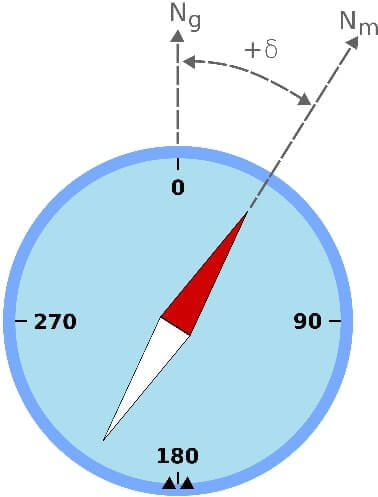
Magnetic Declination
Magnetic Inclination or Magnetic Dip
- Magnetic Inclination: The angle formed by a compass needle when it is held vertically is known as magnetic inclination.
- Magnetic Equator: The magnetic equator is an uneven imaginary line that passes around the globe near the equator. It has no dip (because magnetic field lines are parallel to the horizontal at the equator).
- Like the magnetic field and poles, the magnetic equator is not fixed. The magnetic dip is 0 at the magnetic equator and 90 at the magnetic poles.

Magnetic Inclination
Magnetosphere
- The magnetosphere is the space region above the ionosphere that is defined by the Earth's magnetic field.
- It stretches into space for tens of thousands of kilometers, shielding the Earth from charged particles in the solar wind and cosmic rays that would otherwise deplete the upper atmosphere, including the ozone layer, which protects the Earth from damaging UV radiation.
- The Sun's heliosphere includes the magnetosphere, astrosphere, and outermost layer of the Sun’s atmosphere. Sun's magnetosphere is fundamental to the overall dynamics of the solar system, influencing planetary atmospheres, protecting against cosmic radiation, and playing a key role in space weather phenomena.

Earth’s magnetosphere
Magnetopause
- The solar wind distorts the Earth's magnetic field, which is mostly dipolar at its surface. There is a force exerted by the solar wind. The Earth's magnetic field, on the other hand, keeps it at bay.
- The magnetosphere's boundary is the magnetopause, a zone where pressures are equal.
- Despite its name, the magnetosphere is asymmetric, with the sunward side stretching out around 10 Earth radii and the other side spilling out beyond 200 Earth radii in a magnetotail.
Magnetosheath
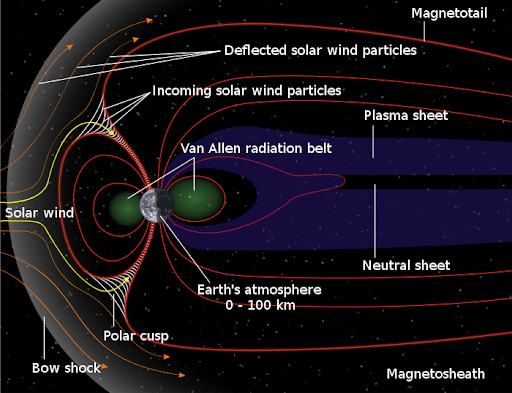
- This region lies between the magnetopause and the bow shock (an area where the solar wind slows abruptly).
- The magnetosheath is filled with turbulent plasma from the solar wind.
- It acts as a cushion, absorbing the changes in the solar wind before they reach the magnetopause.
Auroras
- The luminous light in the Earth's upper atmosphere caused by charged particles (solar wind) descending from the planet's magnetosphere is known as aurora.
- A ring current forms when positive ions migrate westward and negative ions flow eastward. The magnetic field at the Earth's surface is reduced by this current.
- Some of these particles make it into the ionosphere, where they collide with the atoms. The oxygen and nitrogen molecule electrons are excited as a result of this.
- The molecules return to their former state by producing light photons, which are visible as aurorae.
Geomagnetic Storms
- A geomagnetic storm is a temporary disturbance of the Earth's magnetosphere caused by a solar wind shockwave and/or cloud of magnetic field which interacts with the Earth's magnetic field.
- Solar activity is substantially responsible for the changing conditions in the magnetosphere, sometimes known as space weather.
- When the solar wind is light, the magnetosphere expands; when it is strong, the magnetosphere contracts, allowing more of it to enter.
- When a coronal mass ejection erupts above the Sun and sends a shock wave through the Solar System, it can cause periods of high activity known as geomagnetic storms.
- These storms can impact power grids, satellite communications, and navigation systems. They also can amplify the visibility and extent of auroras.
Conclusion
Geomagnetism offers critical insights into the Earth's internal structure, dynamics, and its interaction with the surrounding space environment. The study of the Earth's magnetic field has broad implications ranging from navigation and exploration to understanding Earth's evolutionary history and predicting space weather phenomena.
| Other Relevant Links | |
|---|---|
| Geography Notes | Universe and Solar System |
| Geomorphology | Different Layers of the Earth |
FAQs
Q1: What is geomagnetism?
Answer: Geomagnetism refers to the magnetic field generated by Earth’s core, which influences navigation, animal migration, and protects the planet from harmful solar winds.
Q2: How is the Earth’s magnetic field generated?
Answer: The magnetic field is generated through the movement of molten iron and nickel in the Earth’s outer core, which creates electrical currents. This process is called the geodynamo.
Q3: What is a geomagnetic storm?
Answer: A geomagnetic storm occurs when solar wind disturbances interact with Earth’s magnetic field, causing disruptions in satellite communication and electrical systems.
Q4: What are magnetic poles, and how do they shift?
Answer: Magnetic poles are regions where the Earth's magnetic field is strongest. These poles shift gradually over time due to changes in the Earth's core dynamics, a phenomenon known as geomagnetic secular variation.
Q5: Why is geomagnetism significant for modern technology?
Answer: Geomagnetism affects satellite operations, GPS accuracy, radio communications, and even power grids, making it essential for monitoring space weather to avoid technological disruptions.
MCQs
- Which layer of the Earth is responsible for generating the magnetic field?
(a) Crust
(b) Mantle
(c) Outer Core
(d) Inner Core
Answer: (c) See the Explanation
- What is the term for a reversal of Earth’s magnetic poles?
(a) Secular variation
(b) Pole inversion
(c) Magnetic reversal
(d) Dipole collapse
Answer: (c) See the Explanation
- Which instrument measures Earth’s magnetic field?
(a) Barometer
(b) Magnetometer
(c) Seismograph
(d) Anemometer
Answer: (b) See the Explanation
- Which natural phenomenon is caused by geomagnetic storms?
(a) Earthquakes
(b) Aurora Borealis
(c) Tsunamis
(d) Volcanic eruptions
Answer: (b) See the Explanation
- Which part of modern infrastructure is most vulnerable to geomagnetic disturbances?
(a) Roads
(b) Power grids
(c) Railways
(d) Dams
Answer: (b) See the Explanation
GS Mains Questions and Model Answers
Q1: Discuss the origin of Earth’s magnetic field and its significance.
Answer: Earth's magnetic field originates from the movement of molten iron and nickel in the outer core, generating electrical currents known as the geodynamo. This magnetic field is essential as it shields the Earth from solar and cosmic radiation, ensuring the planet’s habitability. It also plays a crucial role in navigation, animal migration, and the functioning of satellites and GPS systems. Without this protective field, the atmosphere would be stripped away by solar winds.
Q2: Explain how geomagnetic storms affect technological systems on Earth.
Answer: Geomagnetic storms occur when disturbances in solar winds interact with Earth’s magnetic field. These storms induce electrical currents in power grids, potentially causing blackouts. They also affect satellite operations by interfering with GPS signals and communication systems. Auroras, while beautiful, are also a result of such magnetic disruptions. As space technology advances, monitoring geomagnetic activity becomes increasingly important to avoid disruptions.
Q3: Evaluate the phenomenon of geomagnetic reversals and its implications for the future.
Answer: Geomagnetic reversals, where the magnetic north and south poles switch places, have occurred multiple times in Earth’s history. These reversals are unpredictable, spanning hundreds of thousands of years. While there is no immediate threat, a reversal could impact animal migration, satellite systems, and GPS navigation. Understanding the frequency and mechanism behind these reversals is critical for preparing technological systems to withstand future changes.
Previous Year Questions on Geomagnetism
1. UPSC CSE Prelims 2017
Question: What is the cause of the Earth’s magnetic field?
Answer: The Earth’s magnetic field is generated by the movement of molten metals like iron and nickel in the outer core, which produces electric currents through the geodynamo process. The geodynamo process ensures the generation of a magnetic field, which protects the Earth from harmful solar winds. Understanding this process is essential for both scientific study and technological resilience.
2. UPSC CSE Mains 2019
Question: "Analyze the impact of geomagnetic storms on modern infrastructure."
Answer: Geomagnetic storms result from solar wind disturbances interacting with the Earth's magnetic field. These storms have a significant impact on modern infrastructure, particularly in the realms of power transmission, satellite communication, and aviation. Power grids are vulnerable to geomagnetically induced currents, which can overload systems and cause blackouts. Satellites in orbit face disruptions in communication and navigation systems due to changes in the magnetosphere. Additionally, aircraft flying near the poles encounter radio signal loss, which can jeopardize navigation and communication. Auroras, a by-product of geomagnetic storms, provide a visual spectacle but signal potential disruptions in space-based operations. Monitoring space weather and building resilient infrastructure is crucial to mitigating these impacts.
Download the PREPP App and attempt FREE IAS Exam Mock Tests and get complete study material!
UPSC IAS : CSAT - Mini Live Test

Live Test : UPSC CSE Prelims CSAT (Paper-II) (Oct 20 - 23)
Full Test - 04: UPSC CSE Prelims CSAT (Paper-II)
Full Test - 03: UPSC CSE Prelims CSAT (Paper-II)
UPSC CSE Prelims 2026 GS Paper 1 Question Paper (24-May-2026)
UPSC CSE Prelims 2026 CSAT Paper 2 Question Paper (24-May-2026)

17 February 2025 | The Hindu Must Read Articles | Current Affairs

16 February 2026 | The Hindu Must Read Articles | Current Affairs

13 February 2026 | The Hindu Must Read Articles | Current Affairs









Comments