Formation of Planets - Geography Notes
Planet is a celestial object fulfilling three criteria: orbiting the (Star) Sun, possessing sufficient size to maintain a spherical shape through gravity, and having cleared its orbital path of comparable-sized objects. The formation of planets in our Solar System is believed to have been formed from the same spinning disc of dust that formed the Sun. Planets are formed by particles colliding and sticking together as they orbit the star in a disc of gas and dust. In this article, you will read that the formation and process of planets is an integral part of the UPSC geography syllabus.
|
Table of Contents |

Possible conditions and outcomes of core accretion to explain the formation of planets
What are planets exactly?
- A planet is a celestial body that revolves in an orbit around a certain star and receives all of its light from that star.
- Mercury, Venus, Mars, Jupiter, and Saturn are the only five planets visible from Earth with the naked eye.
- Uranus and Neptune, on the other hand, were only found after telescopes were constructed.
- Every planet spins around its own axis, known as rotation.
- The International Astronomical Union (IAU) determines that planets and other bodies in our Solar System, excluding satellites, be classified into three distinct groups as follows:
- A planet is a celestial body that (a) orbits the Sun, (b) has enough mass for its self-gravity to overcome rigid body forces and acquires a hydrostatic equilibrium (almost round) shape, and (c) has cleared the orbital neighborhood.
- A "dwarf planet" is a celestial body that (a) orbits the Sun, (b) has enough mass to overcome rigid body forces and acquires a hydrostatic equilibrium (almost round) shape, (c) has not cleared the neighborhood surrounding its orbit, and (d) is not a satellite.
- Except for satellites, all other objects circling the Sun are referred to as "Small Solar System Bodies.”
|
|
|
|---|---|
| The Universe | Earth and Its Properties |
| Binary Theory | Nebular Hypothesis |
| Origin of Earth | Paleomagnetism |
| Evolution of Earth's Atmosphere and Hydrosphere | Theories of Origin of Earth |
Theories on the Formation of Planets
Early Theories
Kant-Laplace Nebular Hypothesis
- This hypothesis was given by Immanuel Kant which was revised by Laplace in 1796.
- It states that the Sun was surrounded by solar nebulae, composed mostly of hydrogen and helium along with dust.
- Friction and collision of particles lead to the formation of a disk-shaped cloud.
- Through the process of accretion, planets were formed out of material associated with the youthful sun.
Binary Theory
- Chamberlain and Moulton proposed the binary theory in 1900.
- According to this theory, another enigmatic wandering star approached the sun.
- As a result, the material's cigar-shaped extension was separated from the solar surface.
- As the passing star moved away, the separated material condensed into a planet, and the sun continued to revolve.
*Click here to read more about the Theories of the Earth’s Origin
Modern Theory
Big Bang Theory
- The expanding universe hypothesis is another name for it.
- Edwin Hubble provided evidence that the universe is expanding in 1920.
- All of the matter that made up the universe existed in a single location with less than the area of an atom, an unimaginably small volume, infinite temperature, and infinite density.
- Around 13.8 billion years ago, it exploded with a big bang.
- The first atom was formed within 3 minutes of the Big Bang event. The energy was converted into matter over time.
- Around 3 lakh years after the Big Bang, the universe became transparent due to the formation of atomic matter.
Star formation as per Big Bang Theory
- It began 5 billion years ago. The distribution of matter and energy in the early universe was not even.
- It became subject to gravitational forces as a result of the initial density difference. As a result, the situation came to a head.
- The universe is made up of a large number of galaxies. A galaxy is a large collection of stars.
- The formation of galaxies began with the formation of nebulae, which are made up of hydrogen and helium gases.
Stages of Formation of Planets
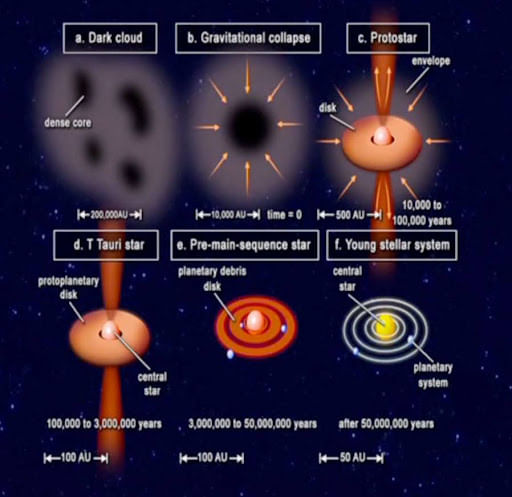
- Most accepted theory of planet formation is Planetesimal theory.
- Nabulae cloud around the star forms the dark cloud.
- Dust in the vicinity of stars contains components such as carbon and iron, which can aid in the formation of planetary systems.
- When a star is in its developing disk, also known as the T Tauri phase, it emits extremely hot winds that are dominated by positively charged protons and neutral helium atoms.
- Although majority of the disk's material is still falling on the star, small groupings of lucky dust particles are colliding and aggregating into larger objects.
- Dust clumps turn into pebbles, and pebbles become into larger boulders that grind together to expand.
- The presence of gas aids in the adhesion of solid particles. Some fall apart, while others cling on. These are the constituents of planets, sometimes known as "planetesimals."
- Tiny pieces of ice hitch a ride with dust where the disk is cooler, far enough from the star that water can freeze. Dirty snowballs can grow into massive planetary cores.
- These colder areas also allow gas molecules to slow down sufficiently to be attracted onto a planet.
- This is how our solar system's gas giants, Jupiter, Saturn, Uranus, and Neptune, are supposed to have formed.
- Jupiter and Saturn are assumed to have formed first and fastest in the solar system's initial 10 million years.
- Rocky planets develop in the warmest areas of the disk, closer to the star. There isn't much gas left for the terrestrial planets to accrete once the icy giants form.
- Rocky planets such as Mercury, Venus, Earth, and Mars may take tens of millions of years to form after the star is born.
- The precise location of planets in disks is still a mystery and an ongoing field of investigation.
- Planetary systems are formed when planets develop around a star and are described as sets of gravitationally bound objects that orbit a star.
- They can have one or more planets, but they can also have dwarf planets, asteroids, natural satellites, meteoroids, and comets.
- The solar system is made up of the Sun and its planets, including Earth.
- The terms "extrasolar" and "exoplanet" refer to planetary systems that are not our own.
Categorization of Planets
- Terrestrial Planets/Inner planets: Mercury, Venus, Earth, and Mars are often referred to as the "terrestrial planets" since their surfaces are rocky.
- Pluto has a rocky, albeit frozen, surface but has never been classified as one of the four terrestrials.
- Jovian Planets/Outer planets: Because of their huge size in comparison to the terrestrial planets, the four massive outer worlds — Jupiter, Saturn, Uranus, and Neptune — are frequently referred to as the Jovian or "Jupiter-like" planets.
- They're also largely formed of gases like hydrogen, helium, and ammonia rather than stony surfaces, though some or all of them may have solid cores.
- Jupiter and Saturn are known as the gas giants, while Uranus and Neptune, which are further distant, are known as the ice giants.
- According to the Planetary Society, this is because Uranus and Neptune have more atmospheric water and other ice-forming compounds, such as methane, hydrogen sulfide, and phosphene, that solidify into clouds in the planets' freezing environments
Difference Between Jovian and Terrestrial Planets
| Criteria | Terrestrial Planets | Jovian Planets |
|---|---|---|
| Examples | Mercury, Venus, Earth, Mars | Jupiter, Saturn, Uranus, Neptune |
| Location | Closer to the Sun | Further from the Sun |
| Size | Smaller in size | Much larger (Gas giants) |
| Composition | Mostly rock and metal | Mostly hydrogen, helium, and other volatile gases |
| Density | Higher density | Lower density |
| Atmosphere | Thinner atmospheres | Thick, massive atmospheres |
| Moons | Fewer moons; some have none | Numerous moons, including some very large ones |
| Rings | No ring systems | All have ring systems |
| Rotation | Generally slower rotation | Typically faster rotation |
| Magnetic Field | Weaker magnetic fields (except for Earth) | Stronger magnetic fields |
| Surface | Solid surfaces with mountains, valleys, etc. | Largely lack a well-defined surface; gaseous |
| Temperature | Generally warmer due to proximity to the Sun | Colder, especially the ones farthest from the Sun |
| Distance between Planets | Relatively small distances between them | Wider distances between the planets |
Conclusion
Originating from the same spinning disk of dust and gas that formed the Sun, planets undergo a fascinating journey from dust particles to massive celestial bodies. Theories from the Nebular Hypothesis to the Big Bang Theory have attempted to demystify the phenomena leading to the inception of planets, emphasizing the dynamic and expansive nature of the universe.
|
|
|
|---|---|
| Geography Notes | Universe and Solar System |
| Geomorphology | Structure of the Earth's Interior |
FAQs
Q1: What is the nebular hypothesis in the context of planet formation?
Answer: The nebular hypothesis suggests that planets form from the residual gas and dust in a nebula surrounding a newly formed star. This material gradually coalesces due to gravity, leading to the creation of planetary bodies.
Q2: How do terrestrial planets differ from gas giants?
Answer: Terrestrial planets, such as Earth and Mars, are rocky and have solid surfaces, while gas giants like Jupiter and Saturn are predominantly composed of hydrogen and helium, lacking solid surfaces and having thick atmospheres.
Q3: What role do protoplanetary disks play in planet formation?
Answer: Protoplanetary disks are rotating disks of dense gas and dust surrounding newly formed stars. These disks are crucial in the process of planet formation, as they provide the material that clumps together to form planets.
Q4: What is the significance of accretion in the formation of planets?
Answer: Accretion is the process where dust and small particles collide and stick together, gradually forming larger bodies. This process is essential for the formation of planets as it leads to the growth of planetesimals and eventually planets.
Q5: How does the age of a star affect its planet formation?
Answer: The age of a star can influence its planet formation process; younger stars typically have more residual gas and dust, which are necessary for forming new planets. As stars age, their protoplanetary disks diminish, reducing the material available for planet formation.
MCQs
- Which of the following processes is primarily responsible for the formation of planets?
A) Fusion
B) Accretion
C) Fission
D) Radiative transfer
Answer: (B) See the Explanation
- What type of planets are formed primarily from ice and gas?
A) Terrestrial planets
B) Gas giants
C) Dwarf planets
D) Exoplanets
Answer: (B) See the Explanation
- What is the primary composition of terrestrial planets?
A) Hydrogen and helium
B) Rock and metal
C) Ice and gas
D) Dust and debris
Answer: (B) See the Explanation
- In the context of planet formation, what is a protoplanetary disk?
A) A type of comet
B) A rotating disk of gas and dust
C) A planetary ring
D) A moon
Answer: (B) See the Explanation
- Which of the following best describes the process of forming planetesimals?
A) Fusion of stellar cores
B) Gravitational collapse of gas
C) Collision and sticking of dust grains
D) Evaporation of gas
Answer: (C) See the Explanation
GS Mains Questions and Model Answers
Q1. Discuss the various theories regarding the formation of planets in our solar system.
Answer: The formation of planets in our solar system is primarily explained by the nebular hypothesis, which posits that planets formed from the accretion of dust and gas in a protoplanetary disk surrounding the young Sun. This process involves several stages, including the formation of planetesimals, which are small bodies formed through the collision and sticking together of smaller particles. Over time, these planetesimals coalesced to form larger protoplanets.
Another theory involves the core accretion model, where a solid core forms first, attracting surrounding gas to form gas giants. Additionally, the gravitational instability model suggests that gas giants can form directly from the collapse of gas and dust in the protoplanetary disk. Understanding these theories helps scientists comprehend the diverse characteristics of planets within our solar system, such as the distinction between terrestrial and gas giants, and provides insight into the conditions necessary for planet formation.
Q2. Analyze the role of the protoplanetary disk in the process of planet formation.
Answer: The protoplanetary disk plays a critical role in the process of planet formation. It consists of gas, dust, and ice surrounding a newly formed star and is essential for creating the conditions necessary for planets to form. In the disk, particles collide and stick together, a process known as accretion, which leads to the formation of larger bodies called planetesimals.
As these planetesimals continue to collide and accumulate mass, they eventually form protoplanets. The distribution of material within the disk influences the types of planets that form; for example, closer to the star, where temperatures are higher, rocky planets develop, while further out, cooler regions allow for the formation of gas giants. Understanding the dynamics of protoplanetary disks provides valuable insights into the initial stages of planetary systems and the varying compositions of planets within them.
Q3. Examine the impact of the solar nebula theory on our understanding of the formation of exoplanets.
Answer: The solar nebula theory has significantly influenced our understanding of exoplanet formation. This theory posits that stars and their planetary systems form from the gravitational collapse of a rotating cloud of gas and dust, known as a solar nebula. By studying our solar system's formation, scientists have developed models that help explain the processes behind the formation of exoplanets—planets orbiting stars outside our solar system.
Observations of protoplanetary disks around young stars using advanced telescopes provide empirical evidence supporting the solar nebula theory. These disks show similar structures and compositions to the disk hypothesized in our solar system, suggesting that the same processes may be at work elsewhere in the galaxy.
The solar nebula theory also helps explain the diversity of exoplanet types observed, from hot Jupiters (gas giants orbiting very close to their stars) to Earth-like planets in the habitable zone. The theory's principles of accretion and differentiation allow astronomers to hypothesize how various planetary bodies form and evolve based on their distance from their parent stars and the material available in their respective protoplanetary disks.
Understanding the implications of the solar nebula theory on exoplanets enhances our knowledge of planetary formation in different environments, guiding ongoing research in astronomy and astrobiology. This framework is crucial as scientists continue to explore the vast array of planetary systems beyond our own, contributing to the broader understanding of the universe and the potential for life on other planets.
Previous Year Questions on Formation of Planets
1. UPSC CSE 2021
Question. Discuss the nebular hypothesis in the context of planet formation.
Answer: The nebular hypothesis is a prominent theory explaining the formation of planets in our solar system. It proposes that the solar system formed from a rotating cloud of gas and dust, known as a solar nebula. As the nebula collapsed under its own gravity, it began to spin faster and flatten into a disk.
In this disk, particles collided and stuck together, forming larger bodies called planetesimals. These planetesimals continued to collide and merge, eventually leading to the formation of protoplanets. The material closer to the Sun formed the rocky terrestrial planets, while the outer regions, which were cooler, allowed for the formation of gas giants composed mainly of hydrogen and helium.
This hypothesis explains not only the formation of planets but also the characteristics of their orbits, compositions, and sizes. The nebular hypothesis remains a foundational concept in understanding planetary formation and the dynamics of our solar system.
2. UPSC CSE 2022
Question. How do the processes of accretion and differentiation contribute to planet formation?
Answer: Accretion and differentiation are fundamental processes in the formation of planets. Accretion refers to the gradual accumulation of material, primarily through the collision and sticking of smaller particles within a protoplanetary disk. As these particles collide, they form larger bodies known as planetesimals. Over time, these planetesimals continue to merge, leading to the growth of protoplanets.
Differentiation occurs after the protoplanets have formed and involves the separation of materials based on density. As a planet's interior heats up due to radioactive decay and the energy from impacts, heavier materials, such as iron, sink towards the center, while lighter materials rise to form the crust. This process leads to the formation of distinct layers within a planet, such as a metallic core, a silicate mantle, and a crust.
Together, accretion and differentiation shape the structure and composition of planets, resulting in the diverse planetary bodies we observe in our solar system today. Understanding these processes is crucial for comprehending planetary formation and the evolution of different types of celestial bodies.
Download the PREPP App and attempt FREE IAS Exam Mock Tests and get complete study material!

Live Test : UPSC CSE Prelims CSAT (Paper-II) (Oct 20 - 23)
Full Test - 04: UPSC CSE Prelims CSAT (Paper-II)
Full Test - 03: UPSC CSE Prelims CSAT (Paper-II)
UPSC CSE Prelims 2026 GS Paper 1 Question Paper (24-May-2026)
UPSC CSE Prelims 2026 CSAT Paper 2 Question Paper (24-May-2026)

17 February 2025 | The Hindu Must Read Articles | Current Affairs

16 February 2026 | The Hindu Must Read Articles | Current Affairs

13 February 2026 | The Hindu Must Read Articles | Current Affairs









Comments