Earth and Its Properties - Geography Notes
Earth is the only planet in the solar system that scientists have the ability to study in-depth. Geologists have not only described surface features and how they change over time, but they can also describe the structure of the Earth down to its core. The study of the Earth establishes the framework for studying other comparable worlds as well. This article will explain the concepts of the Earth and its properties which is a part of geomorphology and is important for the UPSC exam.
|
Table of Contents |

Earth
The Earth
- Earth is the largest of the terrestrial planets and is the third planet from the Sun.
- It is the fifth-largest planet in terms of size.
- With mountains, valleys, canyons, plains, etc., Earth has a substantial and active surface.
- Earth is unique in that it is an ocean world. 70% of the Earth's surface is covered in water.
- The atmosphere of the Earth is primarily nitrogen, but there is plenty of oxygen for us to breathe.
- Earth is the densest large body in the solar system.
- Chemical composition of Earth include Iron (34.6 percent), oxygen (29.5 percent), silicon (15.2 percent), magnesium (12.7 percent), nickel (2.4 percent), sulphur (1.9 percent), and titanium (0.05 percent).
- Direct observations and material analysis provide some of the information about the interior of the Earth.
|
|
|
|---|---|
| The Universe | Formation of Planets |
| The Solar System | Geomagnetism |
| Origin of Earth | Paleomagnetism |
| Formation of Earths Atmosphere | Theories of Origin of Earth |
Position of the Earth with respect to the Sun
- Earth, as the third planet from the sun, has numerous characteristics that distinguish it from the other planets and planetary bodies in the solar system.
- Along with Venus, Mercury, and Mars, it is one of four rocky planets, and it is the fifth-largest planet after Neptune, Uranus, Saturn, and Jupiter.
- At 92,957,130 miles, Earth is located within the solar system's "habitable zone," making it unique within the system.
- This zone is defined as the distance from the sun where solid and liquid water can be found.
- The atmosphere and water on Earth would evaporate if it were in Mercury's or Venus's location.
- It would be too cold to maintain liquid water or life if Earth were pushed out to the position of Mars or further out near the gas giants.
- Goldilocks Zone: It is a zone with a specific distance range where temperatures are conducive to the maintenance of liquid water. Within this zone, significant findings, such as the identification of Earth-size planets like Kepler-186f, fuel scientists' aspirations to locate water and, ultimately, the potential for life in the future.
Composition and Structure of the Earth
- Earth’s composition and structure can be studied in two forms: Mechanical composition and Chemical composition.
| Mechanical Composition(Rheological structure ) | Chemical Composition |
|---|---|
|
|
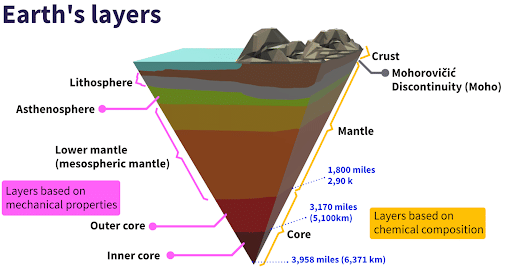
- The crust, which is made up of oceanic crust and continental crust, accounts for less than 1% of the Earth's total mass.
- The heated mantle contains around 68 percent of the Earth's mass.
- Finally, the core is primarily made of iron metal. The core accounts for approximately 31% of the Earth's mass.
- The lithosphere is made up of the crust as well as a section of the upper mantle that is brittle and unyielding.
- The asthenosphere is a partially molten upper mantle substance that can flow and behave plastically.
- Latest development: As per the study published in Down to Earth, there are developments in the research related to the fifth layer of Earth. It is at the center of Earth, inside the Inner core. It seems to have a different arrangement of Iron elements, than the Inner core. Further studies can provide a deeper understanding.
Crust and Lithosphere
- The crust is the planet's outermost layer, a cooled and hardened section of the Earth that ranges in depth from 5-70 km (3-44 miles).
- This layer accounts for only 1% of the total volume of the Earth, but it covers the entire surface (continents and ocean floor).
- The oceanic crust, which lies beneath the ocean basins at a depth of 5-10 km (3-6 miles), is the thinner part, while the continental crust is the thicker part.
- The oceanic crust is made up of dense material such as iron magnesium silicate igneous rocks (like basalt), whereas the continental crust is made up of sodium potassium aluminum silicate rocks (like granite).
- The lithosphere is an uneven layer with a maximum thickness of about 200 km (120 mi) formed by the uppermost segment of the mantle (see below) and the crust.
- Many of the rocks that today make up the Earth's crust developed less than 100 million (1108) years ago.
- The oldest known mineral grains, on the other hand, are 4.4 billion (4.4109) years old, showing that the Earth has had a solid crust for at least that long.
Upper Mantle
- The mantle, which accounts for approximately 84% of the Earth's bulk, is largely solid yet behaves as a highly viscous fluid over geological time.
- The upper mantle extends from a depth of 7 to 35 km (4.3 to 21.7 mi) to a depth of 410 km (250 mi), beginning at the "Mohorovicic Discontinuity" (called the "Moho" - the base of the crust).
- The lithosphere is formed of the uppermost mantle and the overlaying crust, which is generally solid at the top but becomes visibly more malleable beneath.
- Movement in the mantle (i.e. convection) is expressed at the surface via tectonic plate motions.
- This process, which is driven by heat from deeper inside the Earth, is responsible for Continental Drift, earthquakes, the creation of mountain chains, and a variety of other geological phenomena.
- The mantle is also chemically unique from the crust, as well as having various rock types and seismic properties.
- This is owing, in part, to the fact that the crust is composed of solidified materials obtained from the mantle, which is partially melted and viscous.
- Incompatible elements separate from the mantle, causing less dense material to float upward and solidify at the surface.
- Temperatures in the upper mantle range from 500 to 900 °C (932 to 1,652 °F).
- There is also a transition zone between the upper and lower mantles, which extends in depth from 410-660 km (250-410 miles).
Lower Mantle
- The lower mantle has a depth of 660-2,891 km (410-1,796 miles).
- At the border with the core, temperatures in this part of the globe can reach over 4,000 °C (7,230 °F), well exceeding the melting points of mantle rocks.
- However, viscosity and melting are highly limited in comparison to the upper mantle due to the massive pressure put on it. Apart from the fact that it appears to be seismically uniform, very little is known about the lower mantle.
Outer Core
- The outer core, which has been shown to be liquid (through seismic studies), is 2300 km thick and has a radius of 3,400 km.
- The density in this zone is thought to be substantially higher than that of the mantle or crust, ranging between 9,900 and 12,200 kg/m3.
- The outer core is thought to be made up of 80% iron, nickel, and other lighter metals.
- Denser elements, like as lead and uranium, are either too rare to be relevant or bind to lighter elements, remaining in the crust.
- The outer core is not under enough pressure to be solid, hence it is liquid despite having the same composition as the inner core.
- The temperature of the outer core varies between 4,300 K (4,030 °C; 7,280 °F) in the outer regions and 6,000 K (5,730 °C; 10,340 °F) near the inner core.
- Because of its high temperature, the outer core has a low viscosity fluid-state that experiences turbulent convection and rotates faster than the rest of the globe.
- This causes eddy currents to form in the fluid core, resulting in a dynamo effect that is thought to influence the Earth's magnetic field.
- The typical magnetic field strength in Earth's outer core is believed to be 25 Gauss (2.5 mT), which is 50 times the strength recorded on Earth's surface.
Inner Core
- The inner core, like the outer core, is mostly made of iron and nickel and has a radius of 1,220 km.
- The density of the core ranges between 12,600 and 13,000 kg/m3, implying that there must be a significant amount of heavy elements present, such as gold, platinum, palladium, silver, and tungsten.
- The inner core's temperature is predicted to be around 5,700 K (5,400 °C; 9,800 °F).
- Iron and other heavy metals can only be solid at such high temperatures because their melting temperatures increase considerably at the pressures present, which range from roughly 330 to 360 gigapascals.
- Because the inner core is not permanently attached to the Earth's solid mantle, it has long been assumed that it rotates slightly faster or slower than the rest of the Earth.
- Scientists believe that the inner core spins at a rate one degree faster than the surface based on changes in seismic waves as they went through the core over many decades.
- Recent geophysical estimations set the rate of rotation relative to the surface at 0.3 to 0.5 degrees each year.
Properties of Earth

Physical and Chemical Properties of Earth
Physical Properties of Earth
- The core is composed of an outer core that is fluid and an inner core that is solid, including one or more transition zones between them.
- Seismology is a primary source of information about the Earth's interior.
- A chemically distinct silicate solid crust forms the outer layer, which is underlain by a highly viscous solid mantle.
- The Mohorovicic discontinuity separates the crust and the mantle.
- The crust's thickness ranges from about 6 kilometres beneath the oceans to 30–50 kilometres beneath the continents.
- The lithosphere is made up of the crust and the cold, rigid top of the upper mantle, which is divided into independently moving tectonic plates.
- A thin, low-viscosity layer called the asthenosphere lies below the lithosphere.
- An extremely low viscosity liquid outer core and a solid inner core are located under the mantle
- Earth is almost spherical in shape. The rotation of the Earth causes a slight flattening in the poles and a bulging at the equator.
- The Earth is tilted at a 23.5-degree inclination from vertical, rotating at 1,000 miles per hour on that axis once every 24 hours.
Properties of Earth that Support Life
- Water availability: Life requires the availability of free water. Organic life is impossible to exist without water. The Earth is the only planet in the solar system where free liquid water is known to exist.
- Ozone layer:
- Stratospheric Ozone absorbs damaging cosmic radiation. Without the ozone layer, dangerous mutations caused by cosmic radiation reach levels that could result in the extinction of all living beings.
- Perhaps life would not have arisen on its own if the Ozone layer did not exist.
- But Tropospheric (ground level) Ozone can be fatal.
Temperature and Energy
- The amount of energy received, is determined by the planet's distance from the Sun and its albedo.
- Albedo is the percentage of light that reaches the planet that is reflected rather than absorbed.
- The albedo is 0.0 in the case when all of the light is absorbed, and the albedo is 1.0 if all of the light is reflected.
- Earth has an albedo of 0.37 because clouds and ocean regions reflect light.
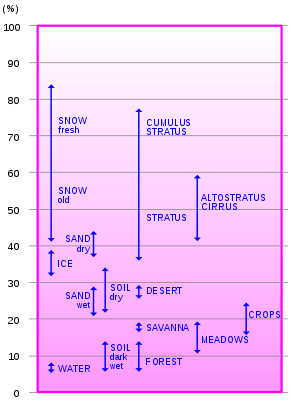
- The greenhouse effect, or the warming of a planet and its lower atmosphere produced by trapped solar radiation, affects its temperature
- Since its formation, Earth has cooled more slowly as a larger object. In fact, it is still cooling, with heat energy left over from Earth's formation pushing its way outward slowly.
- Energy always flows from hotter to cooler material in the Earth's interior; convection currents in the mantle move hot mantle material up toward the crust, while colder mantle and crustal rocks sink downward.
- Plate tectonics (continental drift) is driven by heat flow at the Earth's surface; vast pieces of the Earth's crust (plates) separated by deep cracks called faults are forced into motion.
- When the plates meet, changes in the Earth's crust are caused by tremendous internal tectonic forces that crush and fold solid rock.
- Two components of the crust's continuous recycling and rebuilding are mountain uplift and accompanying volcanic activity when plates intersect.
Unique Properties of Earth
- Suitable temperature: The Earth's temperature is exactly suitable for life because of its location in the solar system. It's neither too hot nor too cold.
- Presence of magnetosphere: The magnetic field protects the Earth from the solar wind, while the atmosphere protects humans from solar radiation.
- Atmospheric composition: Nitrogen (78%) and Oxygen (21%) make up the atmosphere. For all life forms, this is the ideal combination.
- Water: Despite the fact that the Earth is a "rocky" planet, its temperature permits water to exist in all three states: solid, liquid, and gas at the same time. It forms 71% of Earth's surface.
- Process of Plate tectonics: It is the process by which the Earth's outer crust is divided up into regions called tectonic plates.
- Carbon from dead plants and animals is recycled by the plates, which removes it from the atmosphere and cools the planet.
Conclusion
Despite years of its formation, the interior of Earth is still a mystery to us. We cannot predict natural disasters and future mishappenings. Therefore, a relationship between development and conservation must be developed and a proper disaster management ecosystem should be followed to ensure a better standard of living for the future generations.
|
|
|
|---|---|
| Geography Notes | Universe and Solar System |
| Geomorphology | Different Layers of the Earth |
FAQs
Q1: What are the main components of the Earth?
Answer: The Earth consists of the lithosphere (land), hydrosphere (water), atmosphere (air), and biosphere (living organisms).
Q2: How is the Earth structured?
Answer: The Earth has several layers: the crust, mantle, outer core, and inner core, each with distinct properties.
Q3: What is the significance of the Earth's atmosphere?
Answer: The atmosphere protects life by filtering harmful radiation, maintaining temperature, and providing essential gases.
Q4: What role does water play on Earth?
Answer: Water is crucial for life, influences climate, and shapes geological features through erosion and sedimentation.
Q5: How does the Earth's rotation affect its properties?
Answer: The rotation leads to day and night cycles, affects climate patterns, and influences ocean currents.
MCQs
- Which layer of the Earth is primarily composed of molten rock?
a) Crust
b) Mantle
c) Outer Core
d) Inner Core
Answer: (B) See the Explanation
- What gas is most abundant in the Earth's atmosphere?
a) Oxygen
b) Carbon Dioxide
c) Nitrogen
d) Argon
Answer: (C) See the Explanation
- What is the primary source of energy for the Earth's atmosphere?
a) Geothermal energy
b) Solar energy
c) Tidal energy
d) Wind energy
Answer: (B) See the Explanation
- Which of the following is NOT a property of water?
a) High specific heat
b) Universal solvent
c) Low density as a liquid
d) Cohesion and adhesion
Answer: (C) See the Explanation
- Which of these phenomena is caused by the Earth's rotation?
a) Tides
b) Seasons
c) Coriolis effect
d) Erosion
Answer: (C) See the Explanation
GS Mains Questions and Model Answers
Q1: Discuss the significance of the Earth's layers in supporting life.
Answer: The Earth's layers play a crucial role in sustaining life. The crust provides land and resources for habitation. The mantle's movement contributes to tectonic activity, shaping the landscape. The outer core generates the Earth's magnetic field, protecting life from solar radiation. Meanwhile, the atmosphere contains essential gases, regulates temperature, and supports weather patterns vital for ecosystems. This layered structure ensures a stable environment for diverse life forms, making it critical for Earth's habitability.
Q2: Explain how the properties of water influence the Earth's climate.
Answer: Water's unique properties significantly affect the Earth's climate. Its high specific heat capacity allows it to absorb and store heat, moderating temperature fluctuations. Water vapor in the atmosphere acts as a greenhouse gas, trapping heat and regulating climate. Additionally, the movement of oceans influences weather patterns and heat distribution globally. The presence of large water bodies contributes to regional climate stability, affecting precipitation and temperature, which are crucial for ecosystems and human activities.
Q3: Analyze the impact of human activities on the Earth's natural properties.
Answer: Human activities have significantly altered the Earth's natural properties. Urbanization and industrialization have increased greenhouse gas emissions, affecting atmospheric composition and leading to climate change. Deforestation disrupts the balance of ecosystems, diminishing biodiversity and altering local climates. Pollution contaminates air and water, impacting health and natural habitats. Moreover, activities like mining and agriculture modify the land's structure, affecting soil quality and water retention. These changes threaten the sustainability of Earth's resources and the overall health of the planet.
Previous Year Questions on Properties of Earth
1. UPSC CSE 2020
Question: “Discuss the importance of the Earth's atmosphere in supporting life.”
Answer: The Earth's atmosphere is vital for supporting life by providing essential gases like oxygen and carbon dioxide. It regulates temperature through the greenhouse effect, maintaining conditions suitable for life. The atmosphere also protects living organisms from harmful solar radiation and meteoroids. Moreover, it plays a crucial role in the water cycle, facilitating precipitation that nourishes ecosystems. The atmospheric layer helps distribute heat and moisture around the globe, influencing weather patterns and climate stability.
2. UPSC CSE 2018
Question: “Examine the role of water in shaping the Earth's surface.”
Answer: Water plays a critical role in shaping the Earth's surface through processes like erosion, sedimentation, and weathering. Rivers carve valleys and canyons, while glaciers reshape landscapes through glacial movement. The constant cycle of water contributes to the formation of various landforms, such as deltas and alluvial plains. Additionally, waves and tides continuously modify coastal areas, influencing ecosystems and human settlements. Understanding water's impact on geography is essential for managing natural resources and mitigating environmental challenges.
Download the PREPP App and attempt FREE IAS Exam Mock Tests and get complete study material!
UPSC IAS : CSAT - Mini Live Test

Live Test : UPSC CSE Prelims CSAT (Paper-II) (Oct 20 - 23)
Full Test - 04: UPSC CSE Prelims CSAT (Paper-II)
Full Test - 03: UPSC CSE Prelims CSAT (Paper-II)
UPSC CSE Prelims 2026 GS Paper 1 Question Paper (24-May-2026)
UPSC CSE Prelims 2026 CSAT Paper 2 Question Paper (24-May-2026)

17 February 2025 | The Hindu Must Read Articles | Current Affairs

16 February 2026 | The Hindu Must Read Articles | Current Affairs

13 February 2026 | The Hindu Must Read Articles | Current Affairs









Comments