Types of Volcanoes - Geography Notes
A volcano is an opening in the earth's crust that allows lava, volcanic ash, and gases to escape. There are different types of volcanoes based on the shape, nature of the eruption, frequency of eruption, etc. The common types of volcanoes are cinder cone volcanoes, composite volcanoes (stratovolcanoes), shield volcanoes, etc. The topic “Types of Volcanoes” is an important part of the UPSC/IAS Exam Geography syllabus which is discussed in this article in detail.
| To Read update on this topic: |
|
Table of Contents |

What are Volcanoes?
- Volcanoes are landforms or mountains where molten rocks appear from the surface of the planet.
- The volcano mountain opens under the pool of molten rocks inside the earth’s surface.
- A volcano is referred to as a vent or fissure in the crust of the earth from where lava, ash, rocks, and gases come out.
- Active volcanoes are those categories of a volcano that appear in the recent past.
- Mantle volcanoes include a weaker zone which is referred to as the asthenosphere.
Types of Volcanoes
Based on the Shape
Cinder Cones
- Cinder cones are round or oval cones made up of tiny lava pieces blown up from a single vent.
- Cinder cones are formed by the accumulation of largely small fragments of scoria and pyroclastics around the vent.
- The majority of cinder cones only erupt once.
- Cinder cones can arise as side vents on bigger volcanoes or as isolated cinder cones.

Composite Volcano
- Composite volcanoes are steep-sided volcanoes made up of multiple layers of volcanic rocks, most of which are made up of high-viscosity lava, ash, and rock debris.
- These volcanoes are towering conical mountains made up of lava flows and other ejecta layered in alternate layers, hence the name strata.
- Cinder, ash, and lava make up composite volcanoes.
- Cinders and ash build up on top of one another, lava flows over the ash, cools and hardens, and the cycle continues.

Shield Volcano
- Shield volcanoes have long, gradual slopes formed by basaltic lava flows and are fashioned like a bowl or shield in the middle.
- These are generated by the eruption of low-viscosity lava that can travel a long way from the vent.
- They don't usually blow out in a big way.
- Shield volcanoes are more prevalent in marine environment than continental settings because low-viscosity magma is often low in silica.
- Shield cones are found throughout the Hawaiian volcanic system, and they are also frequent in Iceland.

Lava Domes
- Lava domes arise when erupting lava becomes too thick to flow and stacks up near the volcanic vent, forming a steep-sided mound.
- Slow outbursts of exceedingly viscous lava form them.
- They can sometimes be found within the crater of an earlier volcanic eruption.
- They can erupt violently and explosively, just like a composite volcano, although the lava rarely flows far from the erupting vent.

Based on the Nature of the Eruption
Hawaiian Volcanoes
- Hawaiian Volcanoes are named after the Kilauea Volcano on Hawaii's Big Island which is known for its stunning fire fountains.
- Fluid basaltic lava is sprinkled in jets from a vent or series of vents on the summit or side of a volcano during a Hawaiian volcano.
- Fire fountaining is a phenomenon in which the jets linger for hours or even days.
- The spatter formed by hot lava pouring from the fountain can either melt together to form lava flows or build hills known as spatter cones.
- Lava flows can also emerge from vents at the same time as fountaining or after it has stopped.
- These flows can travel kilometers from their source before cooling and hardening because they are extremely fluid.
- The 1969-1974 Mauna Ulu eruption on the volcano's flank and the 1959 eruption of the Kilauea Iki Crater at Kilauea's summit are two excellent examples.
- Lava fountains erupted to heights of nearly a thousand feet in both eruptions.
Strombolian Eruption
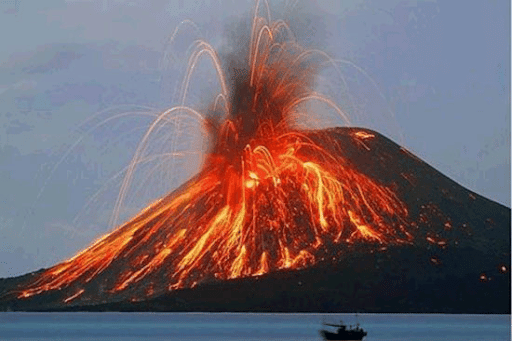
- Strombolian eruptions are fluid lava bursts from the mouth of a magma-filled summit conduit.
- Strombolian eruptions are called after the Stromboli Volcano, which is located on the Italian island of Stromboli and has many volcanic summit vents.
- The explosions normally happen every few minutes, in either regular or sporadic intervals.
- The bursting of huge gas bubbles, which rise upward in the magma-filled conduit until they reach the open air, causes lava explosions, which can reach heights of hundreds of meters.
- This type of eruption can produce a range of eruptive products, including
- spatter (hardened globs of glassy lava)
- scoria (hardened bits of bubbling lava)
- lava bombs (large chunks of lava)
- ashes
- minor lava flows (which form when hot spatter melts together and flows downslope)
- The debris left behind by this explosive eruption is called Tephra.
- Small lava lakes that can form in volcanoes' conduits are commonly associated with Strombolian eruptions.
- They are the least violent of the explosive eruptions, yet bombs and lava flows can still be quite dangerous if they reach populated areas.
- The lava lights brightly at night, making the explosions even more impressive.
Vulcanian Eruption
- A Vulcanian eruption is a viscous magma explosion that is short, intense, and relatively tiny.
- Vulcanian Eruption is named after the minor volcano on the Italian island of Volcano, which was considered to represent the vent above the forge of the Roman smith deity Vulcan.
- This form of eruption occurs when a plug of lava in volcanic conduit fragments and explodes, or when a lava dome ruptures (viscous lava that piles up over a vent).
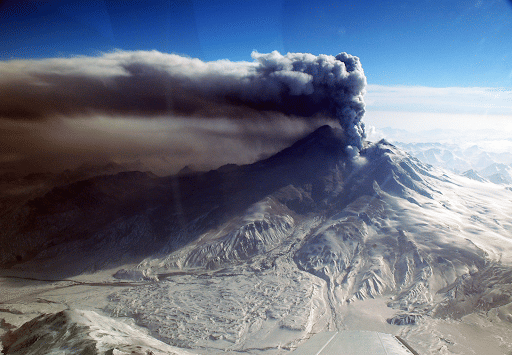
- Vulcanian eruptions produce enormous explosions. The materials from the eruption travel at speeds of up to 350 meters per second and rise many kilometers into the air.
- The materials include tephra, ash clouds, and pyroclastic density currents (clouds of hot ash, gas, and rock that flow almost like fluids).
- Vulcanian eruptions can be monotonous and last for days, months, or even years, or they might be precursors to more explosive eruptions.
Plinian Eruptions
- Plinian eruptions are the largest and most violent of all volcanic eruptions.
- They are frequently linked with particularly viscous magma and are caused by the fragmentation of gassy magma.
- They release massive quantities of energy and produce eruption columns of gas and ash that can reach 50 kilometers in height and travel at hundreds of meters per second.
- Hundreds of thousands of kilometers away from the volcano, ash from an eruption column can float or be blown.
- The eruption columns resemble a mushroom (similar to a nuclear explosion) or an Italian pine tree;
- Plinian eruptions can be highly devastating, obliterating the entire summit of a mountain, as happened in 1980 at Mount St. Helens.
- They can erupt miles away from the volcano, releasing ash, scoria, and lava bombs, as well as pyroclastic density currents that raze forests, strip soil from bedrock, and demolish everything in their path.
- These eruptions are frequently climactic, and a volcano with a magma chamber drained by a massive Plinian eruption may go dormant.
Vesuvian Volcanoes
- Vesuvian Volcanoes have magma that is ejected from a start cone vent and are particularly violent and explosive.
- After a long period of quiet or modest activity, the eruption begins.
- The vent has a tendency to be emptied to a great depth.
- The lava sprays explosively, and the gas cloud rises to a tremendous height before depositing the tephra.
Based on the Frequency of Eruption
Active Volcano
- Active volcanoes are volcanoes that are either erupting or on the verge of eruption.
- There are around 500 active volcanoes on Earth, excluding those submerged beneath the oceans.
- Every year, approximately 50 to 70 active volcanoes erupt, most of them being around the Pacific “ring of fire”.
- Mount Etna (Italy), Hawaiin Islands (Pacific Ocean), Mauna Loa (Pacific Ocean), Mount Vesuvius (Italy), and Barren Island (India) are some examples of Active Volcanoes around the world.
Dormant Volcano
- A dormant volcano is one that is not erupting at the present but has erupted in the past and is expected to erupt again.
- The distinction between active and dormant volcanoes can be hazy;
- Some volcanoes can last thousands of years without erupting, thus they are theoretically predicted to erupt in the future, but they could take many lives.
- Another of the Big Island's five volcanoes, Mauna Kea, last erupted 3,500 years ago, but it is predicted to erupt again, but no date has been set.
- People living in the neighborhood of dormant volcanoes are frequently complacent and unprepared when an eruption occurs.
- This was the case in 1980 with Mt. St. Helens.
Extinct Volcano
- Extinct volcanoes are considered to be dormant and unlikely to erupt again.
- Example: Kohala, the Big Island of Hawaii's oldest volcano, hasn't erupted in 60,000 years and isn't expected to erupt again.
- However, because many Hawaiian volcanoes are in the process of rejuvenation, this classification isn't completely accurate.
- Aconcagua of the Andes is a typical example of an extinct volcano.
Based on the Characteristics of Lava
Basic Lava
- Basic Lava is the hottest lava, with temperatures around 1,000 degrees Celsius and high fluidity.
- They are dark-colored basalt with high iron and magnesium content but low silica content.
- They emerge from the volcanic vent silently and aren't particularly explosive.
- They move easily at a speed of 10 to 30 miles per hour due to their tremendous fluidity.
- They have a wide range of effects, spreading out as thin sheets across long distances before solidifying.
- The resulting volcano has a large circumference and is gradually descending, forming a flattened shield or dome.
- Along the constructive boundaries, shield lava flow is prevalent.
Acid Lava
- Acid Lava flows are viscous and have a high melting point.
- They're light-colored, low-density, and have a high silica content.
- They move slowly and rarely travel a long distance before hardening.
- As a result, the resulting volcanic cone is stratified and steep-sided (hence the name stratovolcano).
- The quick solidification of lava in the vent obstructs the outpouring of the lava flow, resulting in loud explosions and the release of numerous volcanic bombs or pyroclasts.
- Lava can be so viscous that it forms a lava plug in the crater, as seen at Mt. Pelée in Martinique (an island in the Lesser Antilles, Caribbean Islands).
- The majority of andesitic lava flows occur along destructive boundaries (convergent boundaries).
|
|
|
|---|---|
| Active Volcanoes | Dormant Volcanoes |
| Extinct Volcanoes | Volcanic Materials |
| Basic Lava | Acidic Lava |
Significance of Volcanoes
- The majority of Earth's water would still be trapped in the crust and mantle if volcanoes did not exist.
- Early volcanic eruptions gave rise to the Earth's second atmosphere, which eventually gave way to the present-day atmosphere.
- Aside from water and oxygen, volcanoes provide land, which is essential for many living forms.
- Volcanic rock and ash offer fertile land, resulting in increased food yields for farmers.
- The volcano attracts tourists, bringing more money into the local economy.
- The internal heat associated with young volcanic systems can be harnessed to produce geothermal energy.
Conclusion
The volcanic movements create widespread devastation on the planet's surface. However, it can be concluded that these volcanoes are important to maintaining the Earth's crust's unique structure. It is obvious that Earth would have been barren without volcanoes on our planet. These subsurface furnaces contributed to the formation of Earth's continents by venting molten rock onto the planet's surface from their depths.
|
|
|
|---|---|
| Geography Notes | Physical Geography |
| Geomorphic Processes | Geomorphology |
| Distribution of Oceans and Continents Basins | Minerals and Rocks |
| Endogenic Processes | Exogenic Processes |
FAQs
Question: What is the difference between a shield volcano and a composite volcano?
Answer: A shield volcano has broad, gently sloping sides and erupts non-explosively with fluid lava, while a composite volcano has steep, conical slopes and erupts explosively with alternating layers of lava and ash.
Question: Which type of volcano is known for its explosive eruptions?
Answer: Composite volcanoes (stratovolcanoes) are known for their explosive eruptions, as they eject large amounts of ash, tephra, and gases.
Question: What is a cinder cone volcano?
Answer: A cinder cone volcano is a small, steep-sided volcano formed from pyroclastic debris such as volcanic ash, cinders, and tephra.
Question: What type of lava forms lava domes?
Answer: Lava domes are formed by highly viscous lava that does not flow easily, resulting in a dome-shaped accumulation near the vent.
Question: How do fissure volcanoes differ from central vent volcanoes?
Answer: Fissure volcanoes erupt through long cracks or fissures in the Earth’s surface, while central vent volcanoes erupt through a single, central vent.
MCQs
1. Which of the following volcanoes is an example of a shield volcano?
A. Mount Vesuvius
B. Mauna Loa
C. Mount Fuji
D. Krakatoa
Answer: (B) See the Explanation
Mauna Loa in Hawaii is a classic example of a shield volcano, known for its broad, gently sloping sides formed by fluid lava flows.
2. Composite volcanoes are also known as:
A. Lava Domes
B. Stratovolcanoes
C. Fissure Volcanoes
D. Cinder Cones
Answer: (B) See the Explanation
Composite volcanoes are also called stratovolcanoes due to their layered structure, which alternates between solidified lava flows and volcanic ash.
3. What type of volcanic eruption is characterized by the ejection of volcanic bombs and ash?
A. Effusive Eruption
B. Explosive Eruption
C. Phreatic Eruption
D. Submarine Eruption
Answer: (B) See the Explanation
An explosive eruption involves the violent ejection of volcanic bombs, ash, and gases, typically associated with composite volcanoes.
4. Which of the following volcanoes formed from the slow extrusion of viscous lava?
A. Mount Fuji
B. Lassen Peak
C. Kilauea
D. Parícutin
Answer: (B) See the Explanation
Lassen Peak is an example of a lava dome, which forms from the slow extrusion of highly viscous lava, resulting in a dome-shaped structure.
5. The volcanic fissure that erupted in Iceland in 1783, causing widespread environmental impact, is known as:
A. Mauna Kea
B. Laki
C. Krakatoa
D. Mount Etna
Answer: (B) See the Explanation
The Laki fissure in Iceland erupted in 1783, releasing massive amounts of lava and gas, which caused widespread environmental and climatic impacts.
GS Mains Questions and Model Answers
Q1: Discuss the role of volcanic eruptions in shaping Earth's landforms and influencing the environment.
Answer: Volcanic eruptions play a significant role in shaping Earth's landforms by creating new landmasses, mountains, and islands. For instance, shield volcanoes produce broad, gentle slopes, while composite volcanoes create steep, conical mountains. Volcanic eruptions can also lead to the formation of calderas and lava plateaus. In terms of environmental impact, volcanic eruptions release gases such as sulfur dioxide into the atmosphere, which can cause climatic changes by lowering global temperatures. However, they also enrich the soil with minerals, making volcanic regions fertile for agriculture.
Q2: Evaluate the hazards posed by explosive volcanic eruptions and how they can be mitigated.
Answer: Explosive volcanic eruptions pose several hazards, including pyroclastic flows, ashfall, and lava flows, which can destroy settlements and ecosystems. Volcanic gases like carbon dioxide and sulfur dioxide can cause respiratory issues and contribute to climate change. Ash clouds from explosive eruptions disrupt air travel and can lead to acid rain. Mitigation strategies include early warning systems, evacuation plans, and monitoring volcanic activity using seismographs and satellite imagery. Zoning regulations that restrict construction near active volcanoes also help reduce the impact of eruptions.
Q3: Compare and contrast shield volcanoes and stratovolcanoes in terms of their eruption style, shape, and associated hazards.
Answer: Shield volcanoes have broad, gently sloping sides and produce effusive eruptions with low-viscosity lava that flows over long distances. These volcanoes, like Mauna Loa, are less hazardous because their eruptions are non-explosive. In contrast, stratovolcanoes (composite volcanoes) have steep, conical slopes and experience explosive eruptions that eject ash, pyroclastic material, and gases. Mount Vesuvius is an example of a stratovolcano. Stratovolcanoes pose greater hazards due to their potential for violent eruptions, pyroclastic flows, and volcanic mudflows (lahars), making them more dangerous than shield volcanoes.
Previous Year Questions on Types of Volcanoes
1. UPSC CSE Prelims 2021
Question: Which of the following volcanoes is a shield volcano?
A. Mount St. Helens
B. Mount Vesuvius
C. Mauna Loa
D. Krakatoa
Answer: C
Explanation: Mauna Loa in Hawaii is a classic example of a shield volcano, characterized by its broad, gently sloping sides formed by fluid lava flows.
2. UPSC CSE Mains 2020 (GS Paper 1)
Question: Discuss the different types of volcanic eruptions and their impact on the environment.
Answer: Volcanic eruptions can be categorized into effusive and explosive types. Effusive eruptions involve the steady outpouring of low-viscosity lava, forming broad landforms like shield volcanoes. These eruptions typically cause less destruction. Explosive eruptions, on the other hand, eject large volumes of ash, pyroclastic material, and gases, which can lead to severe environmental impacts such as air pollution, climatic changes, and the destruction of ecosystems. Plinian eruptions are the most powerful, sending ash and gases high into the atmosphere. These eruptions can disrupt air traffic, cause health hazards, and alter global temperatures by injecting sulfur dioxide into the stratosphere.
Download the PREPP App and attempt FREE IAS Exam Mock Tests and get complete study material!
UPSC IAS : CSAT - Mini Live Test

Live Test : UPSC CSE Prelims CSAT (Paper-II) (Oct 20 - 23)
Full Test - 04: UPSC CSE Prelims CSAT (Paper-II)
Full Test - 03: UPSC CSE Prelims CSAT (Paper-II)
UPSC CSE Prelims 2026 GS Paper 1 Question Paper (24-May-2026)
UPSC CSE Prelims 2026 CSAT Paper 2 Question Paper (24-May-2026)

17 February 2025 | The Hindu Must Read Articles | Current Affairs

16 February 2026 | The Hindu Must Read Articles | Current Affairs

13 February 2026 | The Hindu Must Read Articles | Current Affairs









Comments