Active Volcanoes - Geography Notes
Active volcanoes are volcanoes that are either erupting or on the verge of eruption. Mount Etna (Italy), Hawaiin Islands (Pacific Ocean), Mauna Loa (Pacific Ocean), Mount Vesuvius (Italy), and Barren Island (India) are some examples of active volcanoes around the world. The topic “Active Volcanoes” is an important part of the UPSC/IAS Exam Geography syllabus which is discussed in this article in detail.
|
Table of Contents |
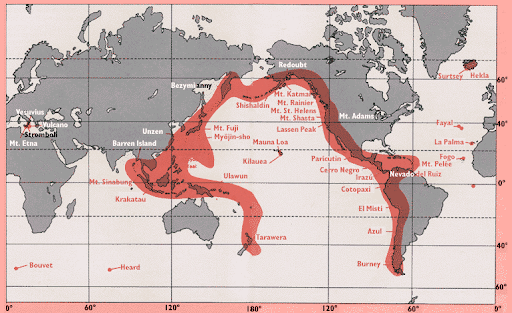
Active Volcanoes - Concept
- Active volcanoes are ones that erupt or are predicted to erupt in the near future.
- There are about 1,350 potentially active volcanoes in the world. Approximately 500 of the 1,350 volcanoes have erupted in recorded history.
- Many of these are found along the Pacific Ocean's rim, known as the "Ring of Fire" (depicted in the above figure).
- Kilauea, one of Hawaii's five volcanoes, has been erupting continuously since 1983.
- According to researchers at the National Institute of Oceanography (NIO) in Goa, India's only active volcano in Andaman & Nicobar Island has been spewing ash since 1991 after being inactive for almost 150 years.
|
|
|
|---|---|
| Types of Volcanoes | Dormant Volcanoes |
| Extinct Volcanoes | Volcanic Materials |
| Basic Lava | Acidic Lava |
Active Volcanoes in India
| S.No | Volcano’s Name | Location | Description |
|---|---|---|---|
| 1 | Barren Island | Andaman Sea |
|
| 3 | Baratang Island | Andaman Island |
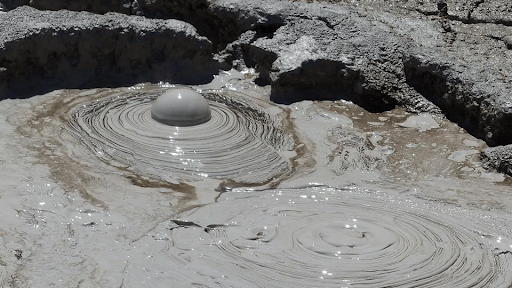 India’s Only Mud Volcano
|
Most Active Volcanoes in the World
| S.No | Volcano’s Name | Location | Description |
|---|---|---|---|
| 1 | Mount Etna | Italy |
|
| 2 | Kīlauea | Hawaiian Islands (Pacific Ocean) |
|
| 3 | Mauna Loa | Hawaiian Islands (Pacific Ocean) |
|
| 4 | Mount Vesuvius | Italy |
|
| 5 | Mount Merapi | Indonesia |
|
Conclusion
Active volcanoes are considered active based on their eruptive history and the presence of associated seismic activity, ground deformation, and gas emissions. Active volcanoes are closely monitored worldwide for signs of impending eruptions, as they can pose significant risks to nearby populations, infrastructure, and the environment.
|
|
|
|---|---|
| Geography Notes | Physical Geography |
| Geomorphic Processes | Geomorphology |
| Distribution of Oceans and Continents Basins | Minerals and Rocks |
| Endogenic Processes | Exogenic Processes |
FAQs
Question: What defines an active volcano?
Answer: An active volcano is one that has erupted recently or is likely to erupt in the near future. Active volcanoes have the potential for ongoing activity and may release gases, lava, and ash periodically.
Question: How many active volcanoes are there globally?
Answer: There are approximately 1,500 active volcanoes worldwide, with the majority located along the Pacific Ring of Fire, a major area prone to seismic and volcanic activity.
Question: What is the difference between active, dormant, and extinct volcanoes?
Answer: Active volcanoes erupt periodically, dormant volcanoes have not erupted in recent history but may do so, and extinct volcanoes are unlikely to erupt again.
Question: What is the Pacific Ring of Fire?
Answer: The Pacific Ring of Fire is a region encircling the Pacific Ocean, marked by high volcanic and earthquake activity due to tectonic plate boundaries and subduction zones.
Question: Can volcanic eruptions be predicted?
Answer: While volcanic eruptions cannot be predicted precisely, monitoring seismic activity, gas emissions, and ground deformation can help scientists forecast potential eruptions.
MCQs
1. Which of the following is an example of an active volcano?
A) Mount Kilimanjaro
B) Mauna Loa
C) Mount Elbrus
D) Mount Sinai
Answer: (B) See the Explanation
Explanation: Mauna Loa, located in Hawaii, is one of the world's most active volcanoes, with regular eruptions.
2. What is the main cause of volcanic activity in the Ring of Fire?
A) Tectonic plate collisions
B) Weather changes
C) Ocean currents
D) Solar flares
Answer: (A) See the Explanation
Explanation: The Ring of Fire experiences volcanic activity due to tectonic plate movements and subduction, where oceanic plates sink under continental plates.
3. How are volcanoes classified as active, dormant, or extinct?
A) Based on their elevation
B) By recent eruption history
C) By lava color
D) Based on seismic activity alone
Answer: (B) See the Explanation
Explanation: Volcanoes are categorized by their eruption history; active volcanoes have recent eruptions, dormant ones have not erupted recently, and extinct volcanoes are unlikely to erupt again.
4. Which region hosts the highest number of active volcanoes?
A) Atlantic Ridge
B) Andes Mountains
C) Pacific Ring of Fire
D) Himalayan Range
Answer: (C) See the Explanation
Explanation: The Pacific Ring of Fire, a horseshoe-shaped area, hosts most of the world's active volcanoes due to tectonic plate boundaries.
5. What type of lava is typically emitted by shield volcanoes?
A) Rhyolitic
B) Basaltic
C) Andesitic
D) Granitic
Answer: (B) See the Explanation
Explanation: Shield volcanoes like Mauna Loa emit basaltic lava, which is low in viscosity and allows lava to flow over long distances, forming gentle slopes.
GS Mains Questions and Model Answers
Q1: Describe the formation and characteristics of the Pacific Ring of Fire. What role does it play in global volcanic and seismic activity?
Answer: The Pacific Ring of Fire forms around the Pacific Ocean due to subduction zones at tectonic plate boundaries. It is the most active volcanic area globally, with numerous earthquakes and volcanic eruptions resulting from convergent tectonic plate movements. This region significantly influences global seismic patterns and tectonic activity.
Q2: Discuss the environmental and economic impacts of volcanic eruptions on nearby regions. How can these areas prepare for potential eruptions?
Answer: Volcanic eruptions can devastate ecosystems, disrupt agriculture, and damage infrastructure. They also release ash and gases, impacting climate temporarily. Regions can prepare through evacuation planning, monitoring systems, and infrastructure resilient to volcanic ash.
Q3: How do volcanic activities contribute to soil fertility? Explain the role of volcanic soils in supporting biodiversity.
Answer: Volcanic eruptions release minerals such as potassium and phosphorus, enriching soils and creating fertile lands ideal for agriculture. Volcanic regions support high biodiversity, with unique flora and fauna adapted to the rich soil composition.
Previous Year Questions on Active Volcanoes
1. UPSC CSE Prelims 2020:
Question: Which of the following volcanoes is known for continuous eruptions?
A) Mount Etna
B) Mount Kilimanjaro
C) Mount Everest
D) Table Mountain
Answer: (A)
Explanation: Mount Etna in Italy is known for its frequent eruptions, making it one of the most active volcanoes in the world.
2. UPSC CSE Mains 2021 (GS Paper 1):
Question: "Examine the impact of volcanic activity on human settlements in the vicinity of active volcanoes." Discuss adaptation strategies for such regions.
Answer: Human settlements near active volcanoes face threats from lava flows, ashfall, and pyroclastic surges. Strategies include building ash-resistant infrastructure, establishing evacuation routes, and enhancing real-time monitoring to mitigate potential hazards effectively.
Download the PREPP App and attempt FREE IAS Exam Mock Tests and get complete study material!

Live Test : UPSC CSE Prelims CSAT (Paper-II) (Oct 20 - 23)
Full Test - 04: UPSC CSE Prelims CSAT (Paper-II)
Full Test - 03: UPSC CSE Prelims CSAT (Paper-II)
UPSC CSE Prelims 2026 GS Paper 1 Question Paper (24-May-2026)
UPSC CSE Prelims 2026 CSAT Paper 2 Question Paper (24-May-2026)

17 February 2025 | The Hindu Must Read Articles | Current Affairs

16 February 2026 | The Hindu Must Read Articles | Current Affairs

13 February 2026 | The Hindu Must Read Articles | Current Affairs









Comments