Types of Tillage - Agriculture Notes
Tillage operations in various forms have been practised since the beginning of plant cultivation. To place the seeds, primitive man used tools to disturb the soil. Tillage is derived from the 'Anglo-Saxon' words Tilian and Teolian, which mean 'to plough and prepare soil for seed sowing, cultivate, and raise crops.' Jethrotull, considered the father of tillage, proposed that thorough ploughing is required to break up the soil into fine particles. Primary tillage is deeper and more thorough, whereas secondary tillage is shallower and often more selective in place. This article will explain to you about Types of tillage which will be helpful in preparing the Agriculture Syllabus for the UPSC Civil Service exam.
|
Table of Contents |
What is Tillage?
- Tillage is man's oldest and most fundamental agricultural activity, preparing virgin or fallow land for crop cultivation.
- Tillage is the mechanical manipulation of soil with tools and implements in order to create ideal conditions for seed germination, seedling establishment, and crop growth.
- Tillage is the agricultural preparation of soil by various types of mechanical agitation, such as digging, stirring, and overturning.
- Shovelling, picking, mattock work, hoeing, and raking are examples of hand-powered tilling methods.
- Ploughing, rototilling, rolling with cultipackers or other rollers, harrowing, and cultivating with cultivator shanks are all examples of draft-animal-powered or mechanised work.
- Tilth is the physical state of soil that results from tillage (or is the result of tillage). A coarse tilth, fine tilth, or moderate tilth is possible, based on the crop requirements and the soil where we are cultivating.
- Primary tillage is deeper and more thorough, whereas secondary tillage is shallower and sometimes more selective in location.
- Primary tillage, such as ploughing, produces a rough surface finish, whereas secondary tillage, such as that required to make a good seedbed for many crops, produces a smoother surface finish.
- Harrowing and rototilling frequently combine primary and secondary tillage.
|
|
|
|---|---|
| Tillage | Blind tillage |
| Clean tillage | Zero tillage (No tillage) |
Types of Tillage
Tillage operations are mainly classified as:
- On-season Tillage: It refers to tillage operations performed for crop production during the same season or at the start of the crop season.
- Off-season Tillage: It refers to tillage operations performed to prepare the soil for the upcoming main season crop. Off-season tillage may include:
- Post harvest tillage
- Summer Tillage
- Winter Tillage
- Fallow Tillage
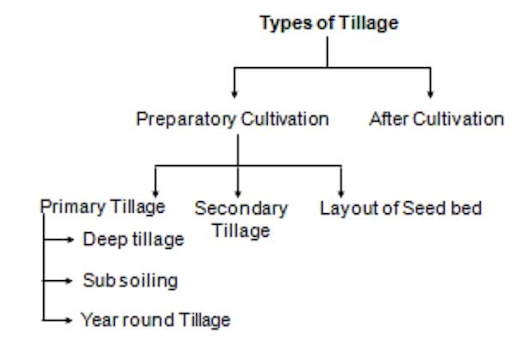
Types of Tillage
Preparatory Tillage
This refers to tillage operations performed to prepare the field for crop production. When the soil is in a workable condition, it consists of deep opening and loosening of the soil to achieve a desirable tilth as well as incorporating or uprooting weeds and crop stubble.
-
Primary Tillage
- Primary tillage is the tillage operation performed after crop harvest to prepare the land for cultivation.
- It is normally done when the soil is moist enough to facilitate ploughing but not so wet that it does not give appropriate traction.
- Primary tillage is often performed after the last harvest, when the soil is moist enough to allow ploughing but dry enough to provide sufficient traction.
- Primary tillage's goal is to achieve an appropriate depth of soft soil, absorb crop leftovers, kill weeds, and aerate the soil.
- When adequate force is available, some soil types are ploughed dry.
- Ploughing is the process of breaking up compact soil with various ploughs.
- Primary tillage is accomplished with a country plough, mould board plough, bose plough, tractor, and power tiller.
Different types of primary tillage are used depending on the purpose or necessity:
(i) Deep Tillage
- Deep tillage refers to modifying the physical or chemical qualities of a soil by executing tillage operations below the standard ploughing depth.
- Deep tillage is achieved by shattering the compacted soil while leaving the topsoil, plants, and surface detritus alone.
- When deep ploughing is done in the summer, it produces large clods that are baked by the hot sun. These clods crumble as a result of alternate heating and cooling, as well as summer showers.
- This gradual clod disintegration process improves soil structure.
- Summer deep ploughing kills pests by exposing pupae to the hot sun.
- Deep tillage of 25-30 cm depth is required for deep-rooted crops such as pigeonpea, while maize requires moderate deep tillage of 15-20 cm depth.
- Deep tillage improves soil moisture content as well. However, the benefit of deep tillage in dry farming depends on the rainfall pattern and crop.
- Deep ploughing should be used only for long-term, deeply rooted crops.
- The depth of ploughing should be proportional to the amount of rainfall that can be absorbed.
(ii) Subsoiling
- Hard pans may be present in the soil, limiting crop root growth. Silt pans, iron or aluminium pans, clay pans, or man-made pans are examples.
- Tillage pans caused by repeated tillage at the same depth are known as man-made pans.
- Crop root growth is restricted to the top few centimetres of soil, where hard pans prevent deep root penetration.
- Special tillage operations (chiselling) are used to break the hard pan beneath the plough layer and reduce compaction.
- Subsoiling is required every four to five years where heavy machinery is used for field operations such as seeding, harvesting, transporting, and so on.
- Subsoiling is the process of breaking the hard pan without inversion and with minimal disturbance to the top soil.
- While a portion of the subsoiler shatters hard pans, a narrow cut is made in the top soil. Chisel ploughs are also used to break up hard pans that can be found at depths of 60-70 cm.
- Subsoiling has a short duration of effect. Vertical mulching is used to prevent the subsoil furrow from closing.
(iii) Year Round Tillage
- Year-round tillage refers to tillage operations that take place all year. Field preparation begins in dry farming regions with the help of summer showers.
- Tillage operations are repeated until the crop is planted.
- Even after the crop has been harvested, the field is repeatedly ploughed or harrowed to prevent weed growth in the off season.
-
Secondary Tillage
- Secondary tillage refers to the tillage operations performed on the soil after primary tillage to improve soil tilth.
- Secondary tillage is a finer or lighter operation used to clean the soil, break up clods, and incorporate manure and fertilisers.
- Harrowing and planking are done to accomplish these goals.
- Secondary tillage is often shallower and more gentle than primary tillage.
- Secondary tillage prepares the seed bed by producing finer soil and occasionally shaping the rows.
- It also offers weed control throughout the growing season throughout crop plant development, unless weed control is done using low-till or no-till methods incorporating pesticides.
-
Layout of Seedbed and Sowing
- Following seedbed preparation, the field is properly laid out for irrigation and sowing or planting seedlings. These are crop-specific operations.
- A levelled seedbed is prepared for most crops such as wheat, soybean, pearl millet, groundnut, castor, and so on.
- These crops are sown without any land treatments after secondary tillage.
- However, growing crops in deep black soils during the rainy season is difficult due to ill-drained conditions and the inability to tillage during the rainy season.
- Broadbed and furrows (BBF) are thus formed prior to the onset of monsoon, and dry sowing is used.
- Some crops, such as maize and vegetables, require the field to be divided into ridges and furrows. Sugarcane is grown in furrows or trenches.
- To facilitate two-way intercultivation, crops such as tobacco, tomato, and chillies are planted with equal inter and intra-row spacing.
- Following field preparation, a marker is run in both directions. The seedlings are planted at the intersections.
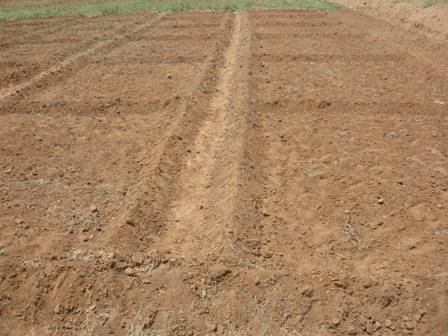
Layout of Seedbed and Sowing
Special Purpose Tillage
Clean Tillage
- Clean-tillage entails inverting the soil and burying the majority of the residue.
- A common clean-till procedure is moldboard ploughing followed by preplant disking.
- Because crop residue is mostly buried, the soil surface is exposed to wind and rain, which increases the risk of erosion and soil moisture loss.
- Clean-tillage poses the greatest risk of wind and water erosion of the tillage systems.
- Clean-tillage is not a conservation tillage method.
- Clean-tillage may be best suited for bottomland or poorly drained soils because it accelerates soil heating and reduces soil water content, and the risk of water erosion is low.
- Moldboard ploughing, on the other hand, can result in a plough pan that restricts plant root growth.
*For detailed notes of this topic, check this link Clean Tillage - Types of Tillage
Blind Tillage
- Blind tillage is tillage done after sowing the crop, either at the pre-emergence stage or during the early stages of crop growth, to damage crop plants in order to uproot weeds.
- Tractor cultivators perform blind tillage at a depth of 4-5 cm. Its purpose is to kill weeds, break up the soil crust, reduce evaporation, and allow air to reach the roots.
- It works especially well on wet clayey soils in areas with long, cold springs.
- Root crop yields are significantly reduced when blind tillage is performed too late.
- Harrowing the fields before and after sprouting is a common substitute for blind tillage.
*For detailed notes of this topic, check this link Blind Tillage - Types of Tillage
Zero Tillage (No Tillage)
- Zero tillage farming is an agricultural practice in which the topsoil of a field is not tilled after harvesting a specific crop and a new crop is sown within the remnants of the previous crop.
- The method is especially important in light of recent stubble burning incidents to clear crop remnants.
- Zero tilling farming, also known as no-tillage or direct drilling, is a farming technique that involves growing crops or pasture without disturbing the soil through tillage.
- The soil is left undisturbed except for the placement of the seeds in the desired position for germination.
- Masanobu Fukuoka, a Japanese farmer, is credited with pioneering zero-till farming.
*For detailed notes of this topic, check this link Zero Tillage (No Tillage) - Types of Tillage
Dry Tillage
- Dry tillage is used for crops that are sown or planted in dry land conditions with enough moisture for seed germination.
- This is appropriate for crops such as broadcasted paddy, jute, wheat, oilseed crops, pulse crops, potato crops, and vegetable crops.
Wet or Puddling Tillage
- Wet or puddling tillage refers to tillage performed on land that has standing water.
- The puddling operation entails repeatedly ploughing in standing water until the soil becomes soft and muddy.
- Puddling forms an impervious layer beneath the surface, reducing deep percolation losses of water and providing a soft seed bed for rice planting.
Conclusion
Tillage is a subsystem in agricultural systems that influences crop production primarily through crop establishment, soil structure modification, fertiliser and soil amendment incorporation and weed control. Tillage is also used to address climatic and soil constraints. The goal is to control soil properties such as water retention, temperature, infiltration, and evapotranspiration. Agriculture will most certainly abandon tillage practices in the future, relying on new technology to preserve the benefits of tillage while eliminating the related carbon emissions and soil degradation.
FAQs
Question: What is the primary purpose of tillage in agriculture?
Answer: The primary purpose of tillage in agriculture is to prepare the soil for planting by improving its physical condition. Tillage aims to create a suitable seedbed, control weeds, enhance soil aeration and drainage, and incorporate organic matter into the soil. By mechanically agitating the soil, tillage also helps to break up compacted layers, making it easier for roots to penetrate and for water to infiltrate.
Question: What are the environmental impacts of conventional tillage?
Answer: Conventional tillage can have several negative environmental impacts, including:
- Soil Erosion: Frequent plowing exposes soil to wind and water erosion, leading to the loss of topsoil.
- Soil Degradation: Continuous disturbance can degrade soil structure and reduce its fertility over time.
- Increased Carbon Emissions: Disturbing the soil releases stored carbon dioxide into the atmosphere, contributing to greenhouse gas emissions.
- Loss of Soil Moisture: Tillage can lead to evaporation of soil moisture, affecting crop growth and yield.
Question: How does no-till farming benefit soil health?
Answer: No-till farming benefits soil health in several ways:
- Soil Structure Preservation: By avoiding disturbance, no-till practices help maintain soil structure, improving water infiltration and root development.
- Enhanced Soil Fertility: Residues from previous crops remain on the surface, contributing organic matter and nutrients as they decompose.
- Reduction of Erosion: The soil surface is protected by crop residues, reducing erosion from wind and water.
- Improved Biodiversity: No-till systems promote a diverse soil ecosystem, supporting beneficial microorganisms and earthworms.
Question: What is strip tillage and how does it work?
Answer: Strip tillage is a conservation tillage practice that involves tilling narrow strips of soil while leaving the inter-row areas undisturbed. This method prepares a seedbed in the tilled strips for planting while conserving soil moisture and reducing erosion in the undisturbed areas. Strip tillage works by:
- Improving Seedbed Conditions: It creates a warm, dry seedbed that promotes early planting and better seed germination.
- Conserving Soil Moisture: The undisturbed soil retains moisture, benefiting crops during dry periods.
- Reducing Erosion: Leaving unplowed strips protects the soil from erosion by wind and water.
Question: How do different tillage practices affect crop yield?
Answer: Different tillage practices can significantly affect crop yield due to their impact on soil conditions, moisture retention, and weed management:
- Conventional Tillage: While it may lead to higher initial yields due to effective weed control, long-term use can degrade soil health and reduce productivity over time.
- No-Till: Although yields may be lower initially as soil adjusts, no-till can enhance long-term productivity by improving soil structure and fertility.
- Reduced Tillage: This practice often results in similar or improved yields compared to conventional tillage while benefiting soil health.
- Strip Tillage: This method can lead to higher yields by providing a favorable environment for seed germination while conserving moisture.
- Ridge Tillage: It can improve yield potential, particularly in regions with drainage issues, by enhancing water management.
MCQs
1. What is the primary purpose of tillage in agriculture?
A) Soil erosion prevention
B) Soil preparation for planting
C) Seed harvesting
D) Pest control
Answer: (B) See the Explanation
Explanation: The primary purpose of tillage in agriculture is to prepare the soil for planting by improving its physical condition and facilitating seedbed preparation.
2. Which type of tillage involves minimal soil disturbance?
A) Conventional tillage
B) No-till
C) Deep tillage
D) Intensive tillage
Answer: (B) See the Explanation
Explanation: No-till farming involves minimal or no soil disturbance, preserving soil structure and moisture.
3. How does conventional tillage affect soil health over time?
A) Improves soil fertility
B) Increases erosion and degradation
C) Enhances biodiversity
D) Has no effect
Answer: (B) See the Explanation
Explanation: Conventional tillage can lead to increased erosion and soil degradation over time, negatively impacting soil health.
4. What is the benefit of strip tillage?
A) Increases soil erosion
B) Enhances moisture conservation
C) Compacts soil
D) Eliminates crop residues
Answer: (B) See the Explanation
Explanation: Strip tillage enhances moisture conservation by leaving undisturbed areas of soil while preparing strips for planting.
5. What is a common challenge of using no-till farming?
A) Soil compaction
B) Improved soil structure
C) Initial lower yields
D) Increased weed growth
Answer: (C) See the Explanation
Explanation: A common challenge of using no-till farming is that it may result in initial lower yields as the soil adjusts to the lack of disturbance.
GS Mains Questions and Model Answers
Q1: Analyze the advantages and disadvantages of various tillage practices in modern agriculture.
Answer: Various tillage practices offer distinct advantages and disadvantages that can significantly impact agricultural productivity and sustainability. Conventional tillage provides effective weed control and prepares a fine seedbed but can lead to soil erosion, degradation, and loss of soil moisture over time. No-till farming enhances soil structure, reduces erosion, and promotes biodiversity but may result in initial lower yields as the soil acclimates to reduced disturbance. Reduced tillage presents a middle ground, maintaining soil health while enabling effective crop management. Strip and ridge tillage improve moisture conservation and drainage, particularly in waterlogged areas, but require careful management to optimize benefits. Ultimately, the choice of tillage practice should align with the specific needs of the crop, soil conditions, and long-term sustainability goals in agriculture.
Q2: Discuss the environmental impacts of conventional tillage and potential solutions to mitigate these impacts.
Answer: Conventional tillage can significantly impact the environment, leading to soil erosion, degradation of soil quality, and increased carbon emissions due to soil disturbance. The exposure of bare soil contributes to wind and water erosion, resulting in the loss of topsoil and essential nutrients. To mitigate these impacts, sustainable practices such as cover cropping, crop rotation, and conservation tillage should be adopted. Cover crops can protect soil from erosion and enhance soil organic matter, while crop rotation promotes biodiversity and pest control. Implementing reduced tillage practices, such as strip tillage or no-till, can also improve soil health by maintaining its structure and moisture levels. Overall, integrating these practices can create a more sustainable agricultural system that minimizes environmental degradation.
Q3: Evaluate the impact of tillage practices on soil health and crop yield.
Answer: Tillage practices significantly influence soil health and crop yield through their effects on soil structure, moisture retention, and nutrient availability. Conventional tillage often leads to soil compaction, reduced organic matter, and erosion, negatively impacting long-term soil fertility and crop yield. In contrast, no-till practices improve soil structure and moisture retention, resulting in healthier soils and potentially higher yields over time. Reduced tillage methods offer a balance, allowing for effective weed management while maintaining soil integrity. Each practice's impact on yield can vary based on factors such as soil type, climate, and crop selection, highlighting the importance of selecting appropriate tillage methods for specific agricultural contexts.
Previous Year Questions on Types of Tillage
1. UPSC CSE Prelims 2021:
Question: Which tillage method involves the least disturbance of soil?
A) Conventional Tillage
B) Reduced Tillage
C) No-Till
D) Deep Tillage
Answer: (C)
Explanation: No-Till involves the least disturbance of soil compared to other tillage methods.
2. UPSC CSE Mains 2019 (GS Paper 1):
Question: "Assess the role of sustainable tillage practices in enhancing soil health and agricultural productivity."
Answer: Sustainable tillage practices play a critical role in enhancing soil health and agricultural productivity by minimizing soil disturbance and promoting ecological balance. Practices such as no-till and reduced tillage preserve soil structure, prevent erosion, and maintain moisture levels, which are essential for healthy crop growth. By reducing reliance on chemical inputs for weed control, these practices foster biodiversity and enhance soil microbial activity, further improving soil fertility. Moreover, sustainable tillage practices contribute to climate resilience by sequestering carbon and improving soil's ability to retain water during dry spells. Overall, the integration of sustainable tillage methods is vital for achieving long-term agricultural sustainability and productivity.
Download the PREPP App and attempt FREE IAS Exam Mock Tests and get complete study material!

Full Test - 04: UPSC CSE Prelims CSAT (Paper-II)
Full Test - 03: UPSC CSE Prelims CSAT (Paper-II)
UPSC CSE Prelims 2026 GS Paper 1 Question Paper (24-May-2026)
UPSC CSE Prelims 2026 CSAT Paper 2 Question Paper (24-May-2026)

17 February 2025 | The Hindu Must Read Articles | Current Affairs

16 February 2026 | The Hindu Must Read Articles | Current Affairs

13 February 2026 | The Hindu Must Read Articles | Current Affairs









Comments