Trio Wins 2023 Nobel Prize In Chemistry For Quantum Dots
Relevance: GS3 - Science and Technology- developments and their applications and effects in everyday life. Prelims - current events of international importance
(Source: The Hindu, 10/05/2023)
Click here for Daily Current Affairs
Why in the news?
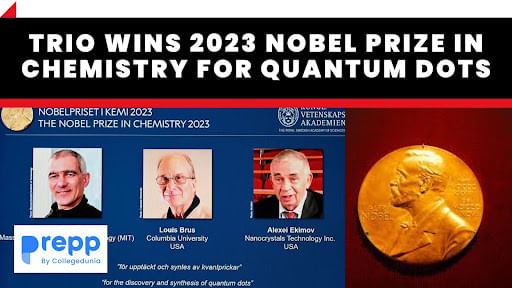
- Recently, the Nobel Prize in Chemistry for 2023 was awarded to Moungi G. Bawendi, Louis E. Brus, and Alexei I. Ekimov for their discovery of “quantum dots”.
- The Royal Swedish Academy of Sciences has described quantum dots as key to the exploration of the nanoworld.
Table of Contents
Who has been awarded the Nobel Prize for Chemistry in 2023?
- In 2023, the Nobel Prize for Chemistry was awarded to Moungi G. Bawendi, Louis E. Brus, and Alexei I. Ekimov for their work related to the discovery and synthesis of quantum dots.
- Quantum dots have unique properties and have been used by researchers to create colored light.
Contributions
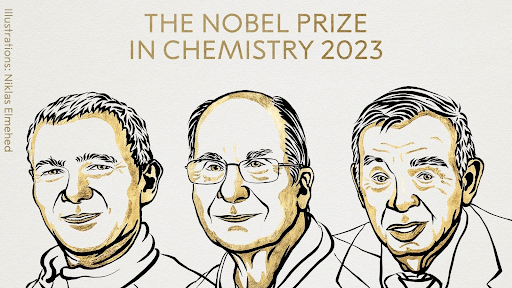
- Louis Brus and Alexei Ekimov: They independently created quantum dots in the early 1980s.
- On melting colored glass and X-raying the results, Ekimov observed that the smaller particles were more blue, which he recognized as a quantum effect.
- Brus became the first to observe the quantum effect in a liquid solution.
- Moungi Bawendi: He revolutionized the production of quantum dots which resulted in the production of high-quality quantum dots.
- He enabled mass production through a method of precisely controlling the temperature of colloid which enabled him to grow nanocrystals to the exact size he wanted.
What are quantum dots?
- Quantum dots are nanoparticles that are so small that their characteristics are determined by quantum effects.
- It is a new class of materials that is neither molecular nor bulk.
- It is a nano-meter size semiconductor crystal that often consists of just a few thousands of atoms.
- Size: In terms of its size, the size ratio of a quantum dot to a football is the same as that of the football to the Earth.
- Although they have the same structure and atomic composition as bulk materials, their properties can be tuned using a single parameter i.e., the particle’s size
Significance
- The work of the three awardees indicated how quantum dots could be developed in multiple ways.
- It also showed how their optical properties could be adjusted by controlling their size and composition.
- For example, scientists can manipulate them to emit specific colors of light when excited by light.
- Nanoscience: The discovery and synthesis of high-quality quantum dots through accurate but relatively simple chemical methods is a crucial step in the development of nanoscience
- The core principle of nanoscience is that at the scale of nanometres, particles attain new, size-dependent properties that can be harnessed and controlled for novel applications.
- Scope: The development of high-quality quantum dots opens up possibilities for development in areas such as electronics, industrial catalysis, medicine, etc.
Applications of quantum dots
- Lighting: They are used in devices such as televisions (QLED), computer monitors, smartphones, and LED lamps.
- These devices are more efficient and have longer lifetimes as compared to devices based on conventional technology.
- Screens using quantum dots offer better brightness, color range, and viewing angles.
- They are used in QLED TVs as they provide better resolution and preserve color quality for longer.
- Bioimaging: They can be used to label and track cells and tissues in living organisms.
- This will help in medical diagnosis and monitor treatment methods and their efficacy.
- Solar energy: The use of quantum dots has the potential to boost the efficiency of a solar cell by allowing it to capture a wider range of sunlight.
- These cells are cheaper to build and more efficient in converting sunlight to electricity.
- Quantum computing: They could be used to build faster and more powerful quantum computers.
- They can also be used to produce photons for quantum communication.
Potential areas
- Lasers: Lasers based on quantum dots are more efficient and adjustable in comparison to traditional lasers.
- As a result, they can be used more effectively in areas such as medical imaging, optical communications, and materials processing.
- Drug delivery: They can be used to deliver drugs to specific cells or tissues which could improve effectiveness and reduce side effects experienced during treatment.
- Biosensors: Quantum dot biosensors can be advantageous in the medical diagnostic sector due to their higher sensitivity and accuracy.
- They can be used to detect specific diseases or biomolecules such as tumors more effectively.
Are there any concerns about quantum dots?
- Toxic: Most quantum dots are developed using cadmium, despite its toxic nature, because of its ability to efficiently convert colors.
- However, scientists are working on developing non-toxic quantum dots.
Nobel Prize
|
(*Click this link to read prelims specific weekly current affairs articles)
FAQs
Question: What is nanoscience?
Answer:
Nanoscience is the study of phenomena that occur when materials are structured on a scale of less than 100 nm. This range includes the wavelength of
light, the de Broglie wavelength, etc. Nanoscience aims to adopt the unique features exhibited by particles in this range for new and improved applications.
Question: What is quantum technology?
Answer:
Quantum technology is a field of science that is related to the principles of quantum mechanics. Quantum mechanics is a branch of physics that describes the behavior of matter and energy at the atomic and subatomic levels.
UPSC Mains Practice Question:
|
MCQs
Question: Which one of the following is the context in which the term “qubit” is mentioned?
(a) Cloud Services
(b) Quantum Computing
(c) Visible Light Communication Technologies
(d) Wireless Communication Technologies
Answer: (b) See the Explanation
- A qubit is a quantum bit, which is the quantum computing counterpart to the binary digit or bit of classical computing.
- It is the basic unit of information in a quantum computer.
Therefore, option (b) is the correct answer.
Question: Consider the following statements:
- The Nobel Prize Awarding Ceremony takes place on December 10, of every year.
- The Nobel Prize for Literature was added later on to the other five areas: Physics, Chemistry, Physiology or Medicine, Peace, and Economics.
Which of the statement(s) given above is/are correct? (UPSC CSE 2006)
(a) 1 only
(b) 2 only
(c) Both 1 and 2
(d) Neither 1 nor 2
Answer: (a) See the Explanation
- The Nobel Prizes, which have been awarded since 1901are presented to the Laureates on 10th December, the anniversary of Alfred Nobel's death. Hence statement 1 is correct.
- The will of Alfred Nobel stipulated that Nobel Prizes were to be awarded in Physics, Chemistry, Physiology or Medicine, Literature, and Peace.
- In 1968, Sveriges Riksbank, the Swedish central bank, established the Sveriges Riksbank Prize in Economic Sciences in Memory of Alfred Nobel, which is presented as the Nobel Prize in Economics. Hence statement 2 is incorrect.
Therefore, option (a) is the correct answer.
Question: Which of the following best defines quantum dots, which were in the news recently?
(a) A molecular scissors used in targeted gene editing.
(b) A biosensor used in the accurate detection of pathogens in patients.
(c) Nanometer-sized semiconductor crystals
(d) A herbicidal substance synthesized in generally modified crops
Answer: (c) See the Explanation
- Quantum dots are nanoparticles that are so small that their characteristics are determined by quantum effects.
- It is a nano-meter size semiconductor crystal that often consists of just a few thousands of atoms.
- It has applications in fields such as medicine, solar energy, optical communication, drug delivery, etc.
Therefore, option (c) is the correct answer.
Download the PREPP App and attempt FREE IAS Exam Mock Tests and get complete study material!

Full Test - 04: UPSC CSE Prelims CSAT (Paper-II)
Full Test - 03: UPSC CSE Prelims CSAT (Paper-II)
UPSC CSE Prelims 2026 GS Paper 1 Question Paper (24-May-2026)
UPSC CSE Prelims 2026 CSAT Paper 2 Question Paper (24-May-2026)

17 February 2025 | The Hindu Must Read Articles | Current Affairs

16 February 2026 | The Hindu Must Read Articles | Current Affairs

13 February 2026 | The Hindu Must Read Articles | Current Affairs









Comments