Centre Hikes LPG Subsidy For Ujjwala Beneficiaries To ₹300 Per Cylinder
Relevance: GS2 - Government policies and interventions for development in various sectors and issues arising out of their design and implementation.
(Source: The Hindu, 10/05/2023)
Click here for Daily Current Affairs
Why in the news?
- Recently, the Union Government raised the subsidy provided for LPG under the Ujjwala scheme from ₹200 to ₹300.
- The Pradhan Mantri Ujjwala Yojana (PMUY) was launched in 2016 to ensure the availability of cooking fuel such as LPG to rural and deprived households that relied on traditional fuels like firewood, coal, cow-dung cakes, etc.
Table of Contents
LPG Subsidy Hike
- The Cabinet Committee on Economic Affairs (CCEA) raised the subsidy on LPG cylinders provided under the Union Government’s flagship Ujjwala programme from ₹200 per cylinder to ₹300 per cylinder.
- The subsidy would be applicable for up to 12 cylinder refills in a year.
- It will benefit around 9.6 crore households throughout the country.
- In August 2023, the Union Government lowered the price of cooking gas by ₹ 200 per cylinder.
Reason for the hike
The decision to enhance the subsidy comes ahead of crucial Assembly elections in five states: Madhya Pradesh, Rajasthan, Telangana, Chattisgarh, and Mizoram.
What is the Ujjwala scheme?
- The Pradhan Mantri Ujjwala Yojana (PMUY) was introduced by the Union Ministry of Petroleum and Natural Gas to ensure access to clean cooking fuels such as LPG, for rural and underprivileged households.
- These households traditionally relied on cooking fuels like coal and firewood which have adverse effects on the environment and the health of women.
Objectives
- Women empowerment: It aims to empower women by ensuring access to clean cooking fuel.
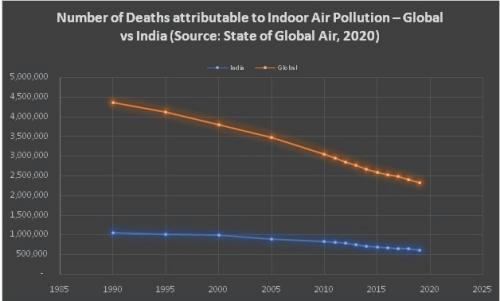
- Reducing Deaths: PMUY aims to reduce the number of deaths due to the use of unclean cooking fuels.
- According to WHO, about 4.3 million premature deaths are caused annually due to indoor air pollution and respiratory illnesses.
Health benefits
- It will help improve the health of rural women who are the worst affected by the use of unclean fuels.
- It also aims to reduce the occurrence of respiratory ailments in children due to indoor air pollution.
- This would indirectly benefit the medical sector in the country by reducing the disease burden.
Features
- Subsidy: It offered beneficiaries a financial subsidy of ₹1600 for each LPG connection to BPL households.
- Free LPG connection for beneficiaries and subsidies on up to 12 refills in a year.
- EMI: Beneficiaries have been provided with an EMI facility to cover the cost of the stove and the first refill.
- Direct transfer: Beneficiaries can join the PAHAL scheme, which would allow them to receive the subsidy amount directly in their bank accounts.
Phases
- Phase I: It was launched on May 1, 2016.
- Target: Provide 8 Crore LPG connections to deprived households by March 2020.
- It resulted in an increase in LPG coverage from 62% in 2016 to 99.8% in 2021.
- Ujjwala 2.0: An additional 1 crore LPG connections to eligible households by March 31, 2022, were accounted for in the Union Budget FY21-22.
- As the target was met by January 2022, an additional 60 lakh LPG connections were released, and this target was achieved by December 2022.
Concerns related to the Ujjwala scheme
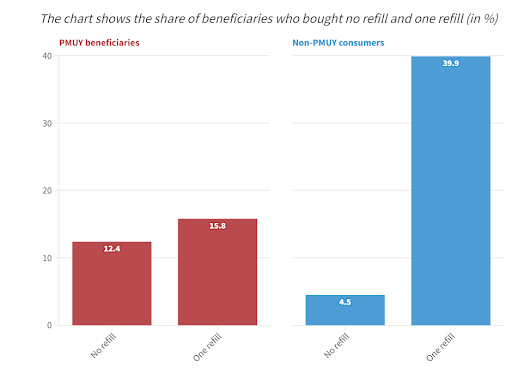
- Limited utilization: There is a significant disparity in the consumption of LPG cylinders between PMUY and non-PMUY households.
- Average PMUY beneficiaries refilled less than four LPG cylinders during 2022-23 while a quarter of PMUY beneficiaries did not use any LPG cylinders or took just one refill in 2022-2023.
- However, non-PMUY households had an average consumption of 6.67 cylinders per household.
- Rising LPG costs: The rise in prices of LPG cylinders due to domestic and international factors has made LPG cylinders economically less viable for rural households.
- These factors include import duties, bottling charges, delivery charges, GST, etc.
- As a result, these households prefer to use conventional fuels which impacts the performance of the scheme.
- Subsidy Expenditure:
- The amount of subsidy provided is based on the difference between the Retail Selling Price and the subsidized cost set by the government.
- The subsidy provided under the Ujjwala scheme increased from ₹6,100 crore in 2022-23 to ₹7,680 crore in 2023-24.
What are the benefits of using LPG as a cooking fuel?
- Good source of heat: LPG can be burnt directly and consistently.
- Easy to transport: It can be transported easily across long distances by using pipelines, thereby reducing the physical burden on women to find firewood.
- Cleaner: It is a clean fuel that does not produce any smoke when burnt, thereby reducing respiratory illnesses.
- LPG doesn't contain sulfur and is more environmentally friendly than other sources of energy.
- LPG only releases 81% of the CO2 released by oil and 70% released by coal.
- Higher heating value: They produce more heat energy when burnt than traditional fuels.
- Efficient: Food cooks faster on LPG which means women have to spend less time completing their household chores.
- This means they can spend more time pursuing paid employment or constructive hobbies.
(*Click this link to read prelims specific weekly current affairs articles)
FAQs
Question: What is the CCEA?
Answer:
The Cabinet Committee on Economic Affairs is chaired by the Prime Minister of India and is responsible for managing and coordinating governmental initiatives in the economic sector. Its key responsibilities include reviewing economic trends, problems, and prospects to evolve a consistent and integrated economic policy and setting the prices of agricultural produce and essential commodities.
Question: What are subsidies?
Answer:
Subsidies refer to any benefits given to individuals, businesses, or institutions by the government. It can be direct in the form of cash payments or indirect through tax breaks. It also includes all grants on the current account made by the government to depress the price of any good or service below its economic cost.
UPSC Mains Practice Question:
|
MCQs
Question: Which of the following are the reasons/factors for exposure to benzene pollution?
- Automobile exhaust
- Tobacco smoke
- Wood burning
- Using varnished wooden furniture
- Using products made of polyurethane
Select the correct answer using the code given below: (UPSC CSE 2020)
(a) 1, 2 and 3 only
(b) 2 and 4 only
(c) 1, 3 and 4 only
(d) 1, 2, 3, 4 and 5
Answer: (a) See the Explanation
- Benzene is a chemical that is a colorless or light yellow liquid at room temperature.
- It is highly flammable and is formed from both natural processes and human activities.
- It is found in crude oils and as a by-product of oil-refining processes.
- It is used in paints, glues, and furniture wax.
- It is a by-product of the combustion of tobacco used in cigarettes. Hence statement 2 is correct.
- It is also found in wood smoke and automobile exhaust. Hence statements 1 and 3 are correct.
Therefore, option (a) is the correct answer.
Question: Consider the following statements about the Ujjwala scheme:
- It is a social welfare scheme to provide LPG connections to BPL households.
- The scheme was launched in 2015.
- It aims to safeguard the health of women and children by ensuring access to clean cooking fuel.
How many of the above statements is/are incorrect?
(a) Only 1 statement
(b) Only 2 statements
(c) All 3 statements
(d) None of the above
Answer: (a) See the Explanation
- The PM Ujjwala Scheme is a flagship social welfare scheme of the Union Government that provides LPG connections to BPL households and thus protect the health of women and children. Hence statements 1 and 3 are correct.
- The scheme was launched in 2016 by the Union Ministry of Petroleum and Natural Gas. Hence statement 2 is incorrect.
Therefore, option (a) is the correct answer.
Download the PREPP App and attempt FREE IAS Exam Mock Tests and get complete study material!

Full Test - 04: UPSC CSE Prelims CSAT (Paper-II)
Full Test - 03: UPSC CSE Prelims CSAT (Paper-II)
UPSC CSE Prelims 2026 GS Paper 1 Question Paper (24-May-2026)
UPSC CSE Prelims 2026 CSAT Paper 2 Question Paper (24-May-2026)

17 February 2025 | The Hindu Must Read Articles | Current Affairs

16 February 2026 | The Hindu Must Read Articles | Current Affairs

13 February 2026 | The Hindu Must Read Articles | Current Affairs









Comments