Discharge Of Mining Waste Into Rivers Affects 50 Times More People Than Tailings Dam Disasters
Relevance: GS3 - Conservation, environmental pollution and degradation, environmental impact assessment. Infrastructure: Energy GS1 - Distribution of key natural resources across the world
(Source: Down to Earth, 10/05/2023)
Click here for Daily Current Affairs
Why in the news?
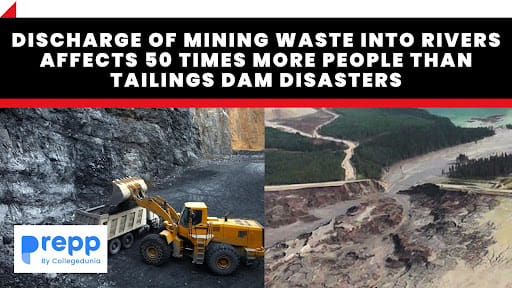
- Recently, a study conducted by the University of Lincoln revealed that the number of people exposed to pollution originating from the continuous discharge of mining waste into rivers is nearly 50 times higher than those immediately affected by incidents of tailings dam failures.
- Rapid growth in global metal mining is a crucial factor in the world’s transition to green and clean energy.
Table of Contents
Study on mining discharge into rivers
Methodology: It used a comprehensive approach that simulated the contamination from operational and decommissioned metal mining sites.
Findings
- Extent of Pollution Exposure: The number of people exposed to pollution due to the discharge of mining waste discharge into rivers is almost 50 times higher than those immediately affected by tailings dam failures.
- Tailings dams are structures used to store mining byproducts.
- Detrimental substances: It assessed the presence of detrimental substances like lead, zinc, copper, and arsenic in rivers due to mining discharge.
- These toxic pollutants are carried downstream from mining sites and accumulate over time in river courses and floodplains.
- New tool: The study has developed a new method that can be used to predict the dispersal of mine waste in river systems worldwide.
- It can be used by governments, environmental regulators, the mining industry, and local communities to assess the offsite and downstream impacts of mining on the environment and human health.
- Need for reform: The global metal mining sector must be reformed in order to ensure the transition to a clean and green future.
- Although the majority of pollution is a legacy from the industrial era, modern mining must prioritize environmental sustainability.
Who could be impacted
- More than 65,000 square kilometers of irrigated land.
- 5.72 million livestock population
- Around 23.48 million people
Diseases caused by exposure to toxic metals
| Metal | Diseases |
|---|---|
| Lead | Anemia, Partial paralysis, loss of hearing, mental retardation |
| Zinc | Fever, Vomiting, Diarrhea, Stomach cramps, |
| Copper | Vomiting, Diarrhea, Stomach cramps, Liver damage, Kidney disease |
| Arsenic | Lung and skin cancer, Black foot disease, Diarrhea |
Mining in India
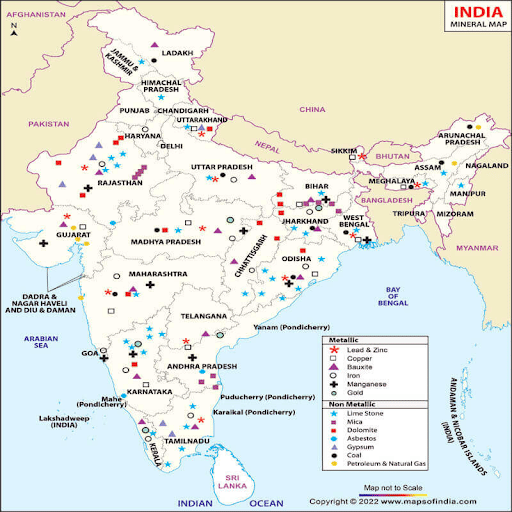
- Mineral mining is one of the most important sectors in India due to its potential for social inclusion, economic progress, and environmental sustainability.
- Contribution to GDP: It contributes around 2.2% to 2.5% of the country’s GDP.
- Employability: It is the second largest sector in terms of generating employment behind agriculture.
- It provides employment opportunities to around 7 lakh people in the country.
- Self-sufficiency:
- India is largely self-sufficient in iron & steel, and aluminum and near to self-sufficient in bauxite, chromite, iron ore, kyanite, limestone, sillimanite etc.
- India is deficient in magnesite, manganese ore, rock phosphate, etc. which were imported to meet the domestic demand.
Steps taken by the government
- The National Steel Policy was developed to boost per capita steel consumption to 160 kgs by 2030-31.
- The government has a fixed objective of increasing rural consumption of steel from the current 19.6 kgs per capita to 38 kgs per capita by 2030-31.
- The National Mineral Exploration Policy 2019 aims to improve transparency, regulation, enforcement, and adoption of sustainable mining practices.
- Mission Purvodaya: It was launched in 2020 to accelerate the development of eastern India through the establishment of an integrated steel hub in Kolkata, West Bengal.
- In January 2016, the Indian Bureau of Mines (IBM) and the National Remote Sensing Centre (NRSC), ISRO signed a MoU to conduct a pilot project on "mining activity monitoring using satellite imagery" to deter illegal mining.
- The District Mineral Foundation Fund (DMF) was established for the benefit of mining-affected people and areas under the Pradhan Mantri Khanij Kshetra Kalyan Yojana.
- 100% FDI is permitted via the automatic route for mining and exploration of metal and nonmetal ores.
Challenges faced by India’s mining sector
- Regulatory hurdles: Indian laws restrict a miner from owning a mining lease beyond 10 km2 in a state which inhibits the participation of major companies in auctions.
- Other concerns include arbitrary coal mine allocations, corruption, and red tapeism.
- Inadequate mineral exploration: The level of investment by India in the exploration of deep-seated minerals like copper, zinc, lead, gold, and silver is insufficient.
- This has affected the discovery of new sources of minerals.
- Import dependency: In 2021-22, India’s import bill rose to $157 billion which is a significant part of the country’s total imports
- Taxation: Minerals like iron ore and bauxite suffer from double taxation in the form of royalty on royalty which affects their cost competitiveness.
- Displacement: Large-scale displacement of communities for mining and inadequate rehabilitation measures have led to a negative sentiment among the public regarding mining.
- This has also adversely impacted the tribal heritage and way of life.
- Safety hazards: Rudimentary methods and the lack of proper safety equipment and protocols have led to an increase in mine-related accidents and fatalities.
- Illegal mining: Illegal mining is prevalent, especially in North Eastern states like Meghalaya, like rat-hole mining, which has been banned by the NGT.
- Environmental concerns: This has led to an increase in environmental degradation, air and water pollution, as well as diseases like fibrosis, pneumoconiosis, and silicosis.
(*Click this link to read prelims specific weekly current affairs articles)
FAQs
Question: What is a tailings dam?
Answer:
A tailings dam is typically an earth-fill embankment dam used to store byproducts of mining operations after separating the ore from the gangue. The mining byproducts collected in tailings dams are often unstable and can damage the environment by releasing toxic metals. They have a higher risk of failure which could expose the surrounding environment to toxic materials.
Question: What is rat-hole mining?
Answer:
Rat Hole Mining is a primitive and hazardous method to mine coal. It involves digging very small narrow tunnels of 3-4 height called rat holes. Workers, mostly children, enter and extract coal.
UPSC Mains Practice Question:
|
MCQs
Question: Pneumoconiosis affects the workers who work mainly in (UPSC CSE 2005)
(a) Tanneries
(b) Coal mining industry
(c) Distilleries
(d) Glass industry
Answer: (b) See the Explanation
- Pneumoconiosis is a respiratory disease caused by the inhalation of various types of dust, such as coal dust, silica dust, asbestos dust, etc.
- Therefore, it is common in workers who work in coal mines and related industries.
Therefore, option (b) is the correct answer.
Question: With reference to the management of minor minerals in India, consider the following statements : [2019-I]
- Sand is a 'minor mineral' according to the prevailing law in the country.
- State Governments have the power to grant mining leases of minor minerals, but the powers regarding the formation of rules related to the grant of minor minerals lie with the central government.
- State Governments have the power to frame rules to prevent illegal mining of minor minerals.
Which of the statements given above is/are correct? (UPSC CSE 2019)
(a) 1 and 3 only
(b) 2 and 3 only
(c) 3 only
(d) 1, 2 and 3 only
Answer: (a) See the Explanation
- Sand has been defined as a minor mineral under Section 3(e) of the Mines and Minerals (Development and Regulation) Act, 1957. Hence statement 1 is correct.
- Section 15 of the MMDR Act grants the state governments the power to grant mining leases of minor minerals and they have formed rules related to the grant of minor minerals. Hence statement 2 is incorrect.
- Section 23 of the MMDR Act empowers the state governments to frame rules to prevent illegal mining, transportation, and storage of minor minerals. Hence statement 3 is correct.
Therefore, option (a) is the correct answer.
Download the PREPP App and attempt FREE IAS Exam Mock Tests and get complete study material!

Full Test - 04: UPSC CSE Prelims CSAT (Paper-II)
Full Test - 03: UPSC CSE Prelims CSAT (Paper-II)
UPSC CSE Prelims 2026 GS Paper 1 Question Paper (24-May-2026)
UPSC CSE Prelims 2026 CSAT Paper 2 Question Paper (24-May-2026)

17 February 2025 | The Hindu Must Read Articles | Current Affairs

16 February 2026 | The Hindu Must Read Articles | Current Affairs

13 February 2026 | The Hindu Must Read Articles | Current Affairs









Comments