MoU Signed With Museum For Return Of Shivaji's 'Wagh Nakh'
Relevance: GS1 - Important Personalities; Prelims
(Source: The Hindu, 10/05/2023)
Click here for Daily Current Affairs
Why in the news?
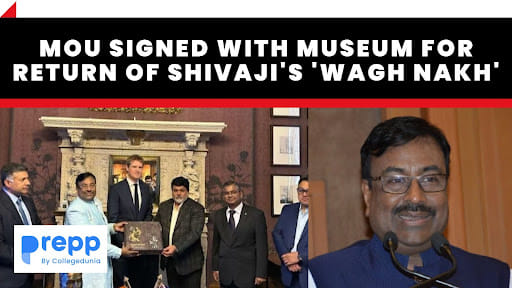
- Recently, Maharashtra's Cultural Affairs Minister Sudhir Mungantiwar signed a memorandum of understanding (MoU) with the Victoria and Albert Museum in London to bring back ‘wagh nakh’, the wartime weapon of Chhatrapati Shivaji Maharaj.
- The 17th century weapon will make a journey back to the State for a historic exhibition to commemorate the 350th anniversary of his ascension to the throne.
Table of Contents
About the MoU
- The Victoria and Albert Museum in London will loan the tiger claws to the Maharashtra government for a period of three years.
- It will be in India from November 2023 to November 2026.
- During this period, it will be displayed at various museums within the state.
What is Wagh Nakh?
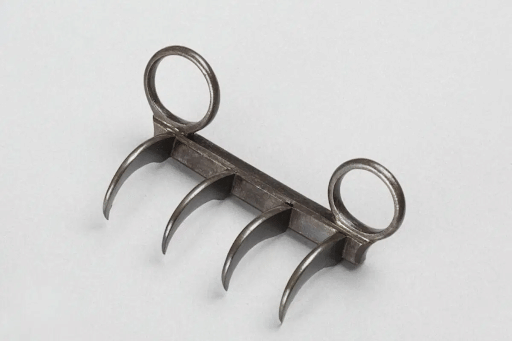
- The historic wagh nakh, is a knuckle duster with metal nails resembling tiger claws.
- It was a martial weapon which holds historical significance, famously employed by the revered Maratha king, Chhatrapati Shivaji Maharaj to kill Afzal Khan, the formidable General in the Bijapur Adil Shahi empire, in 1659.
- It holds a special place in the history of Maharashtra. Its return symbolizes a significant milestone in the state's cultural legacy and the reverence it holds for its iconic leader, Chhatrapati Shivaji Maharaj.
About Chhatrapati Shivaji Maharaj
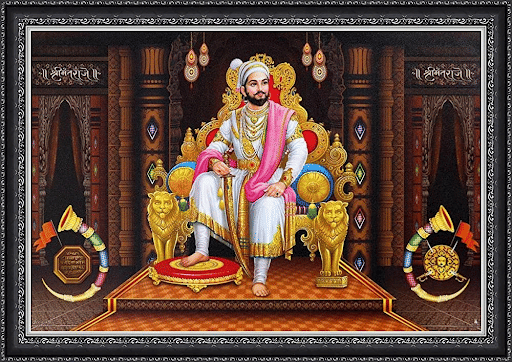
- Chatrapati Shivaji Maharaj, a renowned figure in Indian history, is celebrated for founding the Maratha Empire in western India.
- He was born on February 19, 1630 to Shahaji Bhosle and Jijabai in the fort of Shivneri, near the city of Junnar of the Pune district.
- His exceptional determination and administrative prowess enabled him to establish this empire by transforming the diminishing Adilshahi sultanate of Bijapur.
- Shivaji's rule was characterized by a highly efficient and progressive administration, supported by a disciplined military and a well-established administrative framework.
- His governance was marked by innovation, particularly in military tactics, which relied on non-conventional methods that leveraged geography and speed to gain strategic advantages.
Shivaji’s Struggles with Bijapur
- Shivaji’s father Shahaji was in service of the Bijapuri Sultanate: a tripartite association between Bijapur, Ahmednagar, and Golconda, as a general.
- By 1645, Shivaji acquired control of several strategic areas from under the Bijapur Sultanate around Pune.
- After his success, he had emerged as a threat for Mohammed Adil Shah who gave the order to imprison Shahaji in 1648.
- Shahaji was released on condition that Shivaji kept a low profile and kept from further conquests. Shivaji resumed his conquests after Shahaji’s death in 1665.
- The Battle of Pratapgad took place in 1659, at Pratapgad Fort in Satara. The battle was fought between the Marathas forces led by Chhatrapati Shivaji and the Bijapur troops under General Afzal Khan.
- The Marathas emerged victorious, marking their first significant military triumph against a major regional power.
Other Battles fought by Shivaji Maharaj
| Battle of Pavan Khind, 1660 | It was fought at a mountain pass in the vicinity of fort Vishalgad, near the city of Kolhapur, Maharashtra, between the Maratha Sardar Baji Prabhu Deshpande and Siddi Masud of Adilshahi. |
| Sacking of Surat, 1664 | It occurred near the city of Surat, Gujarat, between Shivaji Maharaj and Inayat Khan, a Mughal captain |
| Battle of Purandar, 1665 | It was a major battle fought between the Mughal Empire and Maratha Empire. |
| Battle of Sinhagad, 1670 | It occurred on the fort of Sinhagad near the city of Pune, Maharashtra between Tanaji Malusare, a commander of Maratha ruler Shivaji Maharaj and Udaybhan Rathod, fort keeper under Jai Singh I who was a Mughal Army Chief. |
| Battle of Kalyan, 1682-83 | It was significant as Bahadur Khan of the Mughal Empire defeated the Maratha army and took over Kalyan. |
| Battle of Sangamner, 1679 | It was again fought between the Mughal Empire and Maratha Empire. This was the last battle fought by Shivaji. |
(*Click this link to read prelims specific weekly current affairs articles)
FAQs
Question: What is Wagh Nakh?
Answer:
It is a knuckle duster with metal nails resembling tiger claws. It was a martial weapon which holds historical significance, famously employed by the revered Maratha king, Chhatrapati Shivaji Maharaj to kill Afzal Khan, the formidable General in the Bijapur Adil Shahi empire, in 1659.
Question: Who was Chhatrapati Shivaji Maharaj?
Answer:
Chatrapati Shivaji Maharaj, a renowned figure in Indian history, is celebrated for founding the Maratha Empire in western India. He was born on February 19, 1630 to Shahaji Bhosle and Jijabai in the fort of Shivneri, near the city of Junnar of the Pune district.
Question: Who is Afzal Khan?
Answer:
Afzal Khan (died 20 November 1659) was a general who served the Adil Shahi dynasty of Bijapur Sultanate in India. He played an important role in the southern expansion of the Bijapur Sultanate by subjugating the Nayaka chiefs who had taken control of the former Vijayanagara territory.
MCQ
Question: With reference to Wagh Nakh, consider the following statements:
- It is a knuckle duster with metal nails resembling tiger claws.
- It was a martial weapon which holds historical significance, famously employed by the revered Maratha king, Chhatrapati Shivaji Maharaj to kill Afzal Khan.
Which of the statements given above is/are correct?
(a) 1 only
(b) 2 only
(c) Both 1 and 2
(d) Neither 1 nor 2
Answer: (c) See the Explanation
The historic wagh nakh, is a knuckle duster with metal nails resembling tiger claws. It was a martial weapon which holds historical significance, famously employed by the revered Maratha king, Chhatrapati Shivaji Maharaj to kill Afzal Khan, the formidable General in the Bijapur Adil Shahi empire, in 1659.
Therefore, option (c) is the correct answer.
Download the PREPP App and attempt FREE IAS Exam Mock Tests and get complete study material!

Full Test - 04: UPSC CSE Prelims CSAT (Paper-II)
Full Test - 03: UPSC CSE Prelims CSAT (Paper-II)
UPSC CSE Prelims 2026 GS Paper 1 Question Paper (24-May-2026)
UPSC CSE Prelims 2026 CSAT Paper 2 Question Paper (24-May-2026)

17 February 2025 | The Hindu Must Read Articles | Current Affairs

16 February 2026 | The Hindu Must Read Articles | Current Affairs

13 February 2026 | The Hindu Must Read Articles | Current Affairs









Comments