TRAI Can’t Regulate OTT Platforms Like Hotstar, Says Tribunal
Relevance: GS2 - Statutory, regulatory and various quasi-judicial bodies. Government policies and interventions for development in various sectors and issues arising out of their design and implementation
(Source: Indian Express, 10/07/2023)
Click here for Daily Current Affairs
Why in the news?
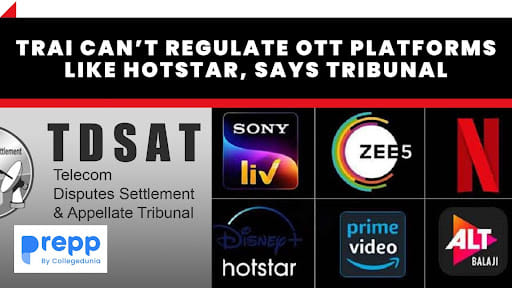
- Recently, the Telecom Disputes Settlement and Appellate Tribunal (TDSAT) ruled that OTT platforms were outside the jurisdiction of the Telecom Regulatory Authority of India (TRAI).
- OTT platforms are governed by the Information Technology Rules, 2021 which have been notified by the Ministry of Electronics and Information Technology.
Table of Contents
In what context did TDSAT pass this order?
- The All India Digital Cable Federation had filed a petition before the TDSAT alleging that free streaming of matches of the ICC Cricket World Cup on mobile devices by Star India through its OTT platform- Disney+Hotstar is discriminatory under TRAI regulations.
- It was discriminatory because access to Star Sports TV channel was only granted to subscribers making monthly payments.
- It petitioned the tribunal to restrain Star India from granting viewers free access to Star Sports on their mobiles or that AIDCF members/cable operators should also be provided free access.
Why is this order significant?
Conflict of jusrisdiction:
- According to the Union Ministry of Electronics and Information Technology (MeitY) OTT services fall outside the jurisdiction of the Department of Telecommunications (DoT) under the Ministry of Communications.
- On the other hand, TRAI has sought to regulate these services including communication platforms like WhatsApp.
- The DoT had proposed a draft telecom bill categorizing OTT platforms as telecommunications services and sought to regulate them similar to telecom operators.
- However, the MeitY objected and stated that internet-based communications services are not within the DoT's purview according to the Allocation of Business Rules.
- It stated that the DoT can only regulate the carriage layer, i.e. telephony, wireless communications, and private sector licences, etc.
TRAI’s changing position
- TRAI had earlier initiated consultations on the regulation of OTT communication services like WhatsApp, Zoom, and Google Meet.
- In June 2023, it asked stakeholders to make suggestions about the regulation of OTT services, and questioned whether selective banning of OTT services could be done as opposed to entirely shutting down the Internet.
- In 2020, TRAI stated that it was against the creation of a specific regulatory framework for OTT services.
Telecom operator demands
- Telecom operators have demanded that OTT services must also be subjected to the same regulatory rules as imposed on traditional telecom services.
- This would ensure a level playing field.
Why is Regulation of OTT Communication Services Important?
- Level playing field: It will help ensure fair competition between telecom service providers (TSPs) and OTT platforms.
- TSP in India are regulated by several laws, including the Indian Telegraph Act, 1885, the Wireless Telegraphy Act, 1933 and the Telecom Regulatory Authority of India Act, 1997 while OTT platforms offer similar services without facing these requirements, which gives them an advantage.
- This adversely impacts the revenue and profitability of TSPs and government revenue from the sector.
- National security: Regulation of OTT communication services is a critical part of ensuring national security and public order.
- OTT platforms should be subject to lawful interception and monitoring to prevent the spread of misinformation, incitement of violence, or facilitation of criminal activities and maintian the internet as a safe enironment.
What is the TDSAT?
- The Telecommunications Dispute Settlement and Appellate Tribunal (TDSAT) was established through an amendment of the TRAI Act, 1997 in 2000.
- The amendment allowed the TDSAT to take over TRAI’s adjudicatory and disputes resolution functions.
Objectives
- Adjudicate disputes between
- A licensor and a licensee
- Two or more service providers
- A service provider and a group of consumers
- Hear and dispose of appeals against any order or decision of TRAI.
Composition
- It consists of a Chairperson and two other members, appointed by the Union Government.
- Members are selected by the Union Government in consultation with the Chief Justice of India.
Eligibility
- Chairperson: He/she should have been either a Judge of the Supreme Court or the Chief Justice of a High Court.
- Other Members: He/She must have held the post of Secretary to the Government of India or any equivalent post in the Union/State Government.
Term of office
- The Chairperson and members hold office for a term of maximum four years
- The Chairperson can serve upto 70 years while for members the maximum age is sixty-five years.
Removal of members
Members of the TDSAT can be removed on the same conditions as members of TRAI.
Jurisdiction
- The jurisdiction of civil courts do not extend to any matter which the TDSAT is empowered to determine.
- The TDSAT has all the powers of a civil court and an order passed by the TDSAT is executable as a decree of civil court.
- However, it is not bound by the procedure laid down by the Code of Civil Procedure but is guided by the principles of natural justice.
- It has been empowered to regulate its own procedure.
- Penalties: Similar penalties as those of TRAI.
To know more about TRAI, click the link.
Constitutional Provisions related to Tribunals
- Tribunals were mentioned in the original constitution but were added through the 42nd Amendment Act, 1976 to ensure speedy, inexpensive and decentralized adjudication of disputes.
- It was based on the recommendations of the Swaran Singh Committee.
- Part XIV A of the Constitution deals with Tribunals.
- Article 323-A: Administrative Tribunals.
- Parliament can establish a tribunal for matters related to public service.
- Article 323-B: Tribunals for other matters.
- Parliament and the state legislatures are authorised to provide for the establishment of tribunals to adjudicate disputes related to - taxation; foreign exchange, import and export; industrial and labour; land reforms; ceiling on urban property; Parliamentary and state elections; food; rent and tenancy rights.
- Article 262: It deals with adjudication of disputes related to inter-state river wate and river valleys.
- Parliament is empowered to adjudicate conflicts surrounding inter-state rivers or river valleys.
- Parliament can also provide that neither the Supreme Court or any other court can exercise any jurisdiction in such matters.
- In order to fulfill this obligation,Parliament passed the Inter-State Water Dispute Act, 1956 which allows the Union Government to constitute tribunals to adjudicate disputes.
Challenges related to tribunals
- Vacancies: In a petition before the Supreme Court, the Labour Law Association (LLA) claimed that out of 22 tribunals, nine do not have presiding officers and vacancies are likely to arise in three more tribunals in 2023.
- The lack of action by the Union government on the recommendations made by selection committees led by sitting Supreme Court judges to fill up the vacancies has been criticized.
- Redundancy: Tribunals have become redundant due to the insufficiency of staff.
- This means that litigants have nowhere to go for justice as High Courts do not have jurisdiction over matters considered by tribunals.
- Non-uniformity: There is a lack of uniformity among tribunals across India.
- This is evident in their service conditions, terms of office, nodal ministries, etc.
- Administrative concerns: Tribunals have separate laws and procedures and do not necessarily follow the principle of the Rule of Law.
- Tribunals are not independent of the Executive like the ordinary courts and have been criticized by the SC as instruments of the Executive.
- Their membership includes administrators and technicians who may have no experience or training in judicial proceedings.
- Opacity: Tribunals often conduct their sittings in secret, which means leads to transparency concerns as common people find it difficult to particiipate.
- Lack of oversight: In the L. Chandra Kumar v. Union of India (1997), it was proposed to set up a b to supervise tribunals and enable their uniform functioning.
- However, this has not been implemented as yet.
(*Click this link to read prelims specific weekly current affairs articles)
FAQs
Question: What are OTT Services?
Answer:
OTT platforms are online content providers that offer streaming of media on demand. It includes video-on-demand platforms, audio streaming, messaging services, or internet-based voice calling solutions.
Question: What is a tribunal?
Answer:
A Tribunal is a quasi-judicial institution that aims to resolve administrative and tax-related issues with the objective of reducing the burden on the ordinary courts. It functions include dispute resolution, rights determination, and making and reviewing administrative decisions, etc.
UPSC Mains Practice Question:
|
MCQs
Question: In India, which of the following review the independentregulators in sectors like telecommunications, insurance, electricity etc.? (UPSC CSE 2019)
- Ad Hoc Committees set up by the Parliament.
- Parliamentary Department Related Standing Committees
- Finance Commission
- Financial Sector Legislative Reforms Commission
- NITI Aayog
Select the correct answer using the code given below.
(a) 1 and 2
(b) 1 , 3 and 4
(c) 3, 4 and 5
(d) 2 and 5
Answer: (a) See the Explanation
- The Department-related Standing Committees are ministry-specific and can review the working of regulators within those departments. Hence statement 2 is correct.
- For example, the Standing Committee on IT can review the working of TRAI.
- Ad-hoc committees are established by Parliament and may have the authority to review the working of regulators. Hence statement 2 is correct.
- However, the Finance Commission and Niti Aayog are advisry bodies that do not review regulators while the Financial Sector Legislative Reforms Commission was set up to review financial legislation. Hence statements 3,4 , and 5 are incorrect.
Therefore, option (a) is the correct answer.
Question: Consider the following statements. (UPSC CSE 2005)
- The number of post office in India is in excess of 1.5 lakh.
- Bharat Sanchar Nigam Limited (BSNL) was formed in the year 1997.
- Telecom Regulatory Authority of India (TRAI) was established in the year 2000.
Which of the statements given above is/are correct
(a) 1, 2 and 3
(b) 1 and 2 only
(c) 1 only
(d) 3 only
Answer: (c) See the Explanation
- India has world’s largest postal network with 1,55,837 post office (1,39,280 in rural areas). Hence statement 1 is correct.
- Bharat Sanchar Nigam Limited (BSNL) was formed in the year 2000. Hence statement 2 is incorrect.
- Telecom Regulatory Authority of India (TRAI) was established in the year 1997. Hence statement 3 is incorrect.
Therefore, option (c) is the correct answer.
Download the PREPP App and attempt FREE IAS Exam Mock Tests and get complete study material!

Full Test - 04: UPSC CSE Prelims CSAT (Paper-II)
Full Test - 03: UPSC CSE Prelims CSAT (Paper-II)
UPSC CSE Prelims 2026 GS Paper 1 Question Paper (24-May-2026)
UPSC CSE Prelims 2026 CSAT Paper 2 Question Paper (24-May-2026)

17 February 2025 | The Hindu Must Read Articles | Current Affairs

16 February 2026 | The Hindu Must Read Articles | Current Affairs

13 February 2026 | The Hindu Must Read Articles | Current Affairs









Comments