How Legitimate Is The Internet Shutdown?
(Source: India Express, 10/06/2023)
Click here for Daily Current Affairs
Why in the news?
- On September 23, 2023, the Manipur government announced the restoration of full internet access and this step ended India’s second-longest internet blackout, which had stretched for over 143 days since May 3.
- But just after some days horrific images of two slain Meitei students were floating around the internet.
- This has led to another shutdown in the state.
Table of Contents
What is the meaning of Internet Shutdown?
- According to the Software Freedom Law Center (SFLC), a legal services organisation working in this field in India, since 2012 there have been 665 Internet shutdowns in India to date.
- Here, ‘shut downs’ mean a total ban on mobile (3G, 4G/LTE), or fixed-line (dial-up, wired/wireless broadband) Internet, both or either of which may be shut down.
- Depending on the reason for execution, shutdowns are of two types:
- Preventive: Imposed before any untoward events take place, usually take place in order to prevent violence.
- Reactive: Imposed after the event takes place and is generally an easy way to control an escalating law and order situation.
- There are four possible method to do such shutdown
- Restrictions of internet access by medium (wired or wireless)
- Restrictions on time (for a certain number of hours or days)
- Restrictions localised to a geographical area (specific districts rather than an entire state)
- Restriction by blocking or whitelisting specific websites or a class of services (such as social media or internet banking)
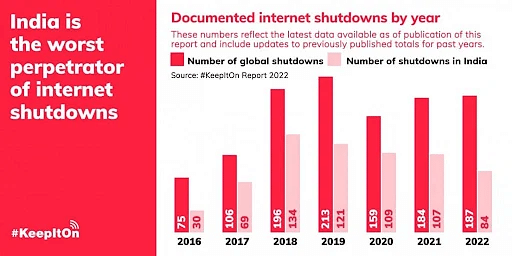
- According to the report “Weapons of control, shields of impunity: Internet shutdowns in 2022” which was released by Access Now and the KeepItOn Coalition, India topped the list of countries with internet shutdowns for the fifth successive year according to the report.
Guidelines for Internet Shutdown in India
Before 2017
- Internet shutdowns were ordered under Section 144 of the Code of Criminal Procedure
- As per this section District Magistrates have broad powers to shut down the internet during dangerous situations.
- Apart from this, Section 69A of the Information Technology Act, 2000 empowers the central government to block access to any information on the internet that it considers to be prejudicial to the sovereignty, integrity, defence, security or friendly relations of India, or to public order or decency, or to incitement of any offence.
After 2017
- The Temporary Suspension of Internet Services (Public Emergency or Public Safety) Rules 2017 govern internet shutdowns in India.
- Under section 5(2) of the rules framed by the DoT state that temporary suspensions can be imposed for reasons of public safety or emergencies with senior bureaucrats at the Centre and State empowered to authorise shutdowns.
- The Review Committee in the respective states, chaired by the Chief Secretary was empowered to decide the legality within 5 days of the shutdowns under the 2017 rules.
Constitutional provisions related to shutdowns
|
How much is it legitimate?
| In favour | In against |
|---|---|
| misinformation and rumours can lead to deterioration in law and order in an area | in the absence of information sources like news outlets, rumours can actually end up spreading even more |
| curbing the flow of information helps maintain peace among communities in times of crisis | important services such as those related to payments, banking, and educational access, all get cut in an instant |
| According to the Information Technology Act, 2000 websites can be blocked if there are threats to national sovereignty or integrity or defence | disruptions at multiple levels and economic losses |
| internet services are temporarily suspended during important examinations to prevent cheating and leakage of question papers | It shows absence of accountability from centre |
| Governments may order internet shutdowns to contain hate speech, rumours, and fake news that could incite violence or create social unrest | Internet shutdowns violate the right to free expression and information, which is guaranteed by Article 19(1)(a) |
| Internet shutdowns violate the Article 19 of the Universal Declaration of Human Rights | |
| Internet shutdowns also deepen the digital divide between those who have access to reliable and affordable internet |
SC Rulings regarding internet shut down
Anuradha Bhasin v Union of India (2020):
- In the Anuradha Bhasin vs Union of India, the Supreme Court ruled that, freedom of speech and expression and the freedom to practise any profession or carry on any trade, business or occupation over the medium of Internet enjoys constitutional protection under Article 19 (1) (a) and Article 19 (1) (g).
- At the same time, restriction upon such fundamental rights should be in consonance with the mandate under Article 19 (2) and (6) of the Constitution, inclusive of the test of proportionality(see FAQ).
Foundation for Media Professionals v. Union Territory of Jammu and Kashmir (2020):
- In this case, the Supreme Court of India directed the Jammu and Kashmir administration to review all existing restrictions on internet access, stating that the right to internet access is a fundamental right and must be respected.
Internet Freedom Foundation v. Union of India (2020):
- The Supreme Court of India heard a petition filed by the Internet Freedom Foundation (IFF) challenging the internet shutdowns in various parts of the country, including during the protests against the Citizenship Amendment Act (CAA).
- The court issued notice to the government, seeking a response to the IFF's contentions.
Challenges
- Due Process: A major problem faced is that shutdowns of all kinds, not just the internet, are not based on decisions made by following due process.
- Although a shutdown cannot be implemented by anybody below the level of a Joint Secretary, district magistrates often end up imposing blanket shutdowns.
- Denial of Rights: An Internet shutdown is essentially a restriction on the fundamental rights of the people whom it affects.
- People cannot work, access telemedicine, study, or order and pay for food and groceries to eat.
- Lack of transparency: According to Rule 5 of the Temporary Suspension Rules, a review committee has to be formed within five working days of the issuance of the order to suspend services.
- However, there is a lack of transparency about the working of the review committee as applications for information about it and its minutes are denied.
- As a result, it is generally difficult to know if the shutdown is justified or not.
- Non-adherence to guidelines: In the aftermath of the Supreme Court’s verdict in the Anuradha Bhasin case, shutdowns have been implemented under the Suspension Rules as opposed to Section 144.
- However, none or very few shutdown orders are made available in the public domain.
- Technical: In 2020, the government stated that it would whitelist some websites and allow access to them through 2G.
- However, this was not practical because most websites do not load on 2G.
- Additionally, there might be problems with using these whitelisted websites.
- Consider the example of a bank website that has been whitelisted. The user may not be able to access his account information which is hosted on another domain.
- The Manipur High Court constituted a committee to consider blocking VPN servers to ensure that Internet access can be restored safely while restrictions on social media websites are still maintained. This is infeasible since VPN servers provide access.
- Proportionality: It examines whether a shutdown is necessary or not, and is considered by the courts.
- Internet shutdowns to prevent cheating in exams as done by Rajasthan and West Bengal do not comply with the principle of proportionality.
- Although the freedom of speech and expression is not an absolute right, shutdowns cannot be implemented for frivolous reasons.
- As situations may vary, decisions to implement shutdowns must be balanced and proportionate as general protocols might not work in every situation.
Conclusion
So such shutdowns should not be imposed abruptly. There is a need for proper regulation which includes defined reasons, procedures, check mechanism, etc for overall betterment.
(*Click this link to read prelims specific weekly current affairs articles)
FAQs
Question: What is the principle of proportionality?
Answer:
According to the Principle of Proportionality, no more harsh measures should be utilised to achieve the intended outcome than are necessary. To ensure fairness and justice, the principle attempts to strike a balance between the methods and the ends.
Question: What is Section 144?
Answer:
Section 144 of CrPC is used by magistrates of any state or UT in India to prohibit the gathering of four or more people in a specified area with the ultimate purpose of maintaining peace and order. It is imposed in urgent cases of nuisance or apprehended danger of some event. It also empowers the authorities to block internet access in the region.
Question: What is the internet shut down?
Answer:
‘shut downs’ mean a total ban on mobile (3G, 4G/LTE), or fixed-line (dial-up, wired/wireless broadband) Internet, both or either of which may be shut down.
MCQs
Question: Consider the following statements:
- Internet shutdowns are implemented by the Union Government alone.
- The State Review Committee on internet shutdowns is headed by the Chief Minister.
Which of the above statements is/are correct?
(a) 1 only
(b) 2 only
(c) 1 and 2
(d) None of the above
Answer: (d) See the Explanation
- Internet shutdowns can be authorised by bureaucrats at the Central and State level according to the Temporary Suspension of Internet Services (Public Emergency or Public Safety) Rules 2017.
- So, statement 1 is incorrect.
- The State Review Committee that determines whether the lockdown was imposed according to the Rules is headed by the Chief Secretary of the state.
- SO,statement 2 is incorrect
- Therefore, option (d) is the correct answer.
Download the PREPP App and attempt FREE IAS Exam Mock Tests and get complete study material!

Full Test - 04: UPSC CSE Prelims CSAT (Paper-II)
Full Test - 03: UPSC CSE Prelims CSAT (Paper-II)
UPSC CSE Prelims 2026 GS Paper 1 Question Paper (24-May-2026)
UPSC CSE Prelims 2026 CSAT Paper 2 Question Paper (24-May-2026)

17 February 2025 | The Hindu Must Read Articles | Current Affairs

16 February 2026 | The Hindu Must Read Articles | Current Affairs

13 February 2026 | The Hindu Must Read Articles | Current Affairs









Comments