Freedom On The Net 2023: The Repressive Power of Artificial Intelligence
Relevance: GS2 - Fundamental Rights; Issues Arising Out of Design & Implementation of Policies
(Source: The Hindu, 10/06/2023)
Click here for Daily Current Affairs
Why in the news?
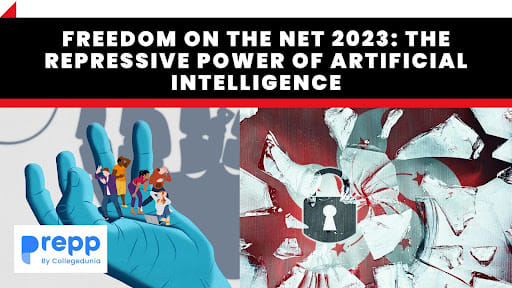
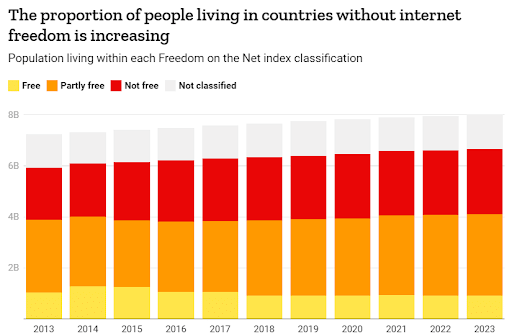
- A recent report by Freedom House, a Washington DC-based non-profit organization, revealed that global Internet freedom has continued to decline for the 13th consecutive year.
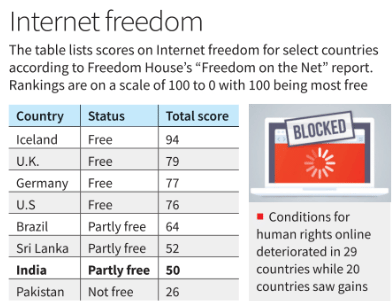
- The report, titled 'Freedom on the Net 2023: The Repressive Power of Artificial Intelligence,' highlights the deteriorating environment for human rights online in 29 countries, while only 20 countries have shown improvements.
Table of Contents
Key points from the report
- AI's Repressive Role: The report highlights the growing use of artificial intelligence (AI) by governments for censorship and the spread of disinformation, raising concerns about its repressive power in controlling online discourse.
- Coverage and Timeframe: The report covers developments in Internet freedom between June 2022 and May 2023, assessing the situation in 70 countries, which collectively represent 88% of the world's Internet users.
- Specific Country Findings:
- Iran saw the sharpest rise in digital repression, with authorities shutting down Internet services, blocking popular platforms like WhatsApp and Instagram, and increasing surveillance in response to anti-government protests.
- China, for the ninth consecutive year, ranked as the world's worst environment for Internet freedom.
- Myanmar was identified as the world's second most repressive country for online freedom.
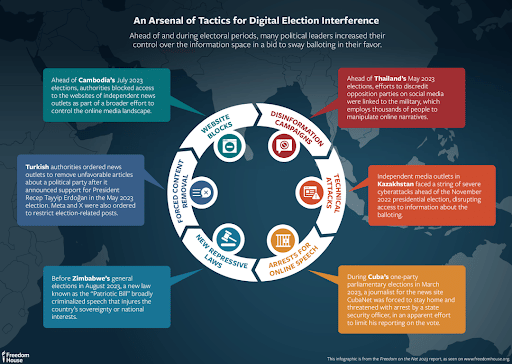
- Elections often triggered digital repression, with incumbent leaders restricting speech, blocking independent news sites, and controlling information flow.
- Legal Repercussions for Online Expression: In a record number of 55 countries, individuals faced legal consequences for expressing themselves online. Authorities in these nations have increasingly cracked down on online speech.
- Widespread Arrests and Imprisonments: Over the past decade, there has been a significant rise in the number of countries (from 18 in 2014 to 31 in 2023) where authorities carry out widespread arrests and impose multi-year prison terms for online activities.
Findings of the report regarding India
- On a range of 1 to 100 where ‘100’ represented highest digital freedom and ‘1’ the worst repression, India scored 50, while Iceland, with 94, emerged as the country with the best climate of Internet freedom.
- The report assesses countries on five censorship methods: Internet connectivity restrictions, blocks on social media platforms, blocks on websites, blocks on VPNs, and forced removal of content.
- India engaged in all of them except one (VPN blocking).
- India was listed among countries that engaged in blocking websites containing political, social, or religious content, intentionally disrupting information and communication technology networks.
- It employed pro-government commentators to influence online discussions, and carried out technical attacks against government critics and human rights organizations.
How elections serve as a trigger for digital repression?
- Criminalizing Speech: During elections, incumbent leaders often use vague laws to criminalize speech, silencing critics, opposition, and independent media, thereby undermining democracy and free expression.
- Blocking Access to Independent News: Governments block access to independent news sites and social media platforms that provide a platform for dissenting voices or critical reporting. This deprives citizens of access to diverse information sources and hinders their ability to make informed choices during elections.
- Imposing Information Controls: Governments manipulate election outcomes by controlling information flow, which involves limiting content dissemination, using state-owned media to shape the narrative, and suppressing detrimental information to incumbent leaders or parties.
- Use of Automated Systems: The report highlights the use of AI-based moderation tools in digital repression strategies, enabling authorities to detect and remove objectionable content and suppress dissenting voices online.
How AI has contributed to declining online freedom?
- Disinformation Spread: AI-based tools, which have become more sophisticated and accessible, have been increasingly used to spread disinformation in at least 16 countries over the past year. These tools are employed to sow doubt, smear opponents, or manipulate public debate, undermining the quality of online discourse and potentially influencing public opinion.
- Efficient Content Censorship: AI has been harnessed to streamline content censorship in 22 countries, including India, Vietnam, and Nigeria. Local laws in these nations require digital platforms to remove content that is considered unacceptable for political, social, or religious reasons.
- For instance, India passed a law in 2021 mandating social media companies to utilize AI-based moderation tools to identify and remove content that violates local laws.
- Earlier this year, the Indian government ordered YouTube and Twitter to restrict access within India to a BBC documentary that investigated Prime Minister Modi's role in communal violence back in early 2000s.
What is the way ahead?
- It is essential to raise awareness about the importance of Internet freedom and its impact on human rights. Advocacy groups, civil society organizations, and individuals can play a crucial role in advocating for a free and open internet.
- Governments need to revisit and reform their legal frameworks related to online censorship and surveillance. Laws that stifle freedom of expression should be amended to protect individuals' rights to free speech and privacy.
- Governments should be transparent about their use of AI and other technologies for censorship and surveillance. There should be mechanisms in place to hold authorities accountable for any abuse of power.
- Addressing global Internet freedom issues often requires international cooperation. Countries can work together to establish norms and standards for protecting online freedoms and holding repressive regimes accountable.
(*Click this link to read prelims specific weekly current affairs articles)
FAQs
Question: What is Censorship?
Answer:
Censorship is the suppression of speech, public communication, or other information. This may be done on the basis that such material is considered objectionable, harmful, sensitive, or "inconvenient". Censorship can be conducted by governments, private institutions and other controlling bodies.
Question: What do you understand by the term Internet freedom?
Answer:
The term “internet freedom” refers to a range of subjects, including digital rights, informational freedom, the right to access the internet, freedom from internet censorship, and net neutrality.
MCQ
Question: With reference to Freedom on the Net Report 2023, consider the following statements:
- It was released by Freedom House, a Washington DC-based non-profit organization.
- It revealed that global Internet freedom has continued to decline for the 13th consecutive year.
- India scored 50 out of 100 in the evaluation of Internet freedom.
How many of the above statements are correct?
(a) Only one
(b) Only two
(c) All three
(d) None
Answer: (c) See the Explanation
- A recent report by Freedom House, a Washington DC-based non-profit organization, reveals that global Internet freedom has continued to decline for the 13th consecutive year. Hence, statements 1 and 2 are correct.
- The report, titled 'Freedom on the Net 2023: The Repressive Power of Artificial Intelligence,' highlights the deteriorating environment for human rights online in 29 countries, while only 20 countries have shown improvements.
- India scored 50 out of 100 in the evaluation of Internet freedom, with Iceland having the highest Internet freedom score of 94. Hence, statement 3 is correct.
Therefore, option (c) is the correct answer.
Download the PREPP App and attempt FREE IAS Exam Mock Tests and get complete study material!

Full Test - 04: UPSC CSE Prelims CSAT (Paper-II)
Full Test - 03: UPSC CSE Prelims CSAT (Paper-II)
UPSC CSE Prelims 2026 GS Paper 1 Question Paper (24-May-2026)
UPSC CSE Prelims 2026 CSAT Paper 2 Question Paper (24-May-2026)

17 February 2025 | The Hindu Must Read Articles | Current Affairs

16 February 2026 | The Hindu Must Read Articles | Current Affairs

13 February 2026 | The Hindu Must Read Articles | Current Affairs









Comments