Indian Banking Sector Towards Atmanirbhar Bharat
Relevance: GS3 - Indian Economy; Effects of liberalization on the economy; Inclusive growth
(Source: India Express, 10/06/2023)
Click here for Daily Current Affairs
Why in the news?
- Recently the chairman of SBI commented that India's banking sector is shifting towards atma nirbhar model.
- This is possible because of the latest innovations that are adopted by Indian Banks in the last decade.
Table of Contents
Latest reforms in the Banking Sector
|
Latest reforms in the Banking Sector
Technological Reforms
Shifting from conventional banking
- Products like mobile banking applications, retail electronic fund transfers, UPI, Aadhaar e-KYC, Bharat Bill Payment System, scan and pay and digital pre-paid instruments have transformed traditional branch banking.
Step ahead with frontier technology
- The Indian banking system is currently moving towards a knowledge-based regime, enabled by AI and cognitive computing across all business functions and processes. The deployment of AI-enabled capabilities can help banks to personalise customer engagement and increase their ability to develop a deeper understanding of customers.
Uninterrupted services
- Ease of banking now comes with added responsibility to ensure the availability of critical support infrastructure for a secured payment settlement system, ATMs, internet/ mobile banking, dealing with cyber security risks, and addressing customer grievances — all these ensure that banking services continue uninterrupted.
Digital Rupee
- The central bank's digital currency (CBDC), the RBI's digital rupee, was announced in the Union Budget 2022-23, and is expected to be launched by the end of this financial year. India's digital economy is predicted to benefit greatly from the introduction of the digital rupee.
Statutory, Legal Reforms & Governance Related Reforms
National Bank for Financing Infrastructure and Development (NaBFID):
- The NaBFID has been set up as a Development Financial Institution (DFI) to aid India in developing long-term infrastructure financing.
The Bankruptcy and Insolvency Act:
- The Code creates time-bound processes for insolvency resolution of companies and individuals. These processes will be completed within 180 days. If insolvency cannot be resolved, the assets of the borrowers may be sold to repay creditors.
National Asset Reconstruction Company Limited (NARCL):
- Setting up of the NARCL was announced in the Union Budget 2021-22. The objective was to construct a 'bad bank' which would house bad loans of Rs. 500 crore (US$ 62.63 million) and above
Marginal Cost of Fund Based Lending Rate (MCLR):
- The MCLR rate is the minimum rate below which the banks are not allowed to lend, except in some cases allowed by the RBI. It is an internal reference rate for the bank. The MCLR method was introduced in the Indian financial system by the Reserve Bank of India in the year 2016.
India Debt Resolution Company Ltd. (IDRCL):
- The IDRCL is a service company/operational entity whose purpose is to manage the assets of the NARCL with the help of turnaround experts and market professionals. The NARCL will buy assets by presenting an offer to the lead bank; IDRCL will be included for management and value addition after NARCL's offer is accepted.
Indradhanush framework
- The Indradhanush framework for transforming the PSBs represents the most comprehensive reform effort undertaken since banking nationalisation in the year 1970 to revamp the Public Sector Banks (PSBs) and improve their overall performance by ABCDEFG.
- Appointments, Bank Board Bureau, Capitalization, Destressing, Employment, Framework of Accountability and Governance Reforms.
Importance of Baking Sector
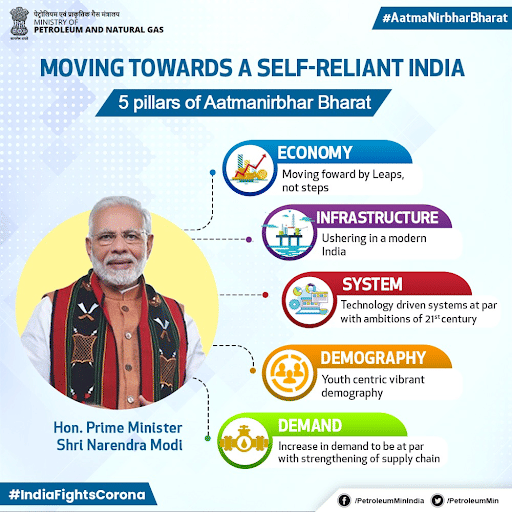
As self-reliant India (Atmanirbhar Bharat) will stand on five pillars viz.
- Economy, which brings in quantum jump and not incremental change;
- Infrastructure, which should become the identity of India;
- System, based on 21st century technology driven arrangements;
- Vibrant Demography, which is our source of energy for a self-reliant India; and
- Demand, whereby the strength of our demand and supply chain should be utilised to full capacity. He underlined the importance of strengthening all stakeholders in the supply chain to increase, as well as fulfil, the demand.
- As banks are one the main pillars of Atmanirbhar Bharat Abhiyan, the strength of the same is very much necessary.
Challenges ahead
Climate change
- Risk management practices of banks have to account for this new risk, more so when methodological and data challenges are significant.
Skilled human resources
- With a dynamic and rapidly changing environment, the skill gap is widening. To address this, banks and financial institutions have to attract, train and retain talent.
- Consequently, upskilling and reskilling of human resources is a sine qua non to face the emerging challenges.
Research and development
- The financial services sector has to invest in research and be open to accepting and developing out-of-box ideas for seamless service delivery and hyper-personalisation of products. Banks and financial institutions will have to consider in-house data science labs or sandbox environments to test out innovative ideas.
Important Committees for Banking Reforms in IndiaNarasimham Committee l
H. Khan Committee
Narasimham Committee ll
Raghuram Rajan Committee
Financial Sector Legislative Reforms Commission (FSLRC)
PJ Nayak Committee
Nachiket Mor Committee
|
Conclusion
As we strive to become a developed country by 2047, financial institutions will need extraordinary amounts of financial resources to support growth to realise our visions for a brighter tomorrow.
(*Click this link to read prelims specific weekly current affairs articles)
FAQs
Question: What is Digital Rupee?
Answer:
The central bank's digital currency (CBDC), the RBI's digital rupee, was announced in the Union Budget 2022-23, and is expected to be launched by the end of this financial year. India's digital economy is predicted to benefit greatly from the introduction of the digital rupee.
Question: When did banks start in India?
Answer:
The first bank to be established as the Bank of Hindustan was founded in 1770 in Calcutta. It closed down in 1832. The Oudh Commercial Bank was India's first commercial bank in the history of the evolution of banking in India.
Question: What was the purpose of setting up Narasimham Committee II?
Answer:
The Narasimham Committee II (Committee on Banking Sector Reforms) was tasked with conducting a progress review of the implementation of banking reforms since 1992, with the goal of further strengthening India's financial institutions. It concentrated on issues such as bank size and capital adequacy ratios, among other things.
MCQs
Question: Which sector is the backbone of the Indian economy?
(a) Service Sector
(b) Banking Sector
(c) Tourism Sector
(d) Agriculture Sector
Answer: (d) See the Explanation
- Agriculture is the pillar of the Indian economy because of its high share in employment and livelihood creation. Agriculture and allied activities are the largest contributors to GDP.
- Therefore option (d) is the correct answer
Download the PREPP App and attempt FREE IAS Exam Mock Tests and get complete study material!

Full Test - 04: UPSC CSE Prelims CSAT (Paper-II)
Full Test - 03: UPSC CSE Prelims CSAT (Paper-II)
UPSC CSE Prelims 2026 GS Paper 1 Question Paper (24-May-2026)
UPSC CSE Prelims 2026 CSAT Paper 2 Question Paper (24-May-2026)

17 February 2025 | The Hindu Must Read Articles | Current Affairs

16 February 2026 | The Hindu Must Read Articles | Current Affairs

13 February 2026 | The Hindu Must Read Articles | Current Affairs









Comments