Nagorno-Karabakh Conflict and India
Relevance: GS2 - Effect of policies and politics of developed and developing countries on India’s interests, Indian diaspora Prelims - Current events of national and international importance
(Source: India Express, 10/06/2023)
Click here for Daily Current Affairs
Why in the news?
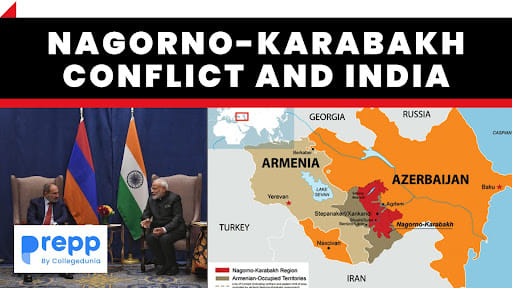
- The conflict between Armenia and Azerbaijan over Nagorno-Karabakh is called one of the “frozen conflicts” of the world.
- Conflict in this region may impact India's connectivity initiatives and other ties in the region.
- In this article we will look at the geography and history of the region; India’s stand over the conflict; impact on India etc.
Table of Contents
History of Nagorno-Karabakh Conflict
Geography of the region
Nagorno-Karabakh is located in the South Caucasus area covering the southern Caucasus mountains and consists primarily of modern-day Armenia, Azerbaijan, and Georgia and is a mountainous region officially recognised as part of Azerbaijan. It is also known as Artsakh in Armenian. |
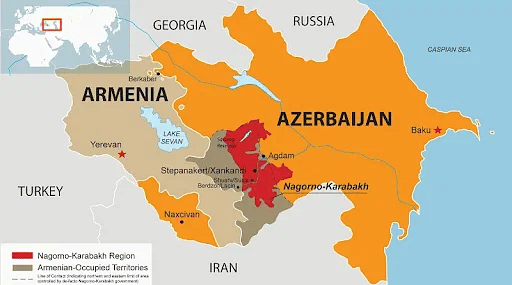
- The 1.2 lakh population of the region is predominantly ethnic Armenian, having close cultural, social, and historical ties with Armenia.
- The Armenians are Christians, while Azeris are Muslims. The conclave is connected to Armenia through the 5-km Lachin Corridor.
- So Nagorno-Karabakh can be called an ethnic Armenian enclave in Azerbaijan.
- Due to this ethnic diversity issue has persisted in this region for a long past.
- When the Soviet Union was dissolved in 1991 and Armenia and Azerbaijan achieved statehood, Nagorno-Karabakh officially declared independence.
- After the disintegration of the USSR the issue was raised more and unsolved till date.
India’s Stand
- Initially, India supported the idea of respecting territorial integrity but modified its stance following Azerbaijan’s support for Pakistan.
- India has previously supported Russia, the USA, and France by voting against an Azerbaijani resolution that demanded the evacuation of Armenian forces in 2008.
- India supports OSCE Minsk Group’s continued efforts for a peaceful resolution of the conflict between Armenia and Azerbaijan.
- Recently, India has encouraged the parties to move forward on ensuring long-term peace and security in the region through dialogue and diplomacy, which includes the safety and well-being of all civilians.
Madrid Principles
Bishkek Protocol
|
Impact on India
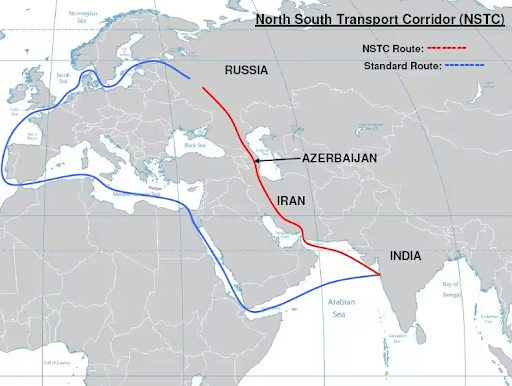
- Because of the geographical location of Armenia and Azerbaijan, the region is important as a viable corridor for India’s connectivity with Russia and Europe through Central Asia and Iran.
- The Conflict can impact India’s major initiatives for connectivity as follows;
- International North South Transport Corridor:
![Impact on India]()
- Armenia and Azerbaijan are members of the International North South Transport Corridor (INSTC), which India is keen to develop. India supports Armenia’s proposal to include Iran’s Chabahar port in INSTC.
- It can also connect India with Turkey and beyond through the Baku - Tbilisi - Kars passenger and freight rail link.
- ONGC India has made investments in an oilfield project in Azerbaijan and GAIL is exploring the possibilities of cooperation in LNG.
- So persistent conflict in the region can hamper strategic, economic and geopolitical aspects of India as mentioned above.
India - Azerbaijan - Armenia Relation
Historical ties between India and Armenia
- According to literary evidence, Indian settlements in Armenia were established by two princes (Krishna and Ganesh escaping from Kannauj) in 149 BC.
- Emperor Akbar, who is believed to have an Armenian wife Mariam Zamani Begum, granted them privileges and considerable religious freedom.
- In the 16th century, Armenian communities emerged in Kolkata, Chennai, Mumbai and Agra. Today, the vestigial community is mainly settled in Kolkata.
- In 2022, the India-Armenia deal to supply Armenian armed forces with PINAKA multi-barrel rocket launchers (MBRL), anti-tank munitions, and ammunition and warlike stores.
Historical ties between India and Azerbaijan
- The ‘Ateshgah’ fire temple in the vicinity of Baku is an 18th-century monument, with a much older history, and has wall inscriptions in Devanagari and Gurmukhi.
- In modern times, after the collapse of the Soviet Union, India recognised the independence of Armenia and Azerbaijan and established diplomatic relations.
Conclusion
Armenia-Azerbaijan conflicts reflect the failure of the Minsk Group of the Organization for Security and Co-operation in Europe (OSCE). In the absence of a peacekeeping force and the political will for peace, low-level frictions have persisted over the years. Under these circumstances, India has done the right thing to adopt a balanced and neutral stance and pitching for a political solution as outlined in the Madrid Principles.
(*Click this link to read prelims specific weekly current affairs articles)
FAQs
Question: What is the Caucasus region?
Answer:
The Caucasus region is located between the Caspian Sea and the Black Sea and lies close to Europe and Asia. Countries that lie within the region include Russia, Iran, Armenia, Azerbaijan, Turkey, and Georgia.
Question: What is Madrid Protocol?
Answer:
Co-chaired by Russia, France and the U.S., the Minsk Group put forward in 2007 the Madrid Principles as the basis for the formulation of a peace treaty between Armenia and Azerbaijan.
Question: What is the Bishkek Protocol?
Answer:
The Bishkek Protocol is a provisional ceasefire agreement, signed by the representatives of Armenia, Azerbaijan, the unrecognised Republic of Artsakh, and Russia on May 5, 1994, in Bishkek, the capital of Kyrgyzstan. The protocol ended the First Nagorno-Karabakh War and the conflict entered a frozen state.
MCQs
Question: Which one of the following countries does not border the Caspian Sea? (UPSC CSE 2003)
(a) Armenia
(b) Azerbaijan
(c) Kazakhstan
(d) Turkmenistan
Answer: (a) See the Explanation
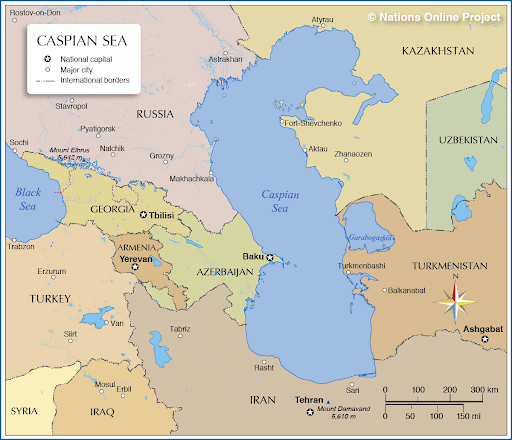
- Armenia is a landlocked country located in the Caucasus region between Asia and Europe.
- Countries bordering the Caspian Sea: Kazakhstan, Turkmenistan, Iran, Azerbaijan, and Russia.
- Therefore, option (a) is the correct answer.
Download the PREPP App and attempt FREE IAS Exam Mock Tests and get complete study material!

Full Test - 04: UPSC CSE Prelims CSAT (Paper-II)
Full Test - 03: UPSC CSE Prelims CSAT (Paper-II)
UPSC CSE Prelims 2026 GS Paper 1 Question Paper (24-May-2026)
UPSC CSE Prelims 2026 CSAT Paper 2 Question Paper (24-May-2026)

17 February 2025 | The Hindu Must Read Articles | Current Affairs

16 February 2026 | The Hindu Must Read Articles | Current Affairs

13 February 2026 | The Hindu Must Read Articles | Current Affairs









Comments